

If you’re a fast-moving trader chasing quick profits, scalping could be your edge—but only with the right broker. In the UK, not all brokers are built for speed, tight spreads, and flawless execution.
We cut through the noise to reveal the top brokers for scalping, allowing you to focus on what matters: making precise trades in seconds.
Top UK Brokers For Scalping Trading
Investing involves risk. Asset prices can move rapidly and you may lose some or all money invested. Never invest more than you can afford to lose.Advertising disclosure
Our picks at a glance
- 1 Pepperstone Top score: Platforms 4.8 Info Visit Pepperstone
- 2 Eightcap Top score: Mobile 4.6 Info Visit Eightcap
- 3 FxPro Top score: Mobile 4.4 Info Visit FxPro
- 4 IG Top score: Fees 4.5 Info Visit IG
- 5 Kraken Top score: Mobile 3.9 Info Visit Kraken
- 6 CMC Markets Top score: Trust 4.7 Info Visit CMC Markets
- 7 XTB Top score: Trust 4.8 Info Visit XTB
-
Our top pick
In our tests, Pepperstone provided execution speeds below 20ms and minimal slippage on major currency pairs, perfect for scalping. Raw spreads averaged 0.1–0.3 pips with a $3.50 per lot commission. The ECN-style pricing and cTrader’s one-click depth ensured high reliability. Transparency and consistent fills were notable, even in volatile sessions.
- Instruments
- CFDs, Forex, Currency Indices, Stocks, Indices, Commodities, ETFs, Crypto CFDs (only Pro clients), Spread Betting
- Regulator
- FCA, ASIC, CySEC, BaFin, DFSA, SCA, SCB, CMA-Kenya
- Platforms
- Pepperstone Trading Platform, MT4, MT5, cTrader, TradingView
- Min. Deposit
- $0
- Min. Trade
- 0.01 Lots
- Leverage
- 1:30 (Retail), 1:500 (Pro)
CFDs and FX are complex instruments and come with a high risk of losing money rapidly due to leverage. 73-89% of retail investor accounts lose money when trading CFDs.
-
When testing Eightcap’s Raw account, we found EUR/USD spreads began at 0.0–0.1 pips with a $3.50 per lot commission. Execution latency was typically below 15 ms, experiencing minimal slippage, even during high-impact events. With ECN-style routing and VPS support, alongside MT4/MT5 compatibility, traders enjoy swift fills, clear pricing, and adaptable order execution.
- Instruments
- CFDs in Forex, Stocks, Indices, Commodities
- Regulator
- FCA, ASIC, CySEC, FSC, SCB, FSA
- Platforms
- MT4, MT5, TradingView, TradeLocker
- Min. Deposit
- £100
- Min. Trade
- 0.01 Lots
- Leverage
- 1:30 (Retail), 1:200 (Pro)
Services are provided subject to applicable laws and regulations. Certain products, services, instruments, platforms or payment methods may not be available to residents of certain jurisdictions.
-
Recent tests showed FxPro's Raw+ and Elite accounts achieving execution speeds under 8ms, spreads from 0.0 pips, and a $3.50 per lot commission. VPS support and NDD execution minimised slippage and ensured deep liquidity. The broker's platform, along with MT4, MT5, and cTrader, provided strong customisation for scalpers.
- Instruments
- CFDs, Forex, Stocks, Indices, Commodities, Futures, Spread Betting
- Regulator
- FCA, CySEC, FSCA, SCB, FSA
- Platforms
- FxPro Edge, MT4, MT5, cTrader, AutoChartist, TradingCentral, DupliTrade, Quantower
- Min. Deposit
- $100
- Min. Trade
- 0.01 Lots
- Leverage
- 1:30 (Retail), 1:500 (Pro)
-
In our scalping tests, IG Markets’ DMA account achieved execution under 15ms, with spreads starting at 0.16 pips and a $6 round-turn commission. Deep liquidity and NDD routing reduced slippage. The L2 Dealer platform, with advanced order types and real-time depth, supports precise professional scalping.
- Instruments
- CFDs (not in US), Forex, Stocks, Indices, Commodities, ETFs, Futures, Options, Crypto, Spread Betting (UK only)
- Regulator
- CFTC, NFA, FCA, BaFin, ASIC, FINMA, MAS, JFSA, FMA, DFSA, BMA, CONSOB
- Platforms
- Web, L2 Dealer, MT4, TradingView, AutoChartist, TradingCentral, ProRealTime
- Min. Deposit
- $0
- Min. Trade
- 0.01 Lots
- Leverage
- 1:30 (Retail), 1:222 (Pro)
Spread bets and CFDs are complex instruments and come with a high risk of losing money rapidly due to leverage. 70% of retail investor accounts lose money when trading spread bets and CFDs with this provider. You should consider whether you understand how spread bets and CFDs work, and whether you can afford to take the high risk of losing your money.
-
Kraken excels as a top cryptocurrency exchange, offering a unique trading platform and access to over 600 crypto tokens. It provides leverage of up to 5 times for spot trading with consistent fees and up to 50 times on futures.
- Instruments
- Cryptos, Pre-IPO Perpetual Futures, Tokenized Stocks
- Regulator
- FINTRAC, AUSTRAC, CySEC, CBI, FCA
- Platforms
- Kraken App, Kraken Pro, Kraken Futures, AlgoTrader, Quantower
- Min. Deposit
- $10
- Min. Trade
- Variable
-
When evaluating CMC Markets' accounts for traders, spreads on EUR/USD were typically 0.1–0.2 pips with a commission of $2.50 per lot. Execution speeds remained under 20ms consistently, with negligible slippage even during major events. The hybrid ECN/STP model and the tiered rebates of the FX Active program ensured cost-efficient and dependable trading conditions.
- Instruments
- CFDs, Forex, Stocks, Indices, Commodities, ETFs, Treasuries, Custom Indices, Spread Betting, Certificates and Warrants (Germany and Austria)
- Regulator
- FCA, ASIC, MAS, CIRO, BaFin, FMA, DFSA
- Platforms
- Web, MT4, MT5, TradingView
- Min. Deposit
- $0
- Min. Trade
- 0.01 Lots
- Leverage
- 1:30 (Retail), 1:500 (Pro)
Spread bets and CFDs are complex instruments and come with a high risk of losing money rapidly due to leverage. 69% of retail investor accounts lose money when spread betting and/or trading CFDs with this provider. You should consider whether you understand how spread bets and CFDs work and whether you can afford to take the high risk of losing your money.
-
In our tests, XTB’s xStation 5 excelled in trading, offering sub-100 ms executions and minimal slippage even during news surges. Pro/Zero accounts provide raw spreads from 0.1 pips with a small commission. While ECN-style pricing is absent, the platform remains a strong choice for active traders with fast order fills, 57 FX pairs, and extensive customisation options.
- Instruments
- CFDs on shares, Indices, ETFs, Raw Materials, Forex currencies, Real shares, Real ETFs
- Regulator
- FCA, CySEC, KNF, DFSA, FSC, SCA, CMF, Bappebti
- Platforms
- xStation
- Min. Deposit
- $0
- Min. Trade
- 0.01 Lots
- Leverage
- 1:30 (Retail), 1:200 (Pro)
CFDs are complex instruments and come with a high risk of losing money rapidly due to leverage. 74% of retail investor accounts lose money when trading CFDs with this provider. You should consider whether you understand how CFDs work and whether you can afford to take the high risk of losing your money
Compare
Safety Comparison
Compare how safe the Best Brokers For Scalping In The UK 2026 are and what features they offer to protect traders.
| Broker | Trust Rating | FCA Regulated | Negative Balance Protection | Guaranteed Stop Loss | Segregated Accounts |
|---|---|---|---|---|---|
 |
4.6 | ||||
 |
4.3 | ||||
 |
4.4 | ||||
 |
4.4 | ||||
 |
3.0 | ||||
 |
4.8 | ||||
 |
4.6 |
Payments Comparison
Compare which popular payment methods the Best Brokers For Scalping In The UK 2026 support and whether they have trading accounts denominated in British Pounds (GBP).
| Broker | GBP Account | Debit Card | Credit Card | Neteller | Skrill | Apple Pay |
|---|---|---|---|---|---|---|
|
||||||
|
||||||
|
||||||
|
||||||
|
||||||
|
||||||
|
Mobile Trading Comparison
How good are the Best Brokers For Scalping In The UK 2026 at mobile trading using apps or other mobile interfaces.
| Broker | Mobile Apps | iOS Rating | Android Rating | Smart Watch App |
|---|---|---|---|---|
|
iOS & Android | 4.4 | 4.1 | |
|
iOS & Android | 4.8 | 4.4 | |
|
iOS & Android | 4.7 | 4.3 | |
|
iOS & Android | 4.6 | 4.0 | |
|
iOS & Android | 4.7 | 4.2 | |
|
iOS & Android | 4.1 | 3.7 | |
|
iOS & Android | 4.7 | 4.1 |
Beginners Comparison
Are the Best Brokers For Scalping In The UK 2026 good for beginner traders, that might want an affordable setup to get started, along with good support and educational resources?
| Broker | Demo Account | Minimum Deposit | Minimum Trade | Support Rating | Education Rating |
|---|---|---|---|---|---|
|
$0 | 0.01 Lots | 4.6 | 4.0 | |
|
£100 | 0.01 Lots | 4.0 | 3.5 | |
|
$100 | 0.01 Lots | 4.0 | 4.0 | |
|
$0 | 0.01 Lots | 4.5 | 4.8 | |
|
$10 | Variable | 3.8 | 3.0 | |
|
$0 | 0.01 Lots | 4.5 | 4.3 | |
|
$0 | 0.01 Lots | 4.3 | 3.8 |
Advanced Trading Comparison
Do the Best Brokers For Scalping In The UK 2026 offer features that allow for more advanced trading strategies?
| Broker | Automated Trading | Pro Account | Leverage | VPS | AI | Low Latency | Extended Hours |
|---|---|---|---|---|---|---|---|
|
Expert Advisors (EAs) on MetaTrader, cBots on cTrader | 1:30 (Retail), 1:500 (Pro) | |||||
|
TradingView Bots | 1:30 (Retail), 1:200 (Pro) | |||||
|
Expert Advisors (EAs) on MetaTrader, cBots on cTrader | 1:30 (Retail), 1:500 (Pro) | |||||
|
Expert Advisors (EAs) on MetaTrader, build your own on ProRealTime | 1:30 (Retail), 1:222 (Pro) | |||||
|
Kraken Futures is integrated in other platforms which have bots: Bookmap, Caspian, FMZ Quant, Gunbot, HaasOnline, Hyndor, Margin | - | |||||
|
Expert Advisors (EAs) on MetaTrader | 1:30 (Retail), 1:500 (Pro) | |||||
|
- | 1:30 (Retail), 1:200 (Pro) |
Detailed Rating Comparison
Use this heatmap to compare our detailed ratings for all of the Best Brokers For Scalping In The UK 2026.
| Broker | Trust | Platforms | Mobile | Assets | Fees | Accounts | Support | Research | Education |
|---|---|---|---|---|---|---|---|---|---|
|
4.6 | 4.8 | 4.3 | 4.6 | 4.5 | 4.0 | 4.6 | 4.3 | 4.0 |
|
4.3 | 4.3 | 4.6 | 3.6 | 3.8 | 4.0 | 4.0 | 3.5 | 3.5 |
|
4.4 | 4.3 | 4.5 | 4.0 | 4.0 | 3.8 | 4.0 | 4.0 | 4.0 |
|
4.4 | 4.8 | 4.3 | 4.5 | 5.0 | 4.0 | 4.5 | 4.9 | 4.8 |
|
3.0 | 3.5 | 4.5 | 3.8 | 3.9 | 3.8 | 3.8 | 1.5 | 3.0 |
|
4.8 | 4.3 | 3.9 | 4.7 | 4.3 | 4.5 | 4.5 | 4.5 | 4.3 |
|
4.6 | 4.0 | 4.4 | 4.6 | 3.9 | 4.0 | 4.3 | 4.1 | 3.8 |
Our Take On Pepperstone
Pepperstone excels in trading with tight spreads, swift execution, and advanced charting for seasoned traders. Beginners enjoy zero minimum deposit, comprehensive educational materials, and outstanding 24/5 support, including 18-hour weekend assistance.
 Tobias Robinson Reviewer
Pros
- Support for top-tier charting platforms such as MT4, MT5, TradingView, and cTrader. These tools accommodate different short-term trading methods, including algorithmic trading.
- Pepperstone offers pre-IPO perpetual futures, adding Anthropic in October 2026, enabling 24/7 speculation on expected share prices through cash-settled CFDs.
- In recent years, Pepperstone has significantly enhanced the deposit and withdrawal process. By 2025, clients can use Apple Pay and Google Pay, while 2024 saw the introduction of PIX and SPEI for customers in Brazil and Mexico.
Cons
- Overnight holding fees exceed those of some Market Maker brokers (typically Benchmark + 2.5%). Pepperstone suits traders and forex scalpers well but is less ideal for swing traders who keep positions open overnight.
- Execution might not appear as dependable in rapid markets as headline speeds imply. Our tests showed swift execution at targeted prices. However, community feedback highlights concerns over slippage, stop-loss fills, and order triggers sensitive to spreads amid volatility.
- Although the market range has expanded, crypto CFD options remain somewhat restricted, especially when compared to specialised brokers like Eightcap. Additionally, there is no facility to invest in actual cryptocurrencies.
73-89% of retail investor accounts lose money when trading CFDs with this provider.
Our Take On Eightcap
Eightcap excels for traders, offering diverse charting platforms, educational Labs, and AI tools. With over 120 crypto CFDs, it stands out in crypto trading and has won our 'Best Crypto Broker' award twice consecutively.
 William Berg Reviewer
Pros
- Eightcap has excelled in all essential trading areas, surpassing all rivals to clinch our 'Best Overall Broker' award for 2024. It also earned the titles of 'Best Crypto Broker' and 'Best TradingView Broker' for 2025.
- In 2026, Eightcap integrated TradeLocker in select areas, establishing itself as the premier regulated broker for this platform. It continues to offer ultra-fast execution and competitive fees for active traders using the charting software.
- Eightcap has launched GOLD247, offering 24/7 gold/USD CFD trading with up to 1:20 leverage, 0.01-lot minimums and zero commission for weekend gold traders.
Cons
- Despite the growing range of tools available, Eightcap lacks popular industry resources such as Autochartist and Trading Central. These provide advanced charting analytics, live news, and essential market insights for traders focused on short-term strategies.
- Eightcap must enhance its range of over 800 instruments to rival top competitors like Blackbull Markets, which offers 26,000+ assets, especially improving its limited commodities selection.
- The demo account is available for 30 days, after which it requires a request for extension. This is less convenient than XM's offering, which provides an unlimited demo mode.
71.28% of retail traders lose money when trading CFDs
Our Take On FxPro
FxPro is an excellent choice for traders, offering execution speeds under 8ms, reduced fees from 2022, and superb charting platforms like MT4, MT5, cTrader, and FxPro Edge.
Tobias Robinson Reviewer
Pros
- FxPro uses a 'No Dealing Desk' (NDD) model for swift and transparent order execution, usually within 12 milliseconds, making it well-suited for short-term trading strategies.
- FxPro's Wallet is a notable feature enabling traders to securely manage their funds. It ensures additional protection and ease by separating unused funds from active trading accounts.
- FxPro provides four dependable charting platforms, including the user-friendly FxPro Edge. It features more than 50 indicators, 7 types of charts, and 15 different timeframes.
Cons
- Passive investment options, such as interest on cash or social trading platforms, are limited. While active traders might not notice, competitors like eToro, serving both active and passive investors, provide more comprehensive offerings.
- FxPro offers customer support five days a week around the clock, accessible via various platforms, and the service quality is reliable based on tests. However, the absence of weekend support can be a drawback for traders requiring help beyond standard market times.
- FxPro, with its $10M funded demo account and expanding Knowledge Hub, mainly caters to experienced traders. Beginners might find its account and fee structure challenging to understand.
Our Take On IG
IG offers a complete package: an easy-to-use web platform, top-tier beginner education, enhanced charting via TradingView, up-to-date data, and strong trade execution for seasoned traders.
Tobias Robinson Reviewer
Pros
- IG excels with its diverse instruments, offering stocks, forex, indices, commodities, and cryptocurrencies. Additionally, it provides US-listed futures, options, and an AI Index, ensuring varied diversification opportunities.
- IG plans to broaden its offering with prediction markets on politics, sport and entertainment in the UK, subject to a gambling licence, with further regions potentially to follow.
- IG secured a crypto asset license from the FCA, enabling its return to the UK market. It now offers buying, selling, and storage services for over 55 digital tokens with fees starting at 1.49%, all under FCA regulation.
Cons
- Beginners may find IG's fees complicated, as they vary depending on the trades or services. This could cause confusion and unexpected costs.
- IG has ended its swap-free account, diminishing its attractiveness to Islamic traders.
- IG imposes a monthly inactivity fee of $12 to $18 after two years, discouraging occasional investors.
70% of retail investor accounts lose money when trading CFDs with this provider. You should consider whether you can afford to take the high risk of losing your money.
Our Take On Kraken
Kraken is ideal for traders seeking a wide range of cryptocurrencies, including Bitcoin, along with an excellent security reputation.
William Berg Reviewer
Pros
- Kraken allows accredited US investors to lock cash and stablecoins for 3 to 18 months, earning fixed APY of up to 7%.
- Kraken, through Payward, obtained VARA approval in the UAE, allowing it to provide Dirham funding and trading pairs to local clients.
- Kraken Pro offers perpetual futures via a CFTC-regulated venue.
Cons
- Insider data breach and extortion event impacting customer information in April 2026.
- Delayed verification for Pro accounts.
- Limited support for newer altcoins.
Our Take On CMC Markets
Equipped with advanced charts and a broad array of tradable CFDs, including an unmatched selection of currencies and bespoke indices, CMC Markets offers an excellent online platform for traders at any level.
Tobias Robinson Reviewer
Pros
- The CMC web platform offers an excellent user experience, featuring advanced trading chart tools and customisable options, suitable for both novice and seasoned traders. It also supports MT4, MT5, and, from 2025, TradingView.
- CMC Markets has introduced an AI News feature. This leverages AI to highlight and summarise market stories instead of executing trades, suggesting the future direction of broker research tools.
- We upgraded its 'Assets & Markets' rating due to frequent product expansions in 2025 and 2026. These include extended hours for 5,000+ US stocks and ETFs, new share CFDs, certificates, warrants, and fractional shares in certain areas.
Cons
- Although there have been improvements, the online platform still needs further refinement to match the user-friendly trading experience offered by competitors such as IG.
- A £15 monthly inactivity fee applies after a year of no activity, possibly discouraging casual investors.
- The CMC Markets app provides a comprehensive trading package; however, its design and user experience lag behind market leaders such as eToro.
69% of retail CFD accounts lose money when trading with this provider.
Our Take On XTB
XTB excels for novice traders with its superb xStation platform, minimal trading costs, no required deposit, and outstanding educational resources, many of which are fully integrated into the platform.
William Berg Reviewer
Pros
- In 2026, XTB expanded its asset offerings and markets. It introduced options trading in Spain and Germany, launched spot cryptocurrencies in select regions, and unveiled Investment Plans 2.0. These enhanced plans now feature more pre-built options, including sectors like Defence, a user-friendly interface, and increased flexibility to mix stocks and ETFs within individual plans.
- The xStation platform stands out with its user-friendly design and intuitive tools, such as adaptable news feeds, sentiment heatmaps, and a trader calculator. These features streamline the learning process for new traders.
- XTB offers a superb array of educational resources, such as training videos and articles, embedded within the platform to assist traders of all experience levels.
Cons
- XTB lacks a raw spread account, a feature increasingly offered by competitors such as Pepperstone. This omission might not satisfy traders seeking the most competitive spreads.
- The demo account lasts only four weeks, posing a challenge for traders wanting to fully explore the xStation platform and refine short-term strategies before investing actual money.
- XTB has stopped supporting MT4, restricting traders to its own platform, xStation. This decision may discourage experienced traders accustomed to using the MetaTrader suite.
74% of accounts lose money when trading CFDs with this provider.
How Investing.co.uk Chose The Top Scalping Brokers
To identify the best scalping brokers, we ran tests across leading trading platforms that accept UK clients, focusing on execution speed, slippage, spread costs, commission structure, platform reliability, and ECN/STP infrastructure.
Each broker was individually examined so we could record data like average raw spreads and evaluate platform features like VPS integration, depth of market (DOM), and customisation tools.
Based on these quantitative results and the user experience of our British testers, we ranked brokers by overall suitability for scalping strategies.
How To Pick A Broker For Scalping
- Tight spreads and low commissions are crucial for scalping, as profits often result from capturing small price movements—sometimes just 1–5 pips. If your spread is too broad or commissions are high, these small gains can be wiped out before a trade becomes profitable. For example, Pepperstone offers spreads as low as 0.0 pips on EUR/USD, accompanied by a £2.25 commission per side per lot, which means a trade can move into profit more quickly in some instances. In contrast, brokers with wider spreads or hidden fees can create a significant barrier, especially when executing dozens of trades a day. Over time, these trading costs directly impact your net return and scalability as a high volume trader.
- Fast execution speeds and low latency are crucial in scalping because prices can change in milliseconds, and any delay between placing and executing an order can lead to slippage—where trades are filled at a worse price than expected. For example, during major economic news releases, even a 100ms delay can mean missing your entry point or exiting at a loss. When placing dozens of trades a day, consistently fast execution helps protect profits and ensures the accuracy of your strategy in fast-moving markets.
- No dealing desk intervention, typically offered through ECN brokers or STP brokers, ensures trades are executed directly in the market without broker interference or artificial delays. This reduces the risk of requotes, slippage manipulation, or having trades rejected during volatile periods. In contrast, market makers may view frequent scalping as unprofitable and could impose restrictions or delays.
- Flexible trading conditions, such as allowing all scalping strategies without restrictions, are vital because some brokers impose rules like minimum holding times, trade frequency limits, or prohibit techniques like news scalping. These restrictions can severely disrupt strategies that rely on fast, repetitive trades or short-term market inefficiencies. For example, XM is known for offering a scalper-friendly environment with no time limits on positions and support for EAs (Expert Advisors), making it ideal for both manual and algorithmic scalpers. Without this flexibility, you risk having profitable trades cancelled or accounts flagged, undermining long-term consistency and trust in execution.
- Leverage and margin options allow greater market exposure with less capital, enabling you to open multiple small, rapid-fire positions. Since scalping targets tiny price movements, high leverage (e.g. 1:100 or more) helps amplify returns—but also increases risk. In the UK, FCA-regulated brokers, such as IG, are limited by ESMA rules, which cap leverage at 1:30 for retail clients. However, some brokers, such as Pepperstone, offer professional accounts with higher leverage (up to 1:500) if you meet specific criteria. The proper margin structure ensures efficient capital utilisation, especially for strategies that require frequent, high-volume trades.
- A reliable and responsive trading platform is crucial for scalping, where every millisecond matters and execution precision is paramount. Platforms like MT4, MT5, and cTrader are popular because they offer fast order execution, customisable charts, and support for automated trading—key tools for scalpers. For example, cTrader, offered by some UK brokers, provides advanced features like depth of market (DOM) and one-click trading, which help execute trades quickly and efficiently. A laggy or unstable platform can lead to missed opportunities, poor fills, or delayed exits—all of which directly impact profitability in high-frequency trading.
- Regulatory compliance, particularly being FCA-regulated, ensures that the broker adheres to strict rules regarding client fund protection, fair trading practices, and financial transparency. FCA-regulated brokers are required to segregate client funds from their company accounts and participate in the Financial Services Compensation Scheme (FSCS), which can protect clients up to £85,000 in the event of broker insolvency. This level of oversight reduces the risk of fraud or unethical practices, which is significant when executing dozens of trades daily. Trusted names like IG operate under the FCA, giving you peace of mind alongside competitive trading conditions.
When I first started scalping, I underestimated the importance of the broker—until I watched winning trades slip into losses due to slow execution or hidden restrictions.For me, finding the right broker for scalping was the turning point between constant frustration and consistent performance.

What Is A Scalping Broker?
A broker that supports scalping trading offers a platform that enables ultra-short-term strategies, enabling you to open and close positions within seconds or minutes to capitalise on small price movements.
These brokers offer tight spreads, lightning-fast execution, and usually operate on ECN or STP models—ensuring minimal interference and direct access to market liquidity.
Brokers like Pepperstone are popular among scalpers because they offer low latency and raw spread accounts, allowing for unrestricted scalping.
Importantly, not all brokers welcome this strategy—market makers or those with dealing desks may block or penalise high-frequency trades, making broker selection critical for scalping success.
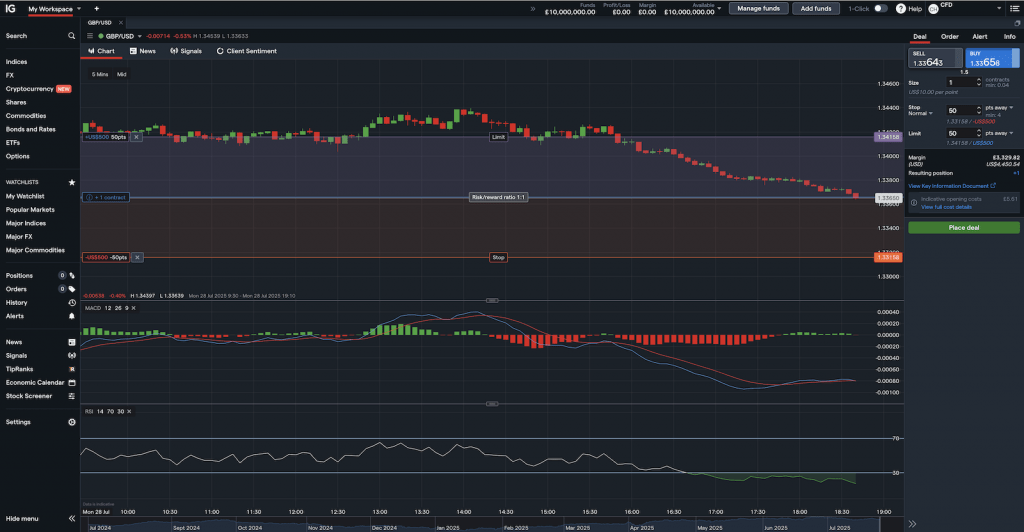
Pros Of Scalping Brokers
- Ultra-low trading costs: Scalping accounts often feature raw spread pricing, where brokers charge a fixed commission per lot, rather than widening the spread. This is ideal for high-frequency trading, capturing price changes of just a few pips. For instance, Pepperstone offers spreads as low as 0.0 pips on major forex pairs and charge around £2.25 per side per lot. These low costs make it economically viable to execute dozens of trades per day without eroding profits through huge spread markups.
- Faster execution speeds: Speed is everything in scalping. True scalping accounts minimise latency and enhance order fill times. For example, Pepperstone and Eightcap offer execution speeds under 30ms, often with no requotes, thanks to their ECN/STP infrastructure. Many also support co-location with trading servers or integrate VPS services, which are necessary for algorithmic and manual scalpers operating in fast-moving markets.
- Flexible trading conditions: Notably allowing all scalping strategies without restrictions is vital because some brokers impose rules like minimum holding times, trade frequency limits, or prohibit techniques like news scalping. These restrictions can severely disrupt strategies that rely on fast, repetitive trades or short-term market inefficiencies. For example, XM offers a scalper-friendly environment with no time limits on positions and support for EAs, making it ideal for both manual and algorithmic scalpers. Without this flexibility, you risk having profitable trades cancelled or accounts flagged, undermining long-term consistency and trust in execution.
Cons Of Scalping Brokers
- High exposure to slippage & latency issues: Scalping relies on milliseconds, so even slight execution delays or slippage can eat into profits—or turn wins into losses. During high-volatility periods (e.g., news events), market conditions can change more rapidly than the broker’s infrastructure can handle, resulting in orders being filled at worse prices. While brokers like Pepperstone optimise for speed, no broker is immune to latency, especially if you’re not using a VPS or fibre connection.
- Stricter broker & platform requirements: Not all brokers allow scalping, and those that do often impose minimum trade durations, execution limits, or require professional account status to bypass FCA leverage caps (up to 1:30 for retail traders). For instance, some market makers or hybrid models may restrict or even cancel trades deemed too short-term in nature. Additionally, platforms like MT4 may have limited order routing customisation options, whereas more scalper-friendly options, such as cTrader or TradingView, are less universally supported.
- Intensive mental & technical demands: Scalping requires a high level of concentration, discipline, and market timing, often necessitating the monitoring of multiple screens or the execution of automated trading algorithms. It’s not ideal for beginners without a solid strategy and risk management system. Moreover, using a scalping account effectively often involves manual backtesting, rapid decision-making, and sometimes the use of third-party tools such as depth-of-market indicators or tick charts—features only available on advanced platforms or through well-equipped brokers.
I learned the hard way that not every broker welcomes scalpers. One platform quietly widened spreads during peak hours, and it cost me more than a few trades.Now, I only trust brokers who are transparent, fast, and built for the pace of scalping demands.
Bottom Line
Scalping is a high-speed trading strategy that requires precision, tight spreads, and lightning-fast execution—choosing a suitable broker is critical to success.
You must also consider regulation, platform performance, and whether the broker truly supports scalping without restrictions.
While some brokers stand out for their raw pricing and execution speed, the best choice depends on your specific trading style, tools, and risk tolerance.
Scalping can be profitable, but only when paired with the best brokers for scalping and disciplined risk management.