Best Futures Brokers In The UK 2026



Looking to trade futures in the UK? With tighter regulations, evolving platforms, and global market access, you need a broker that combines competitive pricing with powerful tools and trusted regulation.
We cut through the noise to reveal the top futures brokers in the UK—helping you choose the one that aligns with your strategy, risk appetite, and investment goals.
Best Brokers For Trading Futures
-


IG Markets provides futures trading on more than 90 international contracts, featuring an intuitive platform and robust charting tools. In our tests, low commissions, beginning at approximately $2.50 per contract, and tight spreads were notable. With regulatory oversight and low minimum deposits, IG accommodates both novice and seasoned traders.
Instruments Regulator Platforms CFDs (not in US), Forex, Stocks, Indices, Commodities, ETFs, Futures, Options, Crypto, Spread Betting (UK only) CFTC, NFA, FCA, BaFin, ASIC, FINMA, MAS, JFSA, FMA, DFSA, BMA Web, L2 Dealer, MT4, TradingView, AutoChartist, TradingCentral, ProRealTime Min. Deposit Min. Trade Leverage $0 0.01 Lots 1:30 (Retail), 1:222 (Pro) -
Trade Nation provides futures trading mainly via CFDs on indices and commodities. In our tests, fixed spreads began at 0.3 points for key indices such as the S&P 500. This approach ensures price certainty, unlike most futures brokers, and it doesn't charge commission fees.
Instruments Regulator Platforms CFDs, Forex, Indices, Shares, Commodities, Futures, Bonds, Spread Betting (UK and Ireland only), Cryptos (Bahamas entity only) FCA, ASIC, CMVM , FSCA, SCB, FSA TN Trader, MT4, TradingView Min. Deposit Min. Trade Leverage $0 0.1 Lots 1:30 -
Interactive Brokers provides direct futures trading on over 30 global exchanges with exceptionally low commissions, starting at just $0.25 per mini-contract. In our evaluation, its sophisticated Trader Workstation platform stood out with extensive order types and algorithmic features. IBKR’s worldwide access and minimal fees render it an excellent option for active futures traders.
Instruments Regulator Platforms Stocks, Options, Futures, Forex, Funds, Bonds, ETFs, Mutual Funds, Cryptocurrencies, CFDs SEC, FINRA, CFTC, NFA, CIRO, FCA, CBI, ASIC, SFC, SEBI, JFSA, MAS Trader Workstation (TWS), IBKR Desktop, GlobalTrader, Mobile, Client Portal, AlgoTrader, OmniTrader, TradingView, eSignal, TradingCentral, ProRealTime, Quantower Min. Deposit Min. Trade Leverage $0 $1 1:30 -
eToro provides futures exposure via CFDs on indices, commodities, and cryptocurrencies instead of direct exchange-traded futures. In our evaluation, the platform excelled due to its simplicity, fixed spreads, and commission-free model, appealing to beginners. Social trading enhances its value by allowing users to replicate the strategies of seasoned futures traders.
Instruments Regulator Platforms CFDs, Forex, Stocks, Indices, ETFs, Smart Portfolios, Commodities, Futures, Crypto, NFTs FCA, CySEC, MiCA, MFSA, FSRA, ASIC, FSAS, MAS, GFSC eToro Web, CopyTrader, TradingCentral Min. Deposit Min. Trade Leverage $50 $10 1:30 -
Founded in 2009, Vantage provides access to over 1,000 short-term CFD products for millions of clients. Trade Forex CFDs from 0.0 pips via RAW accounts on TradingView, MT4 or MT5. ASIC-regulated, Vantage segregates client funds and offers social trading tools for copy traders.
Instruments Regulator Platforms CFDs, Forex, Stocks, Indices, Commodities, ETFs, Bonds, Spread betting FCA, ASIC, FSCA, VFSC, CIMA ProTrader, MT4, MT5, TradingView, TradingCentral, DupliTrade Min. Deposit Min. Trade Leverage $50 0.01 Lots 1:30 -
Tickmill is a worldwide broker regulated by respected authorities like CySEC and FCA. It has attracted hundreds of thousands of traders, executing over 530 million trades. Its edge lies in sophisticated tools, informative resources, and competitive fees.
Instruments Regulator Platforms Forex, CFDs, stocks, indices, commodities, cryptocurrencies, futures, options, bonds FCA, CySEC, FSA, DFSA, FSCA Tickmill Webtrader, MT4, MT5, TradingView Min. Deposit Min. Trade Leverage $100 0.01 Lots 1:1000 -
FxPro provides CFD futures, enabling traders to access indices, commodities, and energy futures through MT4, MT5, and cTrader. In our assessments, future CFD spreads were variable yet frequently competitive, featuring reduced commissions (USD $35 per $1M traded) on cTrader. Its order execution and platform reliability are notable for serious futures traders.
Instruments Regulator Platforms CFDs, Forex, Stocks, Indices, Commodities, Futures, Spread Betting FCA, CySEC, FSCA, SCB, FSA FxPro Edge, MT4, MT5, cTrader, AutoChartist, TradingCentral, DupliTrade, Quantower Min. Deposit Min. Trade Leverage $100 0.01 Lots 1:30 (Retail), 1:500 (Pro)
 IG
IG Trade Nation
 Interactive Brokers
 eToro
eToro Vantage FX
 Tickmill
 FXPro
FXProSafety Comparison
Compare how safe the Best Futures Brokers In The UK 2026 are and what features they offer to protect traders.
| Broker | Trust Rating | FCA Regulated | Negative Balance Protection | Guaranteed Stop Loss | Segregated Accounts |
|---|---|---|---|---|---|
| IG | ✔ | ✔ | ✔ | ✔ | |
| Trade Nation | ✔ | ✔ | ✘ | ✔ | |
| Interactive Brokers | ✔ | ✔ | ✘ | ✔ | |
| eToro | ✔ | ✔ | ✘ | ✔ | |
| Vantage FX | ✔ | ✔ | ✘ | ✔ | |
| Tickmill | ✔ | ✘ | ✘ | ✔ | |
| FXPro | ✔ | ✔ | ✘ | ✔ |
Payments Comparison
Compare which popular payment methods the Best Futures Brokers In The UK 2026 support and whether they have trading accounts denominated in British Pounds (GBP).
| Broker | GBP Account | Debit Card | Credit Card | Neteller | Skrill | Apple Pay |
|---|---|---|---|---|---|---|
| IG | ✔ | ✔ | ✔ | ✘ | ✘ | ✘ |
| Trade Nation | ✔ | ✔ | ✔ | ✘ | ✔ | ✘ |
| Interactive Brokers | ✔ | ✘ | ✘ | ✘ | ✘ | ✘ |
| eToro | ✔ | ✔ | ✘ | ✔ | ✔ | ✘ |
| Vantage FX | ✔ | ✔ | ✔ | ✔ | ✔ | ✘ |
| Tickmill | ✔ | ✘ | ✘ | ✔ | ✔ | ✘ |
| FXPro | ✔ | ✘ | ✔ | ✔ | ✔ | ✘ |
Mobile Trading Comparison
How good are the Best Futures Brokers In The UK 2026 at mobile trading using apps or other mobile interfaces.
| Broker | Mobile Apps | iOS Rating | Android Rating | Smart Watch App |
|---|---|---|---|---|
| IG | iOS & Android | ✔ | ||
| Trade Nation | iOS & Android | ✘ | ||
| Interactive Brokers | iOS & Android | ✔ | ||
| eToro | iOS & Android | ✘ | ||
| Vantage FX | iOS & Android | ✘ | ||
| Tickmill | ✔ | ✘ | ||
| FXPro | iOS & Android | ✘ |
Beginners Comparison
Are the Best Futures Brokers In The UK 2026 good for beginner traders, that might want an affordable setup to get started, along with good support and educational resources?
| Broker | Demo Account | Minimum Deposit | Minimum Trade | Support Rating | Education Rating |
|---|---|---|---|---|---|
| IG | ✔ | $0 | 0.01 Lots | ||
| Trade Nation | ✔ | $0 | 0.1 Lots | ||
| Interactive Brokers | ✔ | $0 | $1 | ||
| eToro | ✔ | $50 | $10 | ||
| Vantage FX | ✔ | $50 | 0.01 Lots | ||
| Tickmill | ✔ | $100 | 0.01 Lots | ||
| FXPro | ✔ | $100 | 0.01 Lots |
Advanced Trading Comparison
Do the Best Futures Brokers In The UK 2026 offer features that allow for more advanced trading strategies?
| Broker | Automated Trading | Pro Account | Leverage | VPS | AI | Low Latency | Extended Hours |
|---|---|---|---|---|---|---|---|
| IG | Expert Advisors (EAs) on MetaTrader, build your own on ProRealTime | ✔ | 1:30 (Retail), 1:222 (Pro) | ✔ | ✔ | ✔ | ✔ |
| Trade Nation | Expert Advisors (EAs) on MetaTrader | ✘ | 1:30 | ✘ | ✘ | ✘ | ✘ |
| Interactive Brokers | TWS API | ✘ | 1:30 | ✘ | ✔ | ✔ | ✔ |
| eToro | Automate your trades via CopyTrader - follow profitable traders. Open and close trades automatically when they do. | ✘ | 1:30 | ✘ | ✔ | ✘ | ✔ |
| Vantage FX | Myfxbook AutoTrade, Expert Advisors (EAs) on MetaTrader | ✘ | 1:30 | ✔ | ✘ | ✘ | ✘ |
| Tickmill | ✔ | ✘ | 1:1000 | ✘ | ✘ | ✘ | ✘ |
| FXPro | Expert Advisors (EAs) on MetaTrader, cBots on cTrader | ✔ | 1:30 (Retail), 1:500 (Pro) | ✔ | ✔ | ✔ | ✔ |
Detailed Rating Comparison
Use this heatmap to compare our detailed ratings for all of the Best Futures Brokers In The UK 2026.
| Broker | Trust | Platforms | Mobile | Assets | Fees | Accounts | Support | Research | Education |
|---|---|---|---|---|---|---|---|---|---|
| IG | |||||||||
| Trade Nation | |||||||||
| Interactive Brokers | |||||||||
| eToro | |||||||||
| Vantage FX | |||||||||
| Tickmill | |||||||||
| FXPro |
Our Take On IG
"IG offers a complete package: an easy-to-use web platform, top-tier beginner education, enhanced charting via TradingView, up-to-date data, and strong trade execution for seasoned traders."Tobias Robinson
Reviewer
Pros
- The ProRealTime advanced charting platform remains free, provided traders meet modest monthly activity requirements.
- IG secured a crypto asset license from the FCA, enabling its return to the UK market. It now offers buying, selling, and storage services for over 55 digital tokens with fees starting at 1.49%, all under FCA regulation.
- The web-based platform supports traders at every level, offering advanced charting tools and real-time market data vital for trading. Additionally, IG now includes TradingView integration.
Cons
- Beginners may find IG's fees complicated, as they vary depending on the trades or services. This could cause confusion and unexpected costs.
- IG imposes a monthly inactivity fee of $12 to $18 after two years, discouraging occasional investors.
- IG has ended its swap-free account, diminishing its attractiveness to Islamic traders.
Our Take On Trade Nation
"Trade Nation caters to discretionary traders aiming to speculate on major indices like the US 500 or liquid FX pairs, with the certainty of fixed spreads. Our tests revealed the TN Trader's fixed spreads to be advantageous, especially during economic announcements, thanks to its dependable charting and capped spreads."Tobias Robinson
Reviewer
Pros
- Trade Nation's 2026 alliance with Volt has streamlined payments for Australian traders, enabling instant deposits and withdrawals via PayID. Faster payout features are also anticipated for UK and EU clients.
- The broker expanded into Europe by launching regulated online trading services, after securing authorization from Portugal's CVMV, enhancing safety measures for European residents.
- The demo includes a £5,000 practice account, and you can request a personalised platform walkthrough via callback. This level of individual assistance is uncommon.
Cons
- Withdrawals may take up to five business days, aligning with industry norms. However, this is slower compared to the 1-3 days many brokers now offer to minimise complaints from retail investors.
- The FCA, CMVM, and ASIC clients are ineligible for the 2–20% rebate scheme. Consequently, active traders in these areas cannot receive transaction rebates.
- Offshore SCB and FSA firms offer retail investors leverage up to 1:200 and 1:500. In contrast, regions like the UK, Europe, and Australia cap leverage at 1:30. Thus, an FSA client can access 16 times more exposure than a UK retail client on identical trades. However, this comes with reduced oversight and no compensation schemes.
Our Take On Interactive Brokers
"Interactive Brokers ranks highly for seasoned traders due to its robust charting platforms, live data, and bespoke layouts via the new IBKR Desktop app. Its competitive pricing and sophisticated order choices appeal to traders, and its wide equity options are industry-leading."Tobias Robinson
Reviewer
Pros
- The TWS platform is tailored for intermediate and advanced traders, featuring over 100 order types and a dependable real-time market data feed with exceptional uptime.
- IBKR is a highly respected brokerage, regulated by top-tier authorities, ensuring the integrity and security of your trading account.
- IBKR consistently offers unparalleled access to global equities, with thousands of shares available across over 100 market centres in 24 countries, including the recently added Saudi Stock Exchange.
Cons
- IBKR offers a variety of research tools, but their inconsistent placement across trading platforms and the 'Account Management' webpage creates a confusing experience for users.
- You are limited to a single active session per account, meaning you cannot use both your desktop programme and mobile app at the same time. This restriction can occasionally lead to a frustrating experience for traders.
- In 2025, IBKR was fined $11.8m by the US OFAC for operating in sanctioned areas. That same year, FINRA imposed a $125k fine for lapses in municipal bond disclosure.
Our Take On eToro
"eToro's social trading platform excels with its outstanding user experience and lively community chat, aiding beginners in spotting opportunities. It offers competitive fees on numerous CFDs and real stocks, alongside exceptional rewards for seasoned strategists."Tobias Robinson
Reviewer
Pros
- There is an extensive online training academy offering a range of accessible resources, from concise articles to detailed courses.
- In 2025, eToro enhanced its trading experience by incorporating insights from over 10 million Stocktwits users, enabling better assessment of market sentiment.
- The entry requirements for eToro Club have been reduced. For $4.99 monthly, members enjoy 18 benefits, including a debit card that converts purchases into stocks with a 4% share return.
Cons
- The absence of extra charting platforms such as MT4 may deter experienced traders who rely on external software.
- The only significant contact option, besides the in-platform live chat, is limited.
- There are no assured stop-loss orders, which could be a valuable risk management tool for novice traders.
Our Take On Vantage FX
"Vantage is an ideal choice for CFD traders looking for a well-regulated broker with access to the dependable MetaTrader platforms. With a swift sign-up process and a minimum deposit of $50, starting trading is simple and fast."Tobias Robinson
Reviewer
Pros
- Hedging and scalping strategies are fully permitted without any short-term restrictions.
- Opening a live account is both straightforward and swift, requiring under 5 minutes to complete.
- In 2026, the app was enhanced to provide comprehensive asset visibility, consolidating balances from Contract, Copy, and Funding accounts onto a single screen.
Cons
- To access optimal trading conditions, a substantial deposit of $10,000 is required. This includes a commission of $1.50 per transaction per side.
- It's unfortunate that some clients must register with the offshore firm, which provides reduced regulatory safeguards.
- Based on tests, average execution speeds of 100ms to 250ms are slower compared to other options.
Our Take On Tickmill
"Tickmill stands out for traders, particularly with the Raw account, offering nearly no pip spreads and exceptionally swift order execution."Tobias Robinson
Reviewer
Pros
- Drawing from our trading experience, Tickmill consistently executes orders rapidly—averaging around 59 milliseconds—with minimal slippage or requotes. This reliability ensures traders can trust their entry and exit prices without delay, safeguarding against potential costs in fast markets.
- Tickmill holds licences from regulators such as the FCA and CySEC, ensuring tangible advantages. Client funds are segregated in secure accounts, and negative balance protection is in place. This guarantees you won't owe more than your deposit, offering reassurance during market fluctuations.
- With the Raw Spread account, spreads are remarkably tight, occasionally reaching zero pips, complemented by a clear per-trade commission. This arrangement minimises trading costs, offering a crucial benefit for frequent trades and eliminating hidden fees that erode profits.
Cons
- If you prefer cTrader's interface and advanced order options, you won't find them here. Tickmill utilises MetaTrader 4 and 5, TradingView, and its own platform but lacks cTrader. This may hinder those who depend on cTrader's features or tools like cTrader Copy.
- Tickmill targets forex pairs, select stock CFDs, indices, and limited commodities. If you prefer trading across diverse asset classes like cryptocurrencies or a wider array of stocks, options here are restricted versus brokers offering thousands of instruments.
Our Take On FXPro
"FxPro is an excellent choice for traders, offering execution speeds under 8ms, reduced fees from 2022, and superb charting platforms like MT4, MT5, cTrader, and FxPro Edge."Tobias Robinson
Reviewer
Pros
- FxPro's Wallet is a notable feature enabling traders to securely manage their funds. It ensures additional protection and ease by separating unused funds from active trading accounts.
- FxPro uses a 'No Dealing Desk' (NDD) model for swift and transparent order execution, usually within 12 milliseconds, making it well-suited for short-term trading strategies.
- The FxPro app continually enhances its offerings, including asset range expansion and spread reduction. Minor user experience upgrades, such as Colour Adjust for better mobile chart configuration, are also planned for 2026.
Cons
- Passive investment options, such as interest on cash or social trading platforms, are limited. While active traders might not notice, competitors like eToro, serving both active and passive investors, provide more comprehensive offerings.
- FxPro, with its $10M funded demo account and expanding Knowledge Hub, mainly caters to experienced traders. Beginners might find its account and fee structure challenging to understand.
- FxPro offers customer support five days a week around the clock, accessible via various platforms, and the service quality is reliable based on tests. However, the absence of weekend support can be a drawback for traders requiring help beyond standard market times.
How Investing.co.uk Chose The Top Futures Brokers
To identify the best futures brokers for UK traders, we conducted hands-on evaluations of each platform’s futures offering. Our testing focused on key factors including the range and number of futures contracts available.
In addition, we reviewed FCA regulatory standing, ease of use, and advanced order types, all critical for UK-based futures traders. Brokers were then rated and ranked.
How To Pick A Futures Broker
- Account types and minimum deposits determine your access to different markets, leverage levels, and trading tools. Some brokers offer tiered accounts—such as standard, professional, or institutional—each with varying margin requirements, fees, and regulatory protections. Understanding these distinctions helps avoid unexpected costs or restrictions, while ensuring the account suits your trading style and capital. Additionally, minimum deposits can impact how much risk you’re exposed to initially, so choosing a broker with flexible requirements can make starting more manageable and less financially stressful.
- The range of markets offered by a futures broker shapes your trading opportunities and diversification potential. Access to commodities, indices and currencies enables you to diversify risk across different asset classes, thereby reducing your reliance on a single market’s performance. Other markets have unique volatility profiles, margin requirements, and trading hours, so having a broad selection enables you to tailor your strategy and manage risk more effectively.
- Leverage and margin requirements determine how much capital you need to control a futures position and the level of risk you take on. Leverage allows you to open larger trades with a smaller deposit, amplifying both potential gains and losses. However, brokers set margin requirements to ensure you maintain enough funds to cover market fluctuations—falling below these can trigger margin calls and forced position closures. Understanding this balance is vital for managing risk effectively and avoiding unexpected losses, especially in volatile futures markets.
- A trading platform and available tools directly impact your ability to analyse markets, execute trades quickly, and manage risk. Advanced technical analysis features—such as customisable charts and indicators on MT5 and cTrader—help identify trading opportunities and trends, while fast execution speeds minimise slippage in fast-moving futures markets. Risk management tools, such as stop-loss orders and real-time margin monitoring, are crucial for safeguarding your capital and mitigating losses. For beginners, a user-friendly yet powerful platform can accelerate learning and improve trading discipline.
- Trading costs—including commissions and spreads—directly impact your profitability and trading strategy. Unlike CFDs, futures contracts typically do incur overnight financing fees, making them more cost-effective for holding positions in the long term. However, brokers may charge commissions per contract, and even small spreads can add up for frequent traders.
- Quick, knowledgeable customer support can prevent costly mistakes, especially in fast-moving futures markets. Responsive UK-based support teams understand local regulations and market conditions, offering tailored guidance and faster issue resolution. In contrast, global brokers with limited local presence may experience slower response times or language barriers, which can be particularly critical when managing margin calls or technical issues.
In my experience, choosing the best futures broker comes down to a balance of clear pricing, dependable trade execution, and responsive support—because in volatile markets, these practical factors often make the most significant difference between success and frustration.
What Is A Futures Broker?
A futures trading broker is a platform that allows you to trade standardised contracts, speculating on the future price of assets such as commodities, forex, or indices.
Unlike stock trading, futures involve derivatives—agreements to buy or sell an asset at a set price on a future date—often using leverage, which can amplify both profits and losses.
Futures brokers may offer access to global futures exchanges or provide futures-like exposure through CFDs. While CFDs are often easier to access for beginners, they differ from true futures in terms of structure, pricing, and tax treatment.
A good broker does more than route trades—it provides fast execution, market data, risk management tools, and educational resources. Picking the right futures trading broker is a crucial step in trading with confidence and managing risk effectively.
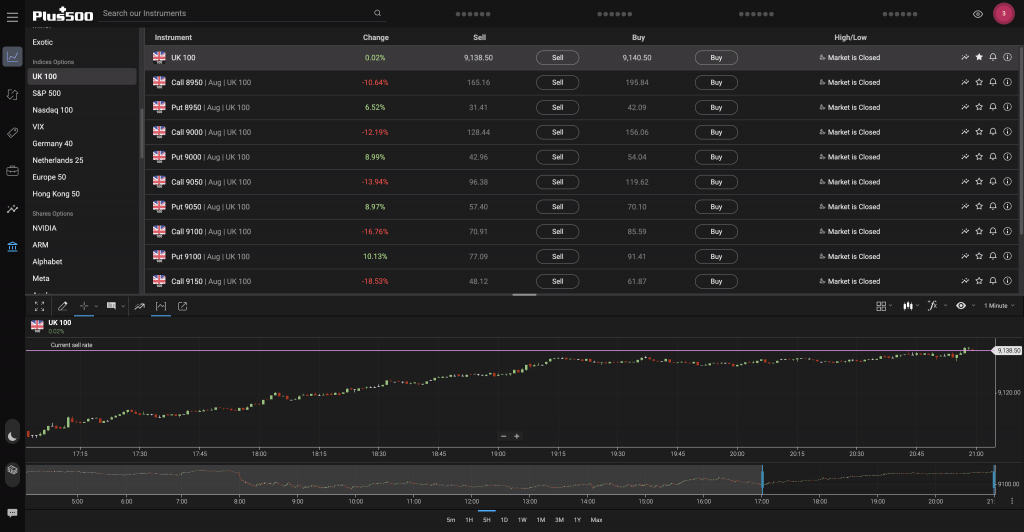
Trading FTSE 100 futures on Plus500 with a clean interface and real time pricing
Pros Of Futures Trading
- High liquidity & market depth: Futures contracts—especially those tied to major indices, commodities, and currencies—are among the most liquid instruments in global markets. This high liquidity translates into tight bid-ask spreads, efficient price discovery, and minimal slippage, even during periods of volatility. For active traders, this means more precise order execution and lower implicit trading costs. Liquidity also allows for faster entry and exit from large positions without significantly impacting the market price.
- Transparent & competitive cost structure: Futures trading generally involves lower and more transparent costs than many over-the-counter products. Trades are executed on centralised exchanges where fees (commissions, clearing, and exchange fees) are itemised. Unlike CFDs, futures do not incur overnight financing or swap charges, making them more cost-efficient for multi-day or long-term positions. Additionally, the absence of broker-set pricing reduces the risk of spread manipulation, which can occur in OTC markets.
- Leverage with institutional-grade risk controls: Futures allow you to control large contract values with relatively small initial margin requirements, offering significant leverage. However, unlike retail leverage products, futures are subject to strict daily mark-to-market settlements and variation margin calls, which help manage counterparty risk and keep accounts in check. This system fosters discipline, requiring you to maintain sufficient capital and mitigating the risk of excessive, unchecked losses.
Cons Of Futures Trading
- Complex contract specifications & expiry dates: Futures contracts come with standardised terms, including fixed contract sizes, expiration dates, and settlement procedures. For beginners, managing contract rollovers—switching from an expiring contract to a new one—can be complicated and costly if not timed correctly. Misunderstanding these details can lead to unintended positions or additional fees, which may erode profits or increase losses.
- Market volatility & price gaps: Futures markets can be highly volatile, especially around economic announcements or geopolitical events. Price gaps—where the price jumps significantly between trading sessions—can occur because many futures markets close overnight. These gaps can bypass stop-loss orders, exposing you to unexpected and potentially substantial losses.
- High leverage increases risk of rapid losses: While leverage magnifies gains, it equally amplifies losses. Futures often require relatively small margins, but adverse market moves can trigger margin calls quickly, demanding additional funds to maintain positions. Failure to meet margin calls may result in forced liquidation of positions at unfavourable prices, potentially leading to losses that exceed the initial investment.
In fast-moving futures markets, having access to reliable technology isn’t just a convenience—it’s essential.I’ve seen firsthand how delays or platform glitches can turn a promising trade into a missed opportunity, so choosing a broker with robust execution tools is key to staying competitive.
Bottom Line
Choosing the right broker for trading futures in the UK involves balancing key factors such as regulation, trading costs, platform features, and market access.
Understanding the difference between actual futures contracts and CFDs is crucial, as is knowing the risks and leverage involved.
Our choice of the best brokers for trading futures will help you find the right fit to trade futures with confidence and effectiveness.