Day trading demo accounts act as a practice simulator for live trading. Full demo accounts are available without a deposit, meaning day traders can explore platform features and test intraday strategies without handing over any money. The top demo day trading software also comes with extra perks, from free trading competitions to app compatibility and no time limit.
This review ranks the best demo accounts for online day trading in 2026. Our expert team also explain how demo brokerage accounts work, including any limitations and tips on getting the most out of day trading simulator software.
Best Day Trading Demo Accounts UK
Investing involves risk. Asset prices can move rapidly and you may lose some or all money invested. Never invest more than you can afford to lose.Advertising disclosure
Our picks at a glance
- 1 XTB Top score: Trust 4.8 Info Visit XTB
- 2 Vantage FX Top score: Trust 4.7 Info Visit Vantage FX
- 3 Pepperstone Top score: Platforms 4.8 Info Visit Pepperstone
- 4 Interactive Brokers Top score: Assets 4.3 Info Visit Interactive Brokers
- 5 IG Top score: Fees 4.5 Info Visit IG
- 6 Trade Nation Top score: Support 4.4 Info Visit Trade Nation
- 7 Eightcap Top score: Mobile 4.6 Info Visit Eightcap
-
Our top pick
In our assessments, XTB’s demo accurately replicated its live xStation 5 platform, featuring over 5,000 assets like forex, indices, commodities, stocks, and crypto. Execution was rapid through CEC liquidity, with EUR/USD spreads starting at approximately 0.6 pips and minimal slippage. Setup required only an email, provided a $100,000 virtual balance, and the demo had no expiration.
- Instruments
- CFDs on shares, Indices, ETFs, Raw Materials, Forex currencies, cryptocurrencies, Real shares, Real ETFs
- Regulator
- FCA, CySEC, KNF, DFSA, FSC, SCA, CMF, Bappebti
- Platforms
- xStation
- Min. Deposit
- $0
- Min. Trade
- 0.01 Lots
- Leverage
- 1:30
CFDs are complex instruments and come with a high risk of losing money rapidly due to leverage. 74% of retail investor accounts lose money when trading CFDs with this provider. You should consider whether you understand how CFDs work and whether you can afford to take the high risk of losing your money
-
In our tests, Vantage's demo provided real-market ECN conditions through MT4/MT5/cTrader. EUR/USD spreads were between 0.0 and 0.2 pips, with a $3 round-trip commission. Execution was fast with minimal slippage. Setup required just an email, offered up to $500K in virtual funds, and never expired—ideal for realistic strategy development.
- Instruments
- CFDs, Forex, Stocks, Indices, Commodities, ETFs, Bonds, Spread betting
- Regulator
- FCA, ASIC, FSCA, VFSC, CIMA
- Platforms
- ProTrader, MT4, MT5, TradingView, TradingCentral, DupliTrade
- Min. Deposit
- $50
- Min. Trade
- 0.01 Lots
- Leverage
- 1:30
-
In our recent tests, Pepperstone’s demo reflected live spreads—EUR/USD averaged 0.1–0.3 pips with Razor accounts. Execution proved swift, with little slippage and over 1,000 assets available. The interface precisely mimicked the real trading environment. No personal information was needed, offering a 30-day trial with up to $50,000 virtual funds.
- Instruments
- CFDs, Forex, Currency Indices, Stocks, Indices, Commodities, ETFs, Crypto CFDs (only Pro clients), Spread Betting
- Regulator
- FCA, ASIC, CySEC, BaFin, DFSA, SCA, SCB, CMA-Kenya
- Platforms
- Pepperstone Trading Platform, MT4, MT5, cTrader, TradingView
- Min. Deposit
- $0
- Min. Trade
- 0.01 Lots
- Leverage
- 1:30 (Retail - UK, EU, Australia), 1:500 (Pro), 1:200 (Offshore), 1:400 (Kenya)
CFDs and FX are complex instruments and come with a high risk of losing money rapidly due to leverage. 73-89% of retail investor accounts lose money when trading CFDs.
-
Using Interactive Brokers' demo mirrored the live TWS platform, featuring global market access and advanced order types. Execution speed felt genuine, although fast-moving assets experienced slight slippage. Basic details were needed for setup. With a virtual balance of $1M, paper trading started post-account approval.
- Instruments
- Stocks, Options, Futures, Forex, Funds, Bonds, ETFs, Mutual Funds, Cryptocurrencies, CFDs
- Regulator
- SEC, FINRA, CFTC, NFA, CIRO, FCA, CBI, ASIC, SFC, SEBI, JFSA, MAS
- Platforms
- Trader Workstation (TWS), IBKR Desktop, GlobalTrader, Mobile, Client Portal, AlgoTrader, OmniTrader, TradingView, eSignal, TradingCentral, ProRealTime, Quantower
- Min. Deposit
- $0
- Min. Trade
- $1
- Leverage
- 1:30
-
In our assessment, IG's demo account provided a $10,000 virtual fund. Execution was dependable with minimal slippage, and real-time market data was accessible. There is no time restriction. Setup required just an email, and users can replenish their virtual funds anytime. The platform is available via MT4, ProRealTime, L2 Dealer, and WebTrader. IG Academy also offered superb educational resources.
- Instruments
- CFDs (not in US), Forex, Stocks, Indices, Commodities, ETFs, Futures, Options, Crypto, Spread Betting (UK only)
- Regulator
- CFTC, NFA, FCA, BaFin, ASIC, FINMA, MAS, JFSA, FMA, DFSA, BMA, CONSOB
- Platforms
- Web, L2 Dealer, MT4, TradingView, AutoChartist, TradingCentral, ProRealTime
- Min. Deposit
- $0
- Min. Trade
- 0.01 Lots
- Leverage
- 1:30 (Retail), 1:222 (Pro)
Spread bets and CFDs are complex instruments and come with a high risk of losing money rapidly due to leverage. 70% of retail investor accounts lose money when trading spread bets and CFDs with this provider. You should consider whether you understand how spread bets and CFDs work, and whether you can afford to take the high risk of losing your money.
-
Trade Nation is a leading FX and CFD broker regulated in the UK and Australia, among other places. The company provides competitively priced fixed and variable spreads on over 1,000 assets. Traders benefit from advanced platforms and comprehensive training materials. Additionally, the Signal Centre offers valuable trade ideas.
- Instruments
- CFDs, Forex, Indices, Shares, Commodities, Futures, Bonds, Spread Betting (UK and Ireland only), Cryptos (Bahamas entity only)
- Regulator
- FCA, ASIC, CMVM , FSCA, SCB, FSA
- Platforms
- TN Trader, MT4, TradingView
- Min. Deposit
- $0
- Min. Trade
- 0.1 Lots
- Leverage
- 1:30
67.3% of retail investor accounts lose money when trading CFDs with this provider.
-
In our tests, Eightcap's demo account matched actual trading conditions with live pricing and execution. Accessible via MT4, MT5, and TradingView, it offers over 1,000 instruments like forex, indices, commodities, stocks, and crypto. Setup merely required an email, offering a $5,000,000 virtual balance for 30 days, extendable on request. Perfect for both novice and experienced traders seeking realistic practice.
- Instruments
- CFDs in Forex, Stocks, Indices, Commodities
- Regulator
- FCA, ASIC, CySEC, FSC, SCB, FSA
- Platforms
- MT4, MT5, TradingView, TradeLocker
- Min. Deposit
- £100
- Min. Trade
- 0.01 Lots
- Leverage
- 1:30
Services are provided subject to applicable laws and regulations. Certain products, services, instruments, platforms or payment methods may not be available to residents of certain jurisdictions.
Compare
Safety Comparison
Compare how safe the Day Trading Demo are and what features they offer to protect traders.
| Broker | Trust Rating | FCA Regulated | Negative Balance Protection | Guaranteed Stop Loss | Segregated Accounts |
|---|---|---|---|---|---|
 |
4.6 | ||||
 |
4.6 | ||||
 |
4.6 | ||||
 |
4.5 | ||||
 |
4.4 | ||||
 |
4.3 | ||||
 |
4.3 |
Payments Comparison
Compare which popular payment methods the Day Trading Demo support and whether they have trading accounts denominated in British Pounds (GBP).
| Broker | GBP Account | Debit Card | Credit Card | Neteller | Skrill | Apple Pay |
|---|---|---|---|---|---|---|
|
||||||
|
||||||
|
||||||
|
||||||
|
||||||
|
||||||
|
Mobile Trading Comparison
How good are the Day Trading Demo at mobile trading using apps or other mobile interfaces.
| Broker | Mobile Apps | iOS Rating | Android Rating | Smart Watch App |
|---|---|---|---|---|
|
iOS & Android | 4.7 | 4.1 | |
|
iOS & Android | 3.6 | 3.9 | |
|
iOS & Android | 4.4 | 4.1 | |
|
iOS & Android | 4.3 | 4.5 | |
|
iOS & Android | 4.6 | 4.0 | |
|
iOS & Android | 4.5 | 4.5 | |
|
iOS & Android | 4.8 | 4.4 |
Beginners Comparison
Are the Day Trading Demo good for beginner traders, that might want an affordable setup to get started, along with good support and educational resources?
| Broker | Demo Account | Minimum Deposit | Minimum Trade | Support Rating | Education Rating |
|---|---|---|---|---|---|
|
$0 | 0.01 Lots | 4.3 | 3.8 | |
|
$50 | 0.01 Lots | 4.4 | 4.0 | |
|
$0 | 0.01 Lots | 4.6 | 4.0 | |
|
$0 | $1 | 3.0 | 4.3 | |
|
$0 | 0.01 Lots | 4.5 | 4.8 | |
|
$0 | 0.1 Lots | 4.9 | 4.2 | |
|
£100 | 0.01 Lots | 4.0 | 3.5 |
Advanced Trading Comparison
Do the Day Trading Demo offer features that allow for more advanced trading strategies?
| Broker | Automated Trading | Pro Account | Leverage | VPS | AI | Low Latency | Extended Hours |
|---|---|---|---|---|---|---|---|
|
- | 1:30 | |||||
|
Myfxbook AutoTrade, Expert Advisors (EAs) on MetaTrader | 1:30 | |||||
|
Expert Advisors (EAs) on MetaTrader, cBots on cTrader | 1:30 (Retail - UK, EU, Australia), 1:500 (Pro), 1:200 (Offshore), 1:400 (Kenya) | |||||
|
TWS API | 1:30 | |||||
|
Expert Advisors (EAs) on MetaTrader, build your own on ProRealTime | 1:30 (Retail), 1:222 (Pro) | |||||
|
Expert Advisors (EAs) on MetaTrader | 1:30 | |||||
|
TradingView Bots | 1:30 |
Detailed Rating Comparison
Use this heatmap to compare our detailed ratings for all of the Day Trading Demo.
| Broker | Trust | Platforms | Mobile | Assets | Fees | Accounts | Support | Research | Education |
|---|---|---|---|---|---|---|---|---|---|
|
4.6 | 4.0 | 4.4 | 4.6 | 3.9 | 4.0 | 4.3 | 4.1 | 3.8 |
|
4.6 | 4.3 | 3.8 | 4.5 | 4.4 | 4.5 | 4.4 | 4.0 | 4.0 |
|
4.6 | 4.8 | 4.3 | 4.6 | 4.5 | 4.0 | 4.6 | 4.3 | 4.0 |
|
4.5 | 3.3 | 4.4 | 4.7 | 4.3 | 3.5 | 3.0 | 4.4 | 4.3 |
|
4.4 | 4.8 | 4.3 | 4.5 | 5.0 | 4.0 | 4.5 | 4.9 | 4.8 |
|
4.3 | 3.9 | 4.5 | 3.7 | 4.3 | 4.2 | 4.9 | 3.9 | 4.2 |
|
4.3 | 4.3 | 4.6 | 3.6 | 3.8 | 4.0 | 4.0 | 3.5 | 3.5 |
Our Take On XTB
XTB excels for novice traders with its superb xStation platform, minimal trading costs, no required deposit, and outstanding educational resources, many of which are fully integrated into the platform.
 William Berg Reviewer
Pros
- In 2026, XTB expanded its asset offerings and markets. It introduced options trading in Spain and Germany, launched spot cryptocurrencies in select regions, and unveiled Investment Plans 2.0. These enhanced plans now feature more pre-built options, including sectors like Defence, a user-friendly interface, and increased flexibility to mix stocks and ETFs within individual plans.
- The xStation platform stands out with its user-friendly design and intuitive tools, such as adaptable news feeds, sentiment heatmaps, and a trader calculator. These features streamline the learning process for new traders.
- XTB offers a superb array of educational resources, such as training videos and articles, embedded within the platform to assist traders of all experience levels.
Cons
- XTB lacks a raw spread account, a feature increasingly offered by competitors such as Pepperstone. This omission might not satisfy traders seeking the most competitive spreads.
- The demo account lasts only four weeks, posing a challenge for traders wanting to fully explore the xStation platform and refine short-term strategies before investing actual money.
- XTB has stopped supporting MT4, restricting traders to its own platform, xStation. This decision may discourage experienced traders accustomed to using the MetaTrader suite.
74% of accounts lose money when trading CFDs with this provider.
Our Take On Vantage FX
Vantage is an ideal choice for CFD traders looking for a well-regulated broker with access to the dependable MetaTrader platforms. With a swift sign-up process and a minimum deposit of $50, starting trading is simple and fast.
 Tobias Robinson Reviewer
Pros
- Vantage upholds a high trust score through its solid reputation, backed by premier regulation from the FCA and ASIC.
- In 2026, the app was enhanced to provide comprehensive asset visibility, consolidating balances from Contract, Copy, and Funding accounts onto a single screen.
- Vantage has enhanced its trading tools for experienced traders, introducing AutoFibo EA to pinpoint potential market reversals.
Cons
- It's unfortunate that some clients must register with the offshore firm, which provides reduced regulatory safeguards.
- To access optimal trading conditions, a substantial deposit of $10,000 is required. This includes a commission of $1.50 per transaction per side.
- Based on tests, average execution speeds of 100ms to 250ms are slower compared to other options.
Our Take On Pepperstone
Pepperstone excels in trading with tight spreads, swift execution, and advanced charting for seasoned traders. Beginners enjoy zero minimum deposit, comprehensive educational materials, and outstanding 24/5 support, including 18-hour weekend assistance.
Tobias Robinson Reviewer
Pros
- Support for top-tier charting platforms such as MT4, MT5, TradingView, and cTrader. These tools accommodate different short-term trading methods, including algorithmic trading.
- Pepperstone offers pre-IPO perpetual futures, adding Anthropic in October 2026, enabling 24/7 speculation on expected share prices through cash-settled CFDs.
- In recent years, Pepperstone has significantly enhanced the deposit and withdrawal process. By 2025, clients can use Apple Pay and Google Pay, while 2024 saw the introduction of PIX and SPEI for customers in Brazil and Mexico.
Cons
- Overnight holding fees exceed those of some Market Maker brokers (typically Benchmark + 2.5%). Pepperstone suits traders and forex scalpers well but is less ideal for swing traders who keep positions open overnight.
- Execution might not appear as dependable in rapid markets as headline speeds imply. Our tests showed swift execution at targeted prices. However, community feedback highlights concerns over slippage, stop-loss fills, and order triggers sensitive to spreads amid volatility.
- Although the market range has expanded, crypto CFD options remain somewhat restricted, especially when compared to specialised brokers like Eightcap. Additionally, there is no facility to invest in actual cryptocurrencies.
73-89% of retail investor accounts lose money when trading CFDs
Our Take On Interactive Brokers
Interactive Brokers ranks highly for seasoned traders due to its robust charting platforms, live data, and bespoke layouts via the new IBKR Desktop app. Its competitive pricing and sophisticated order choices appeal to traders, and its wide equity options are industry-leading.
Tobias Robinson Reviewer
Pros
- IBKR is a highly respected brokerage, regulated by top-tier authorities, ensuring the integrity and security of your trading account.
- Interactive Brokers has introduced a single platform linking prediction markets on Kalshi, CME Group, and ForecastEx. Users can trade yes/no contracts on political, economic, and climate events, with fixed $1 payouts. Enjoy 24/6 market access and earn interest on eligible positions.
- The TWS platform is tailored for intermediate and advanced traders, featuring over 100 order types and a dependable real-time market data feed with exceptional uptime.
Cons
- TWS has a steep learning curve, making it difficult for newcomers to navigate and grasp its features.
- IBKR offers a variety of research tools, but their inconsistent placement across trading platforms and the 'Account Management' webpage creates a confusing experience for users.
- Support can be sluggish and frustrating. Tests reveal that you may face challenges reaching customer service quickly, which could result in delays in issue resolution.
Our Take On IG
IG offers a complete package: an easy-to-use web platform, top-tier beginner education, enhanced charting via TradingView, up-to-date data, and strong trade execution for seasoned traders.
Tobias Robinson Reviewer
Pros
- IG excels with its diverse instruments, offering stocks, forex, indices, commodities, and cryptocurrencies. Additionally, it provides US-listed futures, options, and an AI Index, ensuring varied diversification opportunities.
- IG secured a crypto asset license from the FCA, enabling its return to the UK market. It now offers buying, selling, and storage services for over 55 digital tokens with fees starting at 1.49%, all under FCA regulation.
- The web-based platform supports traders at every level, offering advanced charting tools and real-time market data vital for trading. Additionally, IG now includes TradingView integration.
Cons
- Beginners may find IG's fees complicated, as they vary depending on the trades or services. This could cause confusion and unexpected costs.
- IG has ended its swap-free account, diminishing its attractiveness to Islamic traders.
- IG imposes a monthly inactivity fee of $12 to $18 after two years, discouraging occasional investors.
70% of retail investor accounts lose money when trading CFDs with this provider. You should consider whether you can afford to take the high risk of losing your money.
Our Take On Trade Nation
Trade Nation caters to discretionary traders aiming to speculate on major indices like the US 500 or liquid FX pairs, with the certainty of fixed spreads. Our tests revealed the TN Trader's fixed spreads to be advantageous, especially during economic announcements, thanks to its dependable charting and capped spreads.
Tobias Robinson Reviewer
Pros
- Trade Nation's 2026 alliance with Volt has streamlined payments for Australian traders, enabling instant deposits and withdrawals via PayID. Faster payout features are also anticipated for UK and EU clients.
- The broker expanded into Europe by launching regulated online trading services, after securing authorization from Portugal's CVMV, enhancing safety measures for European residents.
- During tests of the TN Trader account in standard market conditions, fixed spreads remained stable. Major forex pairs experienced prompt order fills, albeit with slight entry level drift as prices fluctuated between click and execution.
Cons
- Offshore SCB and FSA firms offer retail investors leverage up to 1:200 and 1:500. In contrast, regions like the UK, Europe, and Australia cap leverage at 1:30. Thus, an FSA client can access 16 times more exposure than a UK retail client on identical trades. However, this comes with reduced oversight and no compensation schemes.
- The FCA, CMVM, and ASIC clients are ineligible for the 2–20% rebate scheme. Consequently, active traders in these areas cannot receive transaction rebates.
- There is no raw or ECN pricing tier, often favoured by traders. Regardless of your deposit or trading volume, you receive the same fixed (or variable on MT4) pricing as novices, rendering it particularly unsuitable for scalpers.
67.3% of retail investor accounts lose money when trading CFDs with this provider.
Our Take On Eightcap
Eightcap excels for traders, offering diverse charting platforms, educational Labs, and AI tools. With over 120 crypto CFDs, it stands out in crypto trading and has won our 'Best Crypto Broker' award twice consecutively.
William Berg Reviewer
Pros
- Eightcap has excelled in all essential trading areas, surpassing all rivals to clinch our 'Best Overall Broker' award for 2024. It also earned the titles of 'Best Crypto Broker' and 'Best TradingView Broker' for 2025.
- In 2026, Eightcap integrated TradeLocker in select areas, establishing itself as the premier regulated broker for this platform. It continues to offer ultra-fast execution and competitive fees for active traders using the charting software.
- Eightcap has launched GOLD247, offering 24/7 gold/USD CFD trading with up to 1:20 leverage, 0.01-lot minimums and zero commission for weekend gold traders.
Cons
- Despite the growing range of tools available, Eightcap lacks popular industry resources such as Autochartist and Trading Central. These provide advanced charting analytics, live news, and essential market insights for traders focused on short-term strategies.
- Eightcap must enhance its range of over 800 instruments to rival top competitors like Blackbull Markets, which offers 26,000+ assets, especially improving its limited commodities selection.
- The demo account is available for 30 days, after which it requires a request for extension. This is less convenient than XM's offering, which provides an unlimited demo mode.
71.28% of retail traders lose money when trading CFDs
What Is A Day Trading Demo Account?
Day trading demo accounts are offered by online brokers and allow users to practise investing risk-free with virtual funds. They simulate live market conditions, normally giving traders access to a brokerage’s full suite of assets, such as stocks, forex, commodities, and cryptos.
Traders can download the broker’s desktop investing software or iOS and Android mobile app, login and start exploring the various day trading tools available. Demo accounts for online day trading are also useful for testing different strategies and trade setups.
Leading demo day trading software, such as XTB, come with a virtual bankroll of around £100,000. After this has expired, traders can usually request more funds.
The best demo accounts for online day trading are available for an unlimited time. With that said, some brokerages only provide access to paper trading profiles for a fixed period, usually around 30 days.
Importantly, profits and losses made in a day trading demo account are not real. However, users can upgrade to a live day trading account when they feel ready and start investing real money.
Demo Trading Vs Live Trading
Day trading demo accounts often provide access to the same platforms, trading apps and financial instruments. For this reason, they closely mirror the live day trading experience.
With that said, there are a couple of key differences:
- Slippage – Trading spreads, commissions and swaps are usually the same on both demo day trading accounts and live investing software. However, live trades are executed in the market via liquidity providers while demo day trades are not – they take place on the server side. As a result, simulator accounts do not experience the slippage that can take place on live profiles (the difference between the price you request and the actual price the trade is executed at).
- Psychology – Demo day trading accounts do not factor in the trading psychology that comes with investing actual money. You won’t feel the same level of risk and pressure when trading with fake money. As a result, profits generated in demo day trading accounts often do not translate when investors upgrade to real-money profiles.
Pros Of Day Trading Practise Simulators
- Trial a new day trading broker, platform or app
- Practise online day trading in a risk-free environment
- Develop intraday trading strategies without risking funds
- Some brokerages run demo trading competitions with cash prizes
- Explore new financial markets and portfolio diversification opportunities
Cons Of Day Trading Practise Simulators
- Any profits generated cannot be withdrawn
- Day trading demo accounts do not account for slippage
- Brokers sometimes limit demo account access to a finite period and bankroll
- Software for online day trading cannot emulate the pressure of investing with real money
- Some demo accounts offer more competitive spreads and fees than those available in live accounts
How To Compare Day Trading Demo Accounts
Time Limit
Some brokers, such as eToro, offer an unlimited day trading demo account where you can invest in forex, stocks, commodities and other markets with no need to reset the account.
However, other brokers impose an expiry time on the demo account, typically around four weeks. For example, the IG UK demo accounts expire after 30 days. Alternatively, if you sign up with CityIndex, your day trading demo account will expire after 120 days.
Tip: you can often extend the time limit or reset the demo profile by contacting the broker.
Platform & App
Day trading demo accounts are ideal for practising with a new platform you have not used before. This is relevant whether you are using proprietary platforms such as with CMC Markets or popular third-party platforms like MetaTrader 4 (MT4) and MetaTrader 5 (MT5).
Day traders can test technical indicators, drawing tools, instant and pending order types, plus risk management parameters. Users can also customise graphs, charts and widgets so they are familiar with the interface and navigation when they start day trading with real money.
Virtual Funds
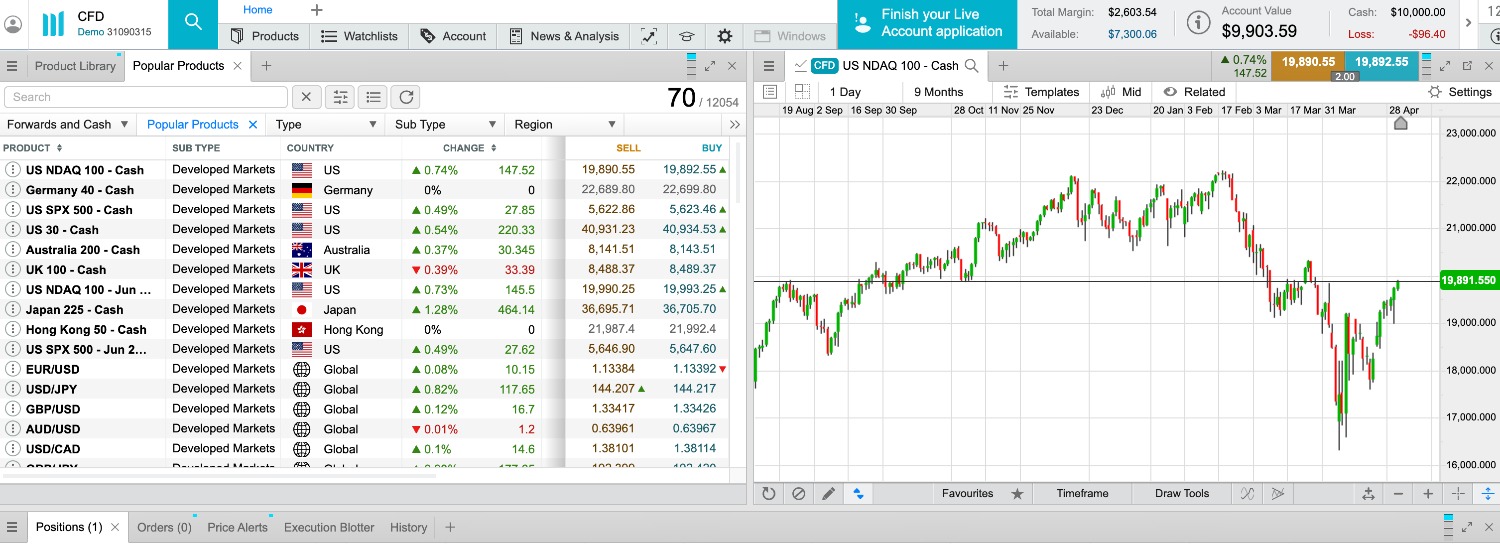
Typically, you can expect paper trading accounts with several thousands of simulated currency. For example, CMC Markets demo accounts have £10,000, Pepperstone accounts have £50,000, and eToro accounts have £80,000.
Often, brokers will permit clients to either reset their funds or create another demo day trading account when funding drops below a certain threshold. For instance, Plus500 automatically resets demo accounts once the virtual funds drop to less than £200. For this reason, the amount of virtual funds provided is not the most important factor when evaluating day trading demo accounts.
Assets & Instruments
If you already have an idea of what you want to day trade and how, for example, forex CFDs, then check the broker offers these instruments before signing up for a demo day trading profile. CFDs, spread betting and binary options are all popular among day traders in the UK.
If you do not yet know what you want to trade, opt for a well-rounded brokerage that offers demo day trading on a range of markets, from stocks and shares to metals, energies, and forex. XTB is a good pick here with more than 2000 assets available.
Restrictions
It is worth checking that the day trading strategies you want to use are permitted. For example, some firms do not allow scalping and arbitrage.
Equally, if you are planning to day trade with leverage, check the rules and availability around trading on margin. For example, most FCA-regulated brokers can only offer leverage up to 1:30 to retail traders in the UK.
Sign Up Requirements
To register for a day trading demo account, brokers require clients to complete a few steps. Usually, this involves providing a name, email address and password, however, some online brokers ask for more detailed information which can delay the sign-up process. For instance, Pepperstone requires clients to sign up for a live account before they can access the demo day trading mode.
Note, the brokers with the best demo day trading accounts do not ask for payment details until you register for a live account.
How To Sign Up For A Demo Account
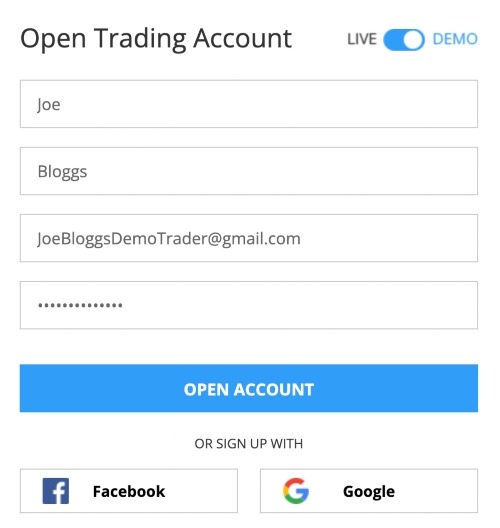
The best brokers with day trading demo accounts make it easy to register for a practice profile:
- Go to the broker’s website or investing app
- Click on the ‘Sign Up’ or similar button
- Enter your name, email, contact number, password and any other information requested
- Choose the platform you want to use, for example, MT4 or MT5
- Select the type of day trading demo account (if applicable), for example, CFD, forex, stock
- Complete any verification steps, such as email confirmation or one-time mobile passcode
- Download the desktop software or mobile app. Alternatively, open the web terminal
- Sign in with your demo credentials and start day trading
Note, the top demo day trading accounts allow you to get set up and started in less than five minutes.
How To Upgrade To A Live Account
To switch to a real-money day trading account, you may need to provide additional information such as documents showing proof of identification and address. You will also need to make a deposit, taking note of any minimum transfer requirements.
The process of switching to a live day trading account may also vary between brokers. At eToro, for example, you only need to click the ‘Switch to Real’ button on the homepage, deposit funds and start trading. At CMC Markets, you need to submit an online form to customer support to request a live account. At Pepperstone, day traders must complete an appropriateness test to determine if they can trade derivatives.
Bottom Line On Day Trading Demo Software
Day trading with a demo account is one of the best ways to build up experience while testing a prospective broker’s instruments, platforms and tools. The top-rated day trading simulator profiles offer mobile app compatibility, trading contests and no time limit.
To get started, use our ranking of the best demo day trading accounts in the UK.
FAQ
Where Can I Practice Day Trading?
You can practise day trading using an online demo account, also known as simulator software. Often free, a demo account comes with virtual funds so you can test out day trading strategies without making a deposit. Importantly, profits generated in the demo account cannot be withdrawn. There may also be a time limit and cap on the virtual bankroll, often around 30 days and £10,000, respectively.
Should I Open A Day Trading Demo Account?
Day trading simulators can be an effective way to trial a potential broker before investing real funds. Paper trading profiles can also be used to test the features of a new platform or app, such as technical indicators, risk management tools, and order types. For day traders new to a volatile market, such as crypto, demo accounts for day trading can also be a helpful way to try a new strategy before risking real money.
Which Is The Best Demo Day Trading Account?
The best demo day trading account will depend on your requirements. With that said, look for simulator accounts with a long expiry (30 days+), a large bankroll (£10,000+), and full access to the broker’s suite of instruments and trading tools, such as MT4 and MT5. Alternatively, choose from our list of the top day trading accounts for UK investors.
Do Day Trading Demo Accounts Expire?
Some brokers, such as FXPrimus, impose an expiration or time limit on demo day trading accounts, often around the one-month mark. Other platforms, including Forex.com and City Index, offer a longer demo period of three months and four months, respectively.
Note, the best demo brokerage accounts can also be reset when the expiry period is over.
What Can I Trade Using A Day Trading Demo Account?
A range of markets is usually available on day trading demo accounts, including forex, commodities such as gold, stocks, indices and ETFs. The selection of trading vehicles will also depend on the brokerage but often includes CFDs. Some UK firms also offer demo spread betting and binary options trading.
How Do I Open A Day Trading Demo Account?
To open a day trading demo account you will need to go to your chosen broker’s website and navigate to the demo account sign-up page. You will typically need to input some basic contact information, including your name, email address and chosen password. Then, download the desktop software or mobile app from the broker – you should see download links on the brand’s website for the Android and iOS applications.
Note, if you already have a live day trading account, no additional registration is required. Instead, just log into your account and request a paper trading profile.