Is Financial Spread Betting Tax Free in the UK?



For most UK individuals, profits from ordinary financial spread betting are normally tax free. A person placing spread bets speculatively with their own money will generally not pay Capital Gains Tax on the winnings, and the profits are not normally treated as taxable trading income either. HMRC’s position is that ordinary spread betting does not create chargeable capital gains, and a person placing spread bets is not normally carrying on a taxable trade. But there are exceptions and they are important.
The main HMRC guidance on the exceptions and when spread betting activity can potentially become taxable are:
HMRC Business Income Manual — Gambling and betting:
https://www.gov.uk/hmrc-internal-manuals/business-income-manual/bim22000
HMRC HS229 — Taxation of betting and gambling:
https://www.gov.uk/government/publications/gambling-taxation-hs229-self-assessment-helpsheet/hs229-taxation-of-betting-and-gambling-2024
HMRC Capital Gains Manual — Betting and gambling:
https://www.gov.uk/hmrc-internal-manuals/capital-gains-manual/cg78300
The key caveat is that the tax treatment can differ where the betting activity is part of a trade, employment arrangement, or another taxable transaction rather than ordinary personal betting.
The familiar statement that “financial spread betting is tax free in the UK” is therefore broadly correct for a private individual who engages in spread betting, but it needs some boundaries. Companies are treated differently. And spread bets entered into for a commercial purpose, such as hedging an existing business exposure, can also receive different treatment.
Tax residence matters too. The fact that it is a UK regulated firm that offers the spread betting account does not automatically make the winnings tax free in any and every country where the customer might live.
For the common UK retail case, though, the tax position is one of the main reasons financial spread betting still exists as a distinct and very popular product in the UK despite heavy competition from Contracts for Difference (CFDs). Two UK traders can take almost identical positions on the FTSE 100, GBP/USD, or a share price, generate the same £50,000 profit before tax, and finish with materially different after-tax results because one traded through a spread betting account and the other used CFDs.
What Does “Tax Free Financial Spread Betting” Actually Mean in the UK?
In the UK, ordinary individuals do not pay Capital Gains Tax on their financial spread betting winnings and the winnings are also not normally charged as trading income. That is different from saying spread betting exists completely outside every form of taxation. Providers themselves face taxes such as General Betting Duty. There are also special circumstances can move a customer’s spread betting into a taxable category.
HMRC’s Capital Gains Manual guidance on financial spread betting states that no assets are acquired or disposed of through a spread bet, so no chargeable gains or allowable (tax deductible) losses arise. HMRC’s separate Business Income Manual guidance on betting and gambling says that a taxpayer placing a spread bet is not normally carrying on a trade and is therefore not taxable on the profits or entitled to relief for the losses.
That treatment is different from buying and selling shares. If an investor buys shares for £20,000 and later sells them for £40,000, the £20,000 gain can enter the Capital Gains Tax calculation. If the investor instead makes £20,000 through ordinary financial spread betting on the movement of that share price, there is normally no disposal of an underlying asset and therefore no chargeable capital gain from the spread bet itself.
It is also different from carrying on an ordinary business. A self employed consultant earning £20,000 has generated trading income. A private individual making £20,000 from ordinary financial spread betting has not automatically generated taxable business income. Both activities made the same amount of money. But the tax follows the legal nature of the transaction.
So, Is Spread Betting Tax Free in the UK?
For most UK individuals using financial spread betting for ordinary personal speculation, yes. Profits are normally outside Capital Gains Tax, and the individual is not normally treated as carrying on a taxable trade simply because they place spread bets. HMRC also makes clear that being systematic, skilled or successful enough to earn a living from betting does not automatically change that position.
The price of that favourable treatment is that ordinary spread betting losses are normally useless for tax purposes. They cannot generally be claimed as capital losses against gains elsewhere. Companies do not receive the same treatment, and spread bets used for commercial purposes such as hedging can fall under different rules. Traders resident outside the UK also need to consider the rules where they are tax resident.
For a profitable UK retail trader, the difference can be substantial. A £100,000 spread betting profit may remain £100,000 after CGT under the ordinary treatment, while an equivalent £100,000 CFD gain could produce £23,280 of CGT for somebody whose taxable gain falls at 24% after the £3,000 Annual Exempt Amount.
That tax advantage is real. It is also narrower than the phrase “spread betting is tax free” makes it sound. The accurate version is that ordinary financial spread betting winnings are normally tax free for UK individuals, while the losses normally receive no tax relief.
Does an Individual Pay Capital Gains Tax on Spread Betting?
Under normal circumstances, no. An ordinary UK individual does not normally pay Capital Gains Tax (CGT) on financial spread betting profits. This is the clearest part of the answer because HMRC addresses the issue directly in its Capital Gains Manual.
That means a £10,000 spread betting profit does not normally use any of the individual’s Capital Gains Tax Annual Exempt Amount. The same applies to a £50,000 or £100,000 profit, assuming the activity remains ordinary personal speculation rather than falling into any of the exceptions we mentioned.
The Annual Exempt Amount for individuals is £3,000 for the 2026/27 UK tax year. The current general individual CGT rates are 18% and 24%, depending on the person’s taxable income and how much of the basic rate band remains available. HMRC’s Capital Gains Tax rates and allowances guidance confirms both the £3,000 exemption and the current rates.
Why even bring this up in our guide, since spread-betting is tax free under normal circumstances? Because it is relevant for a person who is trying to decide if financial spread betting or conventional trading or investing is the best course of action in their particular situation. The £3,000 exemption is relevant when comparing spread betting with CFDs, shares, and other types of trading or investing.
It is also important to remember that since the £3,000 exemption is not needed to cover spread betting profits, it remains available for other gains. Suppose an individual makes £30,000 from financial spread betting and also realises a £3,000 chargeable gain on an investment. Under the ordinary treatment, the £30,000 spread betting profit stays outside CGT while the £3,000 investment gain can potentially be covered by the Annual Exempt Amount. The person has generated £33,000 of economic gains but may have no CGT liability under these simplified assumptions. If the £30,000 profit had instead been generated through CFDs, the tax treatment would normally be different. For a private investor, gains from CFDs will generally fall within the Capital Gains Tax regime. The £30,000 CFD gain would therefore form part of the individual’s chargeable gains for the year and, together with any other chargeable gains, would be subject to the £3,000 Annual Exempt Amount. Assuming no other relevant gains or losses, £27,000 of the CFD gain would remain chargeable to Capital Gains Tax.
Does an Individual Pay Income Tax on Spread Betting Winnings?
So, we have already clarified that under normal circumstances, a private spread betting individual will not pay Capital Gains Tax on their spread betting profits. But what about income tax? Will my spread betting profits be taxed as income?
For most people placing spread bets privately in the UK, the answer is also no. HMRC states that betting and gambling, as such, do not normally amount to trading. Its guidance specifically says that a taxpayer placing a spread bet is not normally carrying on a trade, is not taxable on the profits and does not receive tax relief for losses.
This point matters because a common assumption is that somebody who makes enough money from spread betting will eventually become a “professional trader” and HMRC will automatically start charging Income Tax on the winnings. HMRC’s guidance does not support such a simple threshold. There is no published rule saying that earning £20,000, £50,000, or £200,000 from spread betting automatically converts the activity into taxable trading income. There is also no rule saying that placing a certain number of trades per day, developing a profitable system, or earning your living from betting automatically creates a taxable trade.
HMRC’s guidance on the professional gambler expressly says that having a system for placing bets, or being successful enough to earn a living from gambling, does not by itself turn the activity into a trade. HMRC notes that expertise and systematic activity are not enough on their own.
This does not mean that every spread-betting arrangement is necessarily outside Income Tax. HMRC’s general position is that a private individual placing a spread bet as a wager is not normally carrying on a trade. However, the treatment can differ where the spread betting forms part of a trade or is entered into for a commercial purpose, such as hedging. HMRC states that whether a particular spread bet is taxable depends on the terms of the contract and the economic substance of what is actually being done. For more information, see HMRC — BIM22020: Betting and gambling — spread betting and HMRC — BIM56900: Contracts for differences and spread betting.
The difference can be subtle. A private trader opening spread bets because they believe the FTSE 100 will rise is generally in the ordinary speculative category. A business using spread bets systematically to hedge foreign currency receipts generated by its commercial operations is doing something different. In the latter case, the spread bet can be considered a part of the economics of the underlying trade rather than being an isolated wager.
Does Full-Time Spread Betting Automatically Become Taxable For an Individual?
Full time activity alone does not automatically make spread betting winnings taxable. HMRC’s professional gambler guidance makes this point clear. Someone can be systematic, knowledgeable, and successful enough to support themselves through betting without that fact alone creating a taxable trading business.
A trader therefore should not assume that quitting a salaried job and trading spread bets every weekday instantly creates an Income Tax liability. Nor should they assume that calling themselves a “professional trader” on social media alters the tax position. Tax authorities tend to be more interested in the actual arrangement than the wording.
The qualification is that spread betting profits can become connected with a wider trade. HMRC says that where wins arise from the carrying on of a trade, rather than simply from an opportunity presented by that trade, they may be taxable. Whether this occurs depends on the contract and the economic substance of the activity. Someone whose spread betting activity sits close to another commercial operation should therefore be more cautious than an individual who simply trades markets from a personal account. Large profits or full-time trading are not, on their own, the deciding factor.
Relevant HMRC sources:
- HMRC — BIM22017: The professional gambler
https://www.gov.uk/hmrc-internal-manuals/business-income-manual/bim22017 This is the key source. HMRC expressly says that having a betting system or being successful enough to earn a living from gambling does not make the activity a trade. - HMRC — BIM22015: Betting and gambling — introduction
https://www.gov.uk/hmrc-internal-manuals/business-income-manual/bim22015 This provides the general rule. Betting and gambling as such do not constitute trading, and a taxpayer placing a spread bet is not normally carrying on a trade. - HMRC — BIM22020: Spread betting
https://www.gov.uk/hmrc-internal-manuals/business-income-manual/bim22020 This is the most relevant source for applying the principle specifically to spread betting. It explains that the tax treatment depends on the terms of the contract and the economic substance of what is done.
Is Spread Betting Tax Free for Companies?
No. A company should not assume the ordinary tax treatment available to individual spread bettors applies to it.
HMRC states that financial spread bets entered into by companies fall within the definition of contracts for differences for Corporation Tax purposes and will generally be dealt with under the derivative contracts regime. Its guidance on CFDs and spread betting for financial traders explains that the position for companies is different from that for individuals.
HMRC’s corporate finance guidance says that profits from company derivative contracts are generally charged as income, subject to the detailed rules and exceptions within the regime. Where the derivative is held for the purposes of a company’s trade, credits and debits can be treated as trading receipts and expenses.
Opening a spread betting account through a company will therefore not reproduce the familiar personal “tax free winnings” treatment. The legal label on the broker platform is less important than the tax rules applying to the entity entering the contract. This matters for traders considering whether to operate personally or through a company. The decision involves Corporation Tax, extraction of profits, expenses, accounting, and other issues.
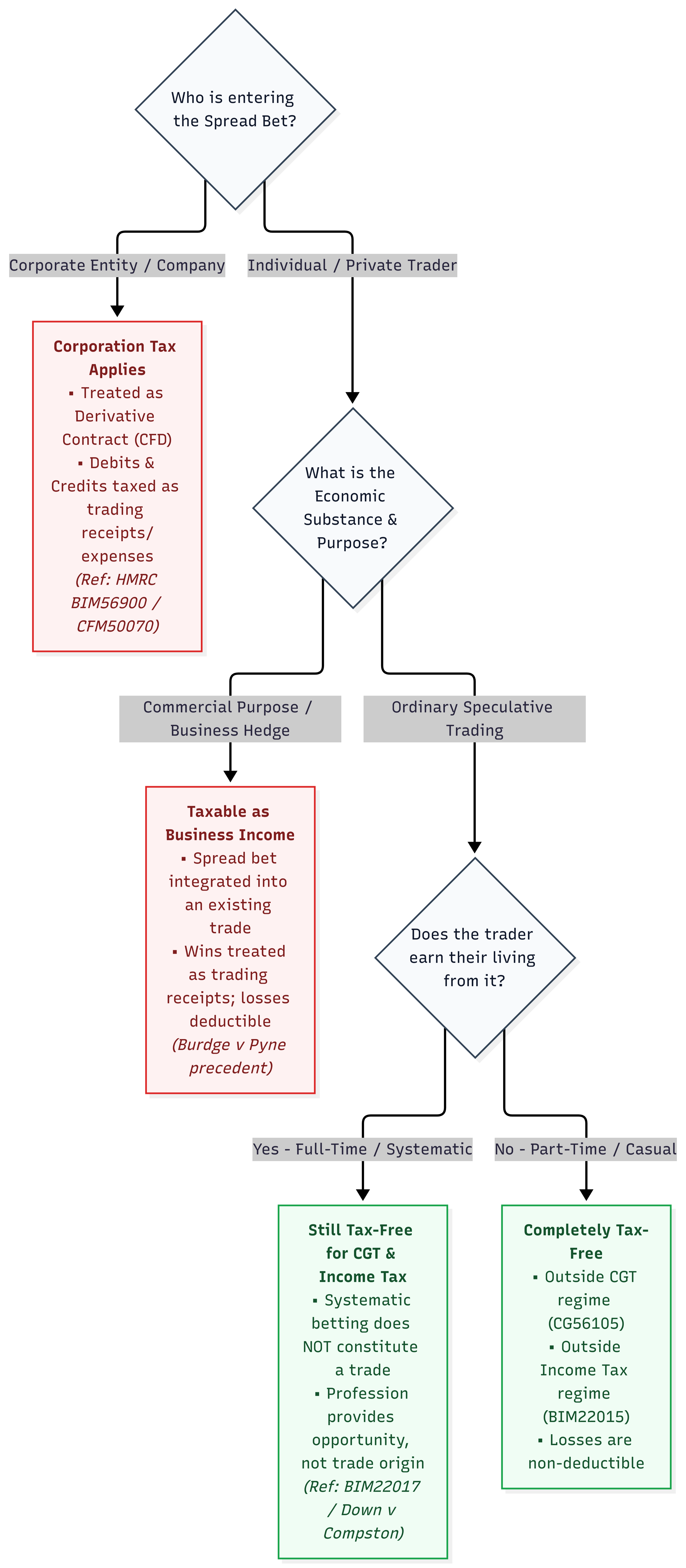
When do the “tax-free” status hold and when does it collapse into Corporation Tax or Trading Income.
HMRC’s spread betting guidance states that taxable treatment depends on the terms of the contract and the economic substance of what has been done. That makes generic “spread betting is tax free” statements unreliable for transactions attached to an existing business.
“The principles of Down v Compston [1937] 21TC60 and Burdge v Pyne [1968] 45TC320 (see BIM22019) apply equally to spread betting. To be taxable, the spread betting wins must come not merely from an opportunity presented by a trade, they must arise from the carrying on of that trade. Whether or not a particular spread bet is taxable will depend on the terms of the contract and the economic substance of what is done.” Source: BIM22020 – Meaning of trade: exceptions and alternatives: betting and gambling – spread betting
For a private investor placing directional bets with personal funds, the ordinary treatment is relatively clear. For commercial hedging, professional tax advice based on the actual transaction structure is a good idea.
The cases Down v Compston [1937] 21TC60 and Burdge v Pyne [1968] 45TC320 are not spread-betting cases themselves. They are older gambling cases whose principles HMRC applies to spread betting too. HMRC’s treatment of personal spread betting is rooted in the tax distinction between betting and carrying on a trade. Down v Compston established that betting winnings do not become taxable trading profits merely because a person’s trade provides the opportunity to place the bets. Burdge v Pyne illustrates the opposite situation. When gambling activity forms part of the business being carried on, the winnings can arise from that trade and therefore be taxable. HMRC applies these principles equally to spread betting. The question is therefore not simply whether someone bets frequently or makes a living from betting, but whether the particular spread bets arise from and form part of a taxable trade, having regard to the contract and the economic substance of the transaction.
Down v Compston [1937] 21 TC 60
The Down v Compston case concerns a professional golfer.
Mr Compston was a professional golfer attached to a golf club. He regularly played private games of golf in which money was wagered. He won substantial amounts from these bets. HMRC sought to tax the betting winnings on the basis that they arose from his professional golfing activities.
The court rejected that argument. The important point was that being a professional golfer created the opportunity to make the bets, but the betting winnings did not arise from the carrying on of his profession as a golfer.
In other words: The golf profession was the setting in which the bets occurred, but the bets were not themselves part of the business of being a professional golfer.
The court therefore did not treat the betting winnings as taxable profits from his profession.
This is the principle HMRC carries across to spread betting. HMRC’s current BIM22020 says that the betting wins must arise from the carrying on of the trade, rather than merely from an opportunity presented by the trade.
Why this matters for a spread bettor
Consider a professional financial adviser who also places personal spread bets.
This person is:
- financially sophisticated
- employed in finance
- professionally involved in financial markets
- able to use information obtained through their work
But these factors will not, by themselves, mean that the individual’s personal spread-betting profits are trading income.
The question is whether the spread betting is actually part of the person’s trade, rather than merely something the person’s trade happens to give them an opportunity to do.
That is the Down v Compston principle.
Burdge v Pyne [1968] 45 TC 320
Burdge v Pyne is the other side of the line.
Mr Pyne was the proprietor of a registered club. The club provided gambling facilities, including a card room. Mr Pyne regularly played three-card brag with members of the club and won substantial amounts.
The important facts were that:
- he owned and operated the club
- the gambling took place on the club’s premises
- he played with the club’s members
- the card-playing was part of the activities taking place at the club
- the gambling was connected with the business of the club
The court therefore concluded that his winnings from the card games were receipts arising from the carrying on of the club’s business. The court distinguished Down v Compston. The crucial difference was that in Down, the golfer’s professional activity merely provided an opportunity for private bets. In Burdge, the gambling activity was integrated into the business being carried on. The judgment explained that the club was a trade, and the card playing was part of the activities of that club.
Is Spread Betting Tax Free if It Is Used for Hedging?
Not necessarily. HMRC specifically identifies commercial hedging as an area where the ordinary treatment can cease to apply. Its guidance for individuals and other taxpayers outside Corporation Tax says gambling or wagering profits and losses are normally outside Income Tax, but that this treatment does not apply where a spread bet is used for a commercial purpose such as a hedge.
Suppose an individual runs a business receiving large amounts of revenue in US dollars and uses spread betting positions in GBP/USD to hedge that commercial currency exposure. Those trades have a different economic purpose from a retail trader speculating on sterling because they think the exchange rate will move next week.
Does Your Tax Residence Matter?
Yes. The favourable treatment described here concerns UK taxation. A person living and paying tax in another country cannot assume their spread betting profits are tax free simply because the broker is based in the UK and authorised by the Financial Conduct Authority (FCA).
Different jurisdictions can classify derivatives, betting income, and investment profits differently. Some may not recognise the same distinction between financial spread betting and CFDs that exists in the UK. A trader moving abroad can therefore keep the same broker, same positions, and same platform while changing their tax treatment substantially.
UK residence can itself become complicated for people who move during a tax year or spend substantial periods abroad. The sensible rule is not to treat “spread betting is tax free” as a feature permanently attached to the instrument. It is the result of the relevant UK tax treatment applying to a particular type of taxpayer and transaction.
Example: A French resident using a UK regulated provider for financial spread betting
Jean is a French citizen who lives permanently in France and is tax resident there. He opens an account with a UK-based provider offering financial spread betting and makes a £10,000 profit from betting on the FTSE 100.
The fact that the provider is based in the UK does not automatically make Jean’s £10,000 profit tax-free. The UK treatment of personal financial spread betting is relevant to UK taxpayers, but Jean is a French tax resident.
France generally taxes its tax residents on income from French and foreign sources, subject to applicable tax treaties. The relevant question for Jean is therefore how French tax law classifies his financial spread-betting profits, rather than how HMRC treats the same transaction for a UK resident.
The fact that the underlying market is the FTSE 100, the account is denominated in GBP, and the provider is based in the UK does not turn Jean into a UK taxpayer.
In other words, Jean should not reason: “HMRC normally does not tax personal spread-betting profits, therefore my £10,000 profit is tax-free.”
The correct question is: “I am tax resident in France. How does France classify and tax my financial spread-betting profits?”
This illustrates why “spread betting is tax-free” should not be presented as an inherent characteristic of the product. It is a consequence of the tax rules applicable to a particular taxpayer and transaction. A UK resident and a French resident can enter into substantially identical spread bets with the same provider while being subject to very different tax regimes.
Are Spread Betting Losses Tax Deductible in the UK?
Usually not. This is a part of the spread betting tax treatment that receives far less attention than the tax free winnings.
The same treatment that keeps profitable spread bets outside the tax system also means losses are normally outside it as well. If you lose £20,000 spread betting, you cannot usually claim a £20,000 capital loss and set it against profits in the capital gains category, such as profits from shares or CFDs. HMRC does not tax ordinary spread betting winnings, so it makes logic sense that the losses wont be deductible either. HMRC’s position is symmetrical. Because ordinary spread betting does not create chargeable gains, it also does not create allowable capital losses. A trader cannot normally take a £25,000 losing year in a spread betting account and subtract it from £25,000 of taxable capital gains made elsewhere.
Example: Suppose an investor sells shares and realises a £40,000 chargeable gain. During the same tax year, they lose £25,000 through ordinary financial spread betting. The economic position is a £15,000 net gain before other costs, but the capital gains calculation does not normally follow that economic result. The £25,000 spread betting loss sits outside capital gains tax (CGT), leaving the £40,000 investment gain to be dealt with under the normal capital gains rules. Assuming the full £3,000 Annual Exempt Amount remains available, the taxable gain would be £37,000. If the individual pays CGT at 24% on the full taxable amount, that produces an £8,880 tax bill.
Contrast that with a qualifying £25,000 CFD loss. CFD losses falling within the capital gains regime can normally become allowable capital losses. If the same £25,000 loss were available to offset the £40,000 gain, the gain would fall to £15,000 before the annual exemption. After deducting £3,000, only £12,000 would remain taxable. At 24%, CGT would be £2,880.
The £6,000 difference is the tax value of recognising the £25,000 loss at a 24% rate under these assumptions. The example does not mean CFDs are preferable for a trader who expects to lose money. There are usually easier ways to improve a tax bill than losing £25,000. But it does show that spread betting’s tax treatment has two sides.
Taxes: Spread Betting vs. CFD Trading
The examples below use the 2026/27 £3,000 Annual Exempt Amount and assume the trader is a UK resident individual using their own funds. They also assume no other chargeable gains or losses and, where stated, that the taxable CFD gain falls entirely at the 24% CGT rate. Real tax bills depend on the individual’s full tax position. (For the 2026/27 UK tax year, HMRC states that individuals pay 18% or 24% CGT on applicable gains. The 24% rate applies to gains falling above the basic-rate band.)
Similar economic exposure, very different tax treatment
Spread betting and CFDs can generate very similar economic exposure. A trader can go long or short the FTSE 100, GBP/USD, gold or a share price through either structure and arrange the position so that the monetary gain or loss from a given market move is nearly identical.
The UK tax treatment is where they separate. HMRC says ordinary financial spread betting creates no chargeable gains or allowable losses. Retail CFD outcomes, by contrast, normally fall within the capital gains regime for private investors unless another tax treatment applies. This means CFD profits can generate CGT, but CFD losses can also provide potentially useful capital loss relief.
For a trader who expects sustained profits well above the £3,000 Annual Exempt Amount, spread betting can provide a large after tax advantage. For a trader who already has sufficient capital losses to shelter CFD gains, the difference can be much smaller. For somebody generating trading losses while realising taxable gains elsewhere, the ability to recognise CFD losses can make the CFD structure more attractive from a tax standpoint. Tax is therefore not simply a choice between “tax free” and “taxable.” Spread betting largely removes both sides of the trading result from CGT. CFDs generally put both sides into it.
Example: £10,000 Spread Betting Profit
A £10,000 ordinary spread betting profit normally produces no Capital Gains Tax. Because the winnings are also not normally trading income, the trader retains the £10,000 before taking account of broker costs, financing and any unrelated taxes.
If the same £10,000 were generated through CFDs, the £3,000 Annual Exempt Amount would reduce the taxable gain to £7,000. A higher rate taxpayer paying CGT at 24% would incur £1,680 of tax and retain £8,320 after CGT.
A basic rate taxpayer may pay less. HMRC’s current CGT calculation uses the individual’s taxable income together with taxable gains to determine how much falls at 18% and how much falls at 24%. If the entire £7,000 taxable CFD gain fell at 18%, the CGT liability would be £1,260.
Example: £50,000 Spread Betting Profit
A £50,000 spread betting profit receives the same ordinary treatment as a £10,000 profit. There is no sliding threshold at which the first portion becomes tax free but the remainder suddenly falls into CGT. Assuming the bets remain ordinary personal speculation, the £50,000 profit is normally outside the capital gains calculation.
An equivalent £50,000 CFD gain would leave £47,000 after the £3,000 Annual Exempt Amount. At 24%, the resulting CGT bill would be £11,280, leaving £38,720 after CGT.
The tax difference is therefore £11,280 under those assumptions. At this profit level the wrapper can materially change the return retained by the trader.
Example: £100,000 Spread Betting Profit
The same reasoning applies at £100,000. Ordinary spread betting profits do not become taxable simply because they are large. HMRC’s guidance on professional gambling also makes clear that success sufficient to earn a living is not, by itself, enough to establish that a betting activity is a trade.
A £100,000 spread betting gain may therefore remain £100,000 after CGT under the normal individual treatment. A £100,000 CFD gain would leave £97,000 taxable after the £3,000 exemption. At 24%, that gives a CGT bill of £23,280 and an after tax CFD profit of £76,720.
Table
| Annual trading profit | Spread betting CGT | CFD CGT at 24% after £3,000 AEA | CFD profit after CGT |
| £10,000 | £0 | £1,680 | £8,320 |
| £50,000 | £0 | £11,280 | £38,720 |
| £100,000 | £0 | £23,280 | £76,720 |
Tax becomes more relevant as sustainable trading profits rise. A trader earning only a few thousand pounds through CFDs may already be protected by the Annual Exempt Amount. A trader making six figures faces a very different calculation.
What Happens If I Profit One Year and Lose the Next?
Tax timing creates another distinction between CFDs and spread betting in the UK. Suppose a trader makes £50,000 in year one and loses £50,000 in year two. Before costs, the economic result across the two years is zero.
If both results come from ordinary spread betting, the £50,000 first year profit is normally outside CGT and the £50,000 second year loss creates no allowable capital loss. The net economic result is zero and the CGT position is also zero.
If the results come from CFDs, year one can create an immediate tax liability. A £50,000 CFD gain for somebody whose taxable gains fall at 24% would produce £11,280 of CGT after using the £3,000 Annual Exempt Amount. The £50,000 loss arising in the following year may then become an allowable loss that can be carried forward for future use, but a later loss does not normally rewrite the previous year’s ordinary capital gains calculation.
The trader could therefore finish the two year period with no economic trading profit, an £11,280 tax payment already made and a pool of capital losses available against future gains. Those losses have value, but the cash timing is poor. Spread betting avoids that mismatch because the ordinary profits and losses remain outside CGT in both years.
Can Spread Betting Losses Be Carried Forward As Capital Losses?
No, ordinary spread betting losses cannot generally be carried forward as capital losses because they were never allowable capital losses in the first place. This is different from qualifying losses on CFDs, shares and other assets within the capital gains rules.
That distinction becomes particularly relevant after a large losing year. A person who loses £100,000 through spread betting has suffered a real £100,000 reduction in wealth, but ordinarily receives no £100,000 capital loss pool to use against future investment gains. A comparable qualifying CFD loss may have future tax value.
At a 24% CGT rate, £100,000 of fully usable allowable capital losses could potentially shelter gains that would otherwise generate as much as £24,000 of CGT. The actual value will depend on future gains, the Annual Exempt Amount, applicable rates and other losses. If the trader never makes taxable capital gains in the future, the loss pool may provide little practical benefit.
What if I Already Have Capital Losses?
A trader with substantial capital losses carried forward should not assume spread betting creates the same tax saving as it would for somebody starting with no losses.
Suppose an individual already has £100,000 of allowable capital losses from previous investments. If they make £50,000 through CFDs, available losses may be able to shelter much of the CFD gain under the normal capital gains rules. The immediate tax liability could be little or nothing, depending on the rest of the person’s gains and the rules governing the use of brought forward losses.
Making the £50,000 through spread betting would still keep the new profit outside CGT, but it would not necessarily save £11,280 that year because the CFD alternative may also have created no immediate tax bill. The person would preserve the existing losses for future use, so there is still an economic distinction, just not the simple one implied by saying spread betting “saves 24%.”
It is important to remember that tax treatment always needs to be compared against the person’s real portfolio. Scenarios featuring a hypothetical trader with no other investments, losses, or income rarely fits reality.
No Stamp Duty For Spread-betting and CFD trading
Financial spread betting does not involve acquiring the underlying shares or other securities. Consequently, Stamp Duty or Stamp Duty Reserve Tax that would ordinarily arise on an acquisition of chargeable securities does not arise merely from entering into the spread bet, because no acquisition of the underlying asset takes place. HMRC’s capital gains guidance describes precisely this structure: although spread betting terminology resembles the derivatives market, no underlying assets are acquired or disposed of.
This is another area where spread betting and CFDs are closer than they first appear. Ordinary CFDs also do not involve acquiring the underlying shares. A trader comparing spread betting with direct share ownership should therefore distinguish between tax on profits and transaction taxes connected with ownership.
The absence of Stamp Duty does not mean betting or trading is cost free. Brokers can charge through spreads, commissions in related products, overnight financing and currency conversion. A tax advantage can easily be reduced by poor execution or high financing costs, particularly on positions held for long periods. For longer-term investments, paying the one-time stamp duty can be better than paying ongoing financing costs for positions held overnight.
What Is General Betting Duty?
While ordinary spread betting winnings are generally tax free for the individual, the UK taxes the spread betting provider. For the 2026/27 tax year, financial spread bets are subject to General Betting Duty at 3% of the provider’s relevant net stake receipts.
This does not mean HMRC deducts 3% from every winning trade in a customer’s account. The General Betting Duty is imposed on the provider’s betting business, not as a personal 3% tax on individual winnings. HMRC’s General Betting Duty guidance describes spread betting as one of the activities for which betting providers may need to register, submit returns and pay duty.
While it is not the client who pays the duty directly, the 3% duty can still impact clients indirectly, since the provider has to recover the cost somehow, and that can influence pricing indirectly. But that is different from an individual spread-betting client receiving a £10,000 spread betting profit and having £300 automatically withheld as tax. Under the ordinary individual treatment, there is no such 3% customer charge.
Since Spread Betting is Taxed As Betting, Is It also Regulated By the Gambling Commission?
Financial spread betting sits in an unusual position in the UK. To a retail trader, it can look very similar to trading CFDs. You choose a market, take a long or short position, use leverage, and make or lose money according to movements in an underlying price.
Yet HMRC treats spread betting as betting for tax purposes, while the Financial Conduct Authority (FCA) regulates financial spread betting as a financial product. The Gambling Commission, despite regulating most forms of gambling in Great Britain, specifically excludes financial spread betting from its regulatory remit.
That combination can create considerable confusion.
For retail traders and punters, it is important to understand the distinction between tax treatment and financial service firm regulation. They are separate, but connected, questions.
Is financial spread betting regulated by the Gambling Commission in the UK?
No. The Gambling Commission itself expressly identifies spread betting as a type of gambling that it does not regulate. Its guidance states that spread betting which can include things like betting on stocks and shares is regulated by the Financial Conduct Authority.”
The Gambling Commission’s memorandum of understanding with the Financial Conduct Authority (FCA) is also explicit. It states that, under the Gambling Act 2005, the Gambling Commission regulates gambling in Great Britain except for spread betting.
Therefore, a financial spread bet on the FTSE 100, an individual share, a currency pair, or another financial market is not brought within Gambling Commission regulation merely because the transaction is described as a “bet”. A fixed-odds football bet and a financial spread bet may both involve the word “bet”, but they sit in different regulatory regimes.
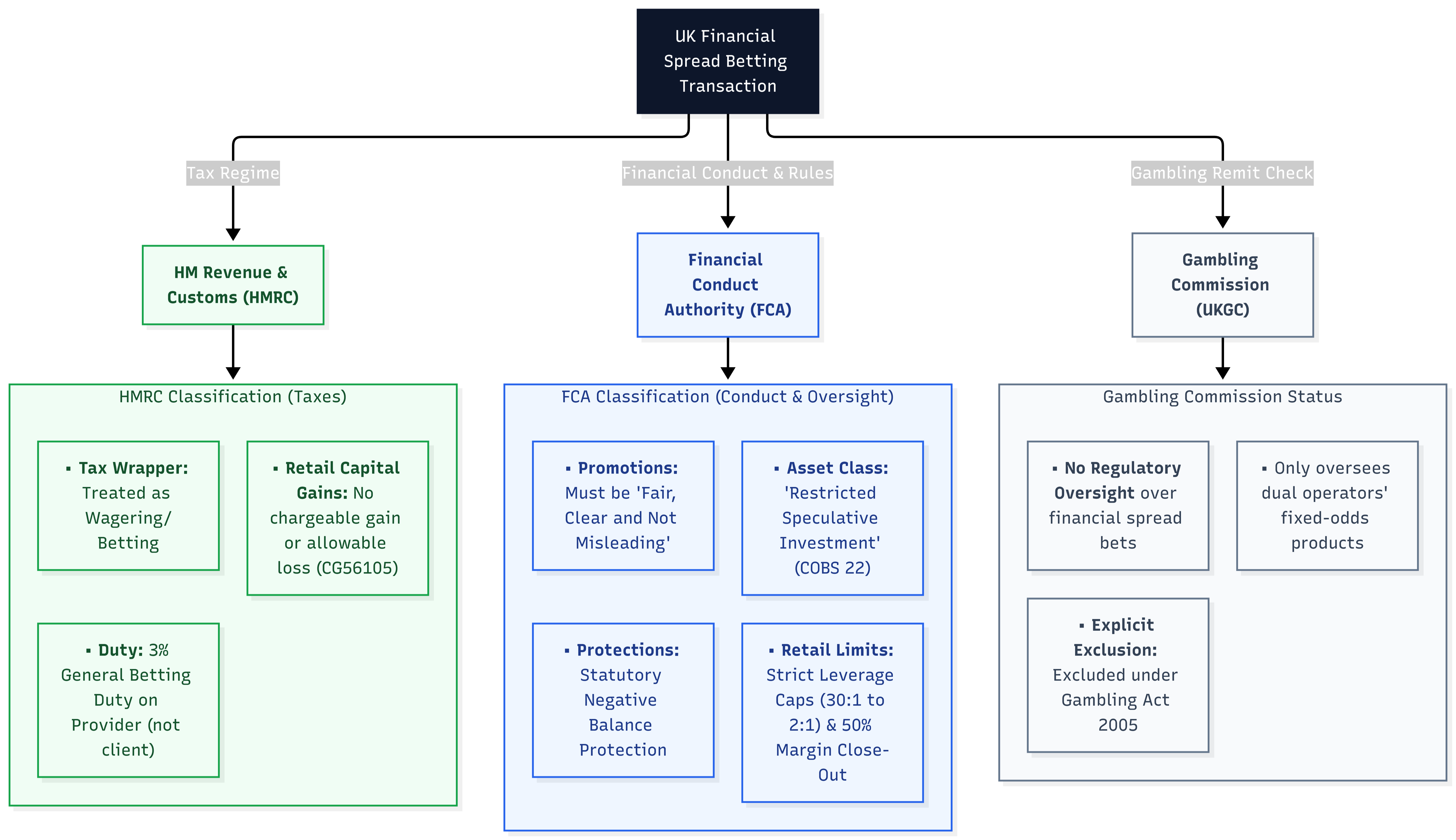
How HMRC, the Financial Conduct Authority (FCA), and the Gambling Commission divide oversight and taxation over financial spread bets without jurisdictional overlap.
Why does the FCA regulate financial spread betting?
Financial spread betting falls within the FCA’s financial regulatory perimeter. The FCA treats financial spread betting as part of the financial-products regulatory framework. Its guidance for firms (providers) states that its expectations apply to providers and brokers offering CFDs, spread betting, and rolling spot foreign exchange (FX).”
An FCA-authorised spread-betting provider is subject to financial-services rules concerning matters such as retail leverage, retail risk warnings, retail appropriateness, retail marketing, and several other retail-client protections.
But isn’t spread betting “betting” for tax purposes?
Yes it is.
HMRC’s Capital Gains Manual contains a specific section dealing with financial spread betting.
HMRC explains that, although the terminology resembles the derivatives market, the normal financial spread bet does not involve acquiring or disposing of the underlying asset.
“Though the terminology used in spread betting frequently echoes that of the derivatives market, no assets are acquired or disposed of and no chargeable gains or allowable losses arise from spread betting.”Source: HMRC, CG56105, “Futures: financial futures: financial spread betting”.
What does FCA regulation mean for advertising?
The FCA regulates financial services promotions for financial products and the FCA’s basic requirement is that financial promotions must be fair, clear and not misleading.
The FCA is regulating financial promotions in a very broad sense that is not limited to traditional advertising.
“Financial promotions or adverts are likely to be the most regular contact consumers have with firms that offer financial services and products. Financial promotions can take the form of a website, Facebook post, tweet, etc. They can form a significant part of a consumer’s product knowledge, and can influence a consumer’s decision making when choosing a product. It’s therefore very important that these promotions are fair, clear and not misleading, so that consumers can make informed decisions.” Source: FCA – Financial promotions and adverts
When does the Gambling Commission become relevant for the advertising?
Even though spread betting providers are regulated and supervised by the FCA and not by the Gambling Commission, the latter actually becomes relevant when we are talking about spread betting advertising since it is possible for a firm to offer both gambling and spread betting.
The financial products can fall within the FCA perimeter, while the conventional gambling products can fall within the Gambling Commission’s remit.
The UK Government’s gambling reform white paper makes this distinction explicit. It states:
“There are currently no products which are regulated both by the Commission and FCA but two operators are separately regulated by both organisations because they offer both spread betting and fixed odds betting products.” Source: Policy paper – High stakes: gambling reform for the digital age
The same company can be subject to both regulatory regimes without the same product being regulated by both regulators. A firm might therefore need to comply with FCA requirements when advertising its financial spread-betting service and Gambling Commission requirements when advertising its conventional betting service. The fact that the advertisements may appear on the same website, social-media account or brand does not erase the product-level regulatory distinction.