Forex Spread Betting



Forex spread betting is one of several methods that can be used to speculate on movements in currency pairs without buying or selling the currencies themselves. Instead of purchasing a certain number of euro currency units and paying with sterling, the trader places a monetary stake on each point of movement in an exchange rate. If GBP/USD moves in the expected direction, each point produces a profit based on that stake. If it moves against the position, each point produces an equivalent loss.
The structure is similar to the one you get from forex CFDs. Both forex CFDs and forex spread betting provide leveraged exposure to currency prices, both allow traders to go long or short, and neither involves actually buying or selling physical currency. In the United Kingdom, where financial spread betting is very popular, both financial spread betting (including forex spread betting) and CFD trading are regulated by the Financial Conduct Authority (FCA). Even though it is called financial spread betting, it is not regulated by the Gambling Commission.
For a UK individual, the biggest difference between forex spread betting and forex CFD trading is tax. A person placing ordinary spread bets is not normally carrying on a taxable trade, and financial spread betting does not normally create chargeable capital gains or allowable capital losses. This particular UK situation makes forex spread betting particularly relevant there. A trader can take exposure to a currency pair such as GBP/USD, EUR/USD, or USD/JPY in much the same way as through CFD trading, yet qualifying spread betting profits can normally remain outside Capital Gains Tax for an individual. The trade-off is that losses receive the same treatment: a £20,000 spread betting loss will not normally create an allowable capital loss that can be carried forward or used to offset taxable investment gains.
We should not allow the preferential tax treatment to distract us from the inherent risks associated with spread betting. Forex spread betting is leveraged. In the UK, FCA rules permit retail leverage of up to 30:1 on major currency pairs and 20:1 on minor currency pairs. Leverage will amplify both losses and gains, and relatively small exchange rate movements can create large movements in account equity. The wrapper can change the tax bill, but it does not make leveraged forex speculation less risky.
What Is Forex Spread Betting?
Forex spread betting is a derivative product that provides exposure to movements in a currency exchange rate without the trader buying or taking delivery of the underlying currencies. The spread-betting provider quotes buy and sell prices based on the underlying FX market, with a spread between them. The trader selects a stake representing the amount won or lost for each point (or pip) that the currency pair moves. The resulting profit or loss depends on the direction and magnitude of the price movement between opening and closing the position.
Consider GBP/USD quoted at 1.3500. A trader who expects sterling to strengthen against the US dollar can open a long spread bet. If the position is sized at £5 per point and GBP/USD rises by 20 recognised points, the gross trading profit is £100 before spreads, financing, and other costs. If the pair falls by 20 points instead, the trader loses £100. The exact definition of a “point” can vary between platforms because some brokers quote fractional pips, so traders need to check the contract specification before calculating risk.
A short forex spread bet works in the opposite direction. If the trader expects GBP/USD to fall, they sell the market. A decline in the currency pair generates a profit and a rise generates a loss. The ability to short a currency without physically borrowing currency is one reason leveraged derivatives have become widely used for short-term FX speculation. Of course, this can also be achieved through other derivatives, including forex CFDs, but they create a different tax situation for UK individuals.
With spread betting, you are not interacting with other traders on an open market. You are not selling GBP and getting paid in USD or vice versa. The bettor has a contract with the spread betting provider and the contract value references a GBP/USD exchange rate. Closing the position settles the monetary difference between the opening and closing levels according to the trader’s stake. That makes forex spread betting economically similar to a rolling spot forex CFD even though the legal and tax wrapper is different. In the UK, spread betting is therefore regulated and supervised by the Financial Conduct Authority (FCA) and not by the Gambling Commission.
How Forex Spread Betting Works
A forex pair expresses the value of one currency in another. GBP/USD at 1.3500 means one pound is priced at 1.35 US dollars. EUR/GBP at 0.8650 means one euro is priced at 0.865 pounds. Traders will not exchange either currency when spread betting. They are speculating on whether the quoted rate will rise or fall.
Each spread betting provider normally displays two prices. The lower price is used when selling and the higher price when buying. The difference between the two is the bid-ask spread. If GBP/USD is shown at 1.3500/1.3502, a trader buying immediately begins the position slightly below break-even because closing at the current sell price would realise the spread as a loss. The market needs to move sufficiently in the trader’s direction to recover that cost before the position becomes profitable.
This is why a forex spread betting strategy cannot be judged from directional accuracy alone. A trader may correctly predict that GBP/USD will rise and still make little money if the move is too small relative to spreads, slippage, and financing. Frequent traders feel that effect particularly strongly because they repeatedly cross the spread when entering and exiting positions.
Suppose a trader buys GBP/USD at an illustrative level equivalent to 1.3502 with a £10 per point stake. If the platform defines one point as 0.0001 and the closing sell price later reaches 1.3522, the position has moved 20 points in the trader’s favour. Gross profit is therefore £200. If the closing price falls to 1.3482, the 20-point adverse move produces a £200 gross loss.
The same position can be described in risk terms before it is opened. If the trader intends to close the position after a 25-point adverse movement and chooses £4 per point, the planned market risk is approximately £100 before slippage. At £20 per point, the same stop distance produces roughly £500 of planned risk. The currency pair has not become more volatile simply because the stake changed. But the trader has changed the amount of money attached to each unit of movement. This pounds per point convention is one of the practical attractions of spread betting. A trader can begin with the amount they are willing to lose and work backwards into position size. Forex CFDs usually require the same calculation through currency units or lots. Both routes can reach the same economic exposure, but spread betting often makes the monetary result more visible on the ticket and this can be appealing to beginners.
Pips, Points, and Forex Spread Betting Stakes
Forex terminology can be confusing because “pip” and “point” are not always used identically across platforms. Traditionally, a pip in most currency pairs (but not all) is the fourth decimal place (0.0001). A move in EUR/USD from 1.1000 to 1.1001 is one pip. For pairs that include the Japanese yen (JPY), a pip is traditionally the second decimal place (0.01). If USD/JPY moves from 150.00 to 150.01, that is a 1 pip movement. If USD/JPY moves from 150.00 to 150.25, that is a 25 pip movement.
That is the traditional way of measuring pips. However, on modern spread betting platforms, you will commonly see five decimal places instead of four for most currency pairs, and three decimal places instead of two for pairs that contain the Japanese yen. This allows the platform to display fractional pips rather than only full pip movements.
To add to the confusion, different spread betting providers can define their stake increments differently. One platform may treat the conventional pip as the relevant point for stake calculations, while another interface may display a finer increment. A trader should therefore consult the broker’s contract specification rather than assume that £10 per “point” means exactly the same monetary exposure on every platform.
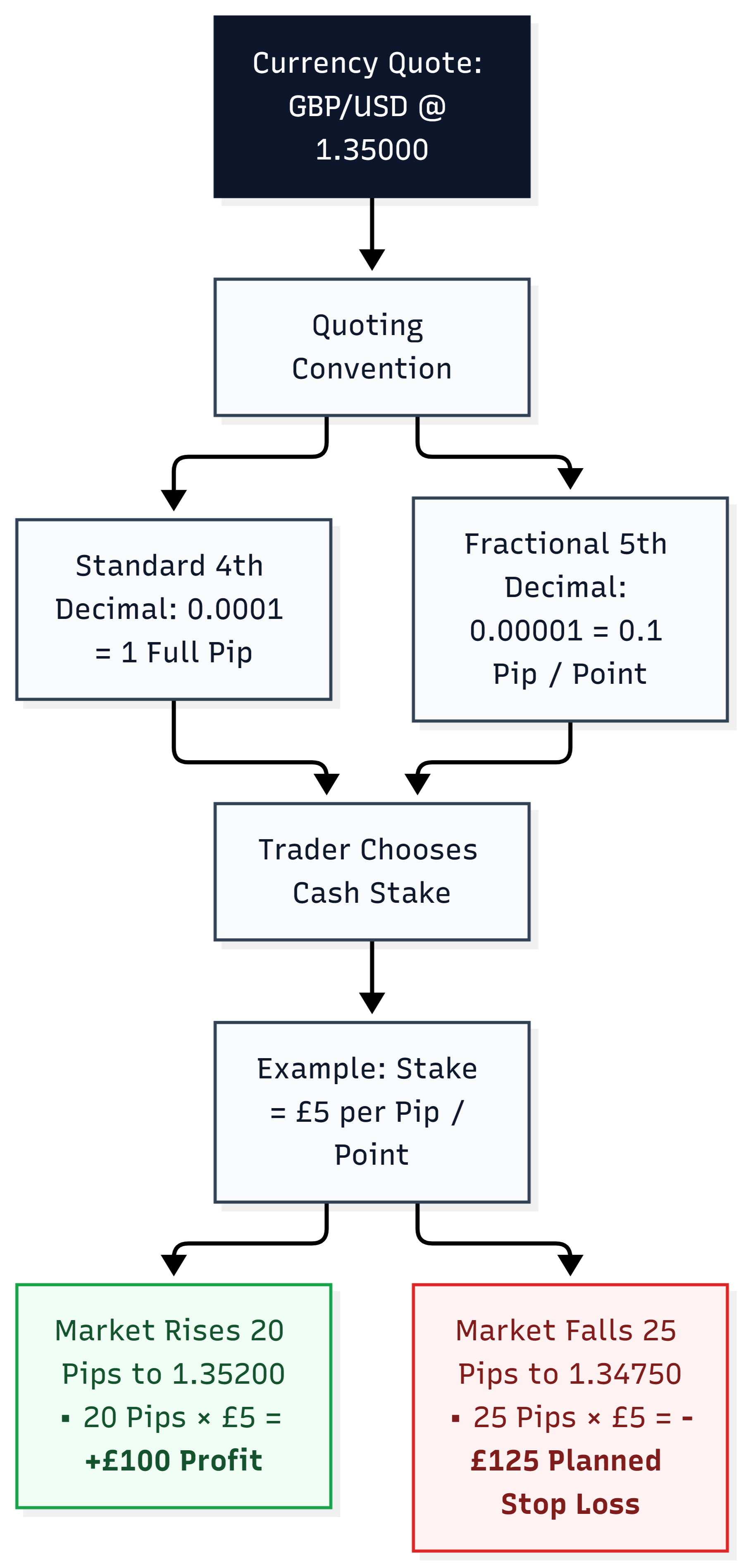
How currency quoting (4-decimal vs 5-decimal fractional pips) maps directly to monetary risk per pip
This matters when transferring strategies between accounts. A stop described as 20 pips in a trading plan needs to be converted into the actual pricing units used by the spread betting platform. Getting the conversion wrong by a factor of ten is not a subtle accounting error once the market starts moving. The safest calculation is based on the actual monetary loss shown by the platform at the intended stop level. If the trader wants to risk £200 and the planned stop represents 40 recognised points, a stake of £5 per point produces approximately £200 of market risk before slippage and charges. The calculation should then be checked against the trade ticket and margin requirement before the order is submitted.
Retail Protections: Leverage Caps, Margin Close Out, and NBP
The FCA Retail Protection Package
Forex spread betting combines two features that can produce large losses very fast: leverage and a market capable of moving sharply around economic and political events. Central bank decisions, inflation data, employment reports, elections, and unexpected geopolitical developments are all examples of factors that can move currency exchange rates extremely quickly. Standard stop-loss orders reduce planned risk, but cannot guarantee execution at that exact price during slippage or market gaps. (On some platforms, the trader can elect to use a special guaranteed stop-loss order, but that typically comes with an additional premium.)
For the purposes of its retail conduct regime, the FCA groups leveraged contracts for differences, leveraged spread bets, and leveraged rolling spot forex contracts together and uses “CFDs” as a collective shorthand in the prescribed risk warning applicable to those products. While the FCA distinguishes between these products for certain regulatory and permissions purposes, it has adopted a common regulatory framework for retail protections applicable to CFDs, spread bets, and rolling spot forex. For more information, see the FCA Handbook – COBS 22 – Restrictions on the distribution of certain complex investment products.
The FCA classifies leveraged spread bets as high-risk products and requires providers to publish standardised warnings showing the proportion of retail client accounts that lose money. The FCA also mandates strict leverage limits, margin close-out arrangements, and negative balance protection for eligible retail clients.
These protections are there to reduce certain forms of catastrophic damage. They do not turn forex spread betting into a low-risk activity and will not prevent a bettor from losing all the money in their account. A 30:1 leverage cap (for major FX pairs) or a 20:1 leverage cap (for minor FX pairs) still allows considerable exposure relative to deposited capital, and a trader does not need to use anywhere near the maximum permitted leverage to suffer a large loss even from a very small exchange rate movement.
Retail Forex Spread Betting Leverage in the UK
Forex spread betting is usually traded on margin, i.e. using leverage. You do not need to have £1,000 available in your account to gain exposure to a £1,000 position. This makes the product capital efficient, but it also magnifies both gains and losses.
The FCA rules require a retail client to post margin equal to at least 3.33% of the exposure for major foreign exchange pairs, corresponding to a maximum leverage of roughly 30:1. Minor currency pairs require at least 5% initial margin, equivalent to a maximum leverage of 20:1.
“COBS 22.5.1106/01/2021R
A firm must require a retail client to post margin to open a position of at least the following amounts:
Source: FCA Handbook – COBS 22 – Restrictions on the distribution of certain complex investment products
At 30:1 leverage, £1,000 of margin can support roughly £30,000 of market exposure. A 1% adverse move in that exposure represents £300 before costs, which is an immediate 30% loss relative to the £1,000 margin posted. A sufficiently large adverse movement can therefore consume a substantial portion of the trading capital even when the percentage change in the underlying currency pair appears modest.
The FCA’s own research illustrates the broader leverage problem. Its 2025 analysis of investment behaviour noted that the maximum permitted retail leverage for major FX pairs is 30:1 and that leveraged CFD positions can generate large losses from comparatively small changes in the underlying asset. Forex spread bets sit within the same restricted speculative investment framework.
Maximum available leverage should not be confused with sensible leverage. A broker allowing 30:1 does not mean every position should be sized at 30 times account equity. A trader using the full available margin leaves little room for ordinary market fluctuation before margin pressure becomes serious. The more useful calculation is the amount of money lost if the stop is hit, followed by the amount of margin required to maintain the position.
A trader with £10,000 of capital who risks £100 on a GBP/USD setup is taking a very different risk from another trader who uses nearly all £10,000 as margin simply because the platform permits it.
Retail Leverage & the 50% Margin Close-Out Rule
When a margin close-out occurs, a position or positions are closed automatically because the account balance has fallen far enough relative to required margin. Margin close-out is a risk control imposed at account level, not a substitute for the trader’s own stop or position sizing rules. A trader should not treat the broker’s compulsory margin close-out as the intended exit for an ordinary trade.
The mandatory 50% margin close-out rule is an account-level risk-control measure applying to UK retail spread betting accounts. It requires the provider to close a retail client’s open position(s) when the client’s net equity falls below 50% of the margin required to maintain those positions. Positions must be closed as soon as market conditions allow, but it is not always possible to close them at exactly the 50% threshold, since rapid market movements can cause severe liquidity gaps. Therefore, the 50% margin close-out rule is not a guaranteed floor preventing equity from dropping lower.
The 50% margin close-out rule applies to the whole account and not separately to each individual spread bet. The rule looks at the customer’s overall margin position across all open trades combined.
Alongside the other trader protection rules discussed in this section of our guide, the 50% margin close-out rule was initially introduced in 2018 as an EU-wide temporary retail CFD measure by the European Securities and Markets Authority (ESMA). It was subsequently made permanent in the UK by the FCA in 2019 and retained post-Brexit. Under FCA rules, these retail protections apply to several types of high-risk speculation, including leveraged forex spread betting.
In the information material published regarding their temporary measure, ESMA noted that margin close-out practices varied considerably between providers within the European Union, with some firms allowing customer funds to erode to 0–30% of required margin before triggering an exit. ESMA concluded that a standardised threshold was needed.
“Some NCAs reported to ESMA (22) that the level at which automatic margin close-out is applied is inconsistent across CFD providers (23). CFD providers with clients who typically trade at lower value order sizes, and who typically act as direct counterparty to the clients’ trades, have previously set the margin close-out rule between 0 and 30 % of initial margin required. By eroding the client’s funds close to 0, the provider is placing the client at increased risk of losing more money than they had invested. Some NCAs also observe that it is standard market practice to apply margin close-out on a per account basis (24). This means that minimum margin requirements are applied based on the combined margin required for all a client’s open positions connected to the CFD account, including across different asset classes. This allows profitable positions to offset losing positions across the client’s account.” Source: EUROPEAN SECURITIES AND MARKETS AUTHORITY DECISION (EU) 2018/796 of 22 May 2018
With a higher threshold for automatic margin close-out, a client’s trading account is less likely to be depleted to zero during periods of significant market volatility. Therefore, ESMA established the 50% margin close-out rule as a balanced standard, which is now firmly embedded in the FCA rulebook for leveraged spread betting.
Statutory Negative Balance Protection (NBP) For Retail Accounts
FCA retail protections apply to leveraged spread bets as part of the broader CFD product intervention framework, and eligible retail clients receive statutory negative balance protection (NBP). This means they cannot lose more than the total funds in the protected trading account. If the account balance drops below zero, the provider must absorb that deficit and cannot seek repayment from the retail client.
Negative balance protection provides an indispensable safeguard during extreme market volatility and weekend gap events. However, it is vital to understand the scope: NBP does not prevent you from losing your deposited funds; it only prevents you from ending up in debt to the broker. For instance, if an account has £10,000 and suffers a £15,000 loss during a sudden market crash, the entire £10,000 is lost, but the remaining £5,000 shortfall is absorbed by the provider.
In offshore or unregulated jurisdictions where NBP is not a statutory requirement, brokers may only offer contractual NBP, which frequently contains exclusions during volatile market conditions. Contractual NBP is not equivalent to FCA statutory protection, making regulatory jurisdiction a crucial factor when choosing where to spread bet.
Forex Spread Betting Costs
The headline attraction of spread betting is often tax, but trading costs determine how much of the pre-tax edge actually survives. Forex spread betting costs generally appear through the bid-ask spread, overnight financing, and, depending on the account, potential ancillary charges such as guaranteed stop premiums or currency conversion fees.
Spread
The spread is the primary transaction cost. If EUR/USD has an underlying market price near 1.1000 but the provider quotes a sell price below the buy price, the trader effectively pays that difference when entering and exiting. A strategy trading multiple times per day repeatedly crosses the spread, compounding costs rapidly. For high-frequency strategies with low average returns per trade, a tight spread is often far more important than the tax wrapper. Favourable tax treatment offers no benefit if trading friction erodes the entire gross profit.
Slippage
Execution quality and slippage directly influence net performance. The difference between the requested order price and actual filled price represents slippage. While major FX pairs are deeply liquid, market depth is not static. Spreads widen and liquidity thins during major macroeconomic data releases, central bank rate decisions, and the transition between trading sessions. Understanding that liquidity varies across the 24-hour trading cycle is essential for managing execution slippage.
Overnight Financing on Forex Spread Bets
Rolling forex spread bets incur overnight financing charges (rollover/swap) when held past the provider’s daily cut-off time (typically 10:00 PM UK time). The calculation reflects benchmark interbank interest rates, the interest rate differential between the two currencies, and the provider’s commercial markup.
Holding costs alter the break-even threshold over time. For a short-term intraday scalp lasting a few minutes, overnight financing is irrelevant. However, holding leveraged currency positions for weeks or months can accumulate substantial financing drag, potentially turning a winning market move into a net loss after financing. Traders should evaluate the broker’s complete overnight financing formula rather than relying solely on advertised headline spreads.
Is Forex Spread Betting Tax Free in the UK?
For individuals, forex spread betting is normally tax free in the UK
For most UK individuals making ordinary speculative financial spread bets, profits are normally free from both Capital Gains Tax and Income Tax. His Majesty’s Revenue and Customs (HMRC) states that a private taxpayer placing a spread bet is not normally carrying on a trade, is not taxable on the profits, and does not receive relief for losses.
Important HMRC sources:
- HMRC Business Income Manual BIM22015 — “Meaning of trade: exceptions and alternatives: betting and gambling – introduction”. HMRC states that a taxpayer placing a spread bet is not normally carrying on a trade, is not taxable on the profits, and does not receive relief for losses.
- HMRC Business Income Manual BIM56900 — “Financial traders – instruments and shares: contracts for differences and spread betting”. For individuals outside Corporation Tax, HMRC confirms that gambling and wagering contracts fall outside the scope of Income Tax, unless used for a commercial purpose.
Forex spread betting does not receive a separate tax rule merely because the underlying instrument is currency rather than shares or commodities. The standard financial spread betting tax rules apply equally across all asset classes. A private individual spread betting on GBP/USD, EUR/USD, or USD/JPY is assessed under the exact same tax rules as an index or commodity spread bettor.
Suppose a UK individual generates £25,000 from ordinary forex spread betting during the tax year. That £25,000 does not enter the Capital Gains Tax calculation and does not consume any of the £3,000 Annual Exempt Amount. Nor does it become taxable trading income simply because of transaction volume or success, provided it remains personal speculative activity.
Tax residency remains decisive. This tax exemption applies strictly to UK tax residents. If you are tax resident in another jurisdiction, foreign tax authorities will classify and tax derivative profits under their own domestic laws.
Forex Spread Betting Losses and Tax
The tax treatment is entirely symmetrical: because spread betting profits are not taxed, spread betting losses are not deductible. A £25,000 forex spread betting loss cannot be claimed as an allowable capital loss to offset capital gains made on shares, property, or CFDs.
This is the fundamental strategic difference between forex spread betting and forex CFDs. If an investor realises a £40,000 chargeable gain on shares and incurs a £20,000 loss in forex spread betting, the spread betting loss cannot reduce the share gain. In contrast, qualifying CFD losses can be offset against chargeable gains, providing a valuable tax shield. For investors with large taxable portfolios, non-deductible spread betting losses represent a significant hidden opportunity cost.
Does Full Time Forex Spread Betting Automatically Become Taxable?
No. Full-time trading does not automatically make spread betting winnings taxable. Earning your primary living or trading systematically from home does not, in itself, create a taxable trade under UK law. HMRC confirms that betting and gambling do not constitute trading, and BIM22017 establishes that skill, system, and expertise do not transform gambling winnings into taxable income.
When Spread Betting Is Connected To An Existing Commercial Trade
The primary exception occurs when a spread bet is connected to an existing commercial business or trade. HMRC dictates that taxable treatment depends on the economic substance of the transaction. If currency spread bets are used by a business or sole proprietor to hedge commercial exchange rate risk (e.g. hedging incoming US dollar receipts), the profits and losses arise from the carrying on of that commercial trade and become taxable as part of normal business trading profits.
When Companies Carry Out Spread Betting
Companies do not receive tax-free spread betting treatment. HMRC explicitly provides that financial spread bets entered into by corporate entities are classified as contracts for differences under the Corporation Tax Act 2009 and fall squarely within the derivative contracts regime (Part 7 CTA 2009).
Consequently, all corporate spread betting profits are taxable under Corporation Tax, and losses are treated as loan relationship or derivative debits. Operating a spread betting account through a limited company completely negates the personal tax exemption.
Do I Have To Pay The General Betting Duty On My Forex Spread Betting?
The fact that an individual’s spread-betting winnings are normally not subject to Income Tax or Capital Gains Tax does not mean that spread betting is entirely outside the UK tax system. Spread-betting providers can be liable to General Betting Duty on their spread-betting profits, in addition to other taxes that may apply to their business. For the 2026/27 tax year, financial spread bets are charged at 3% of the provider’s relevant net stake receipts. HMRC’s General Betting Duty guidance requires businesses offering spread betting from the UK to register, submit returns and pay the applicable duty.
This is a tax on the provider’s betting business, not a direct deduction from retail clients. An individual making a £10,000 gain does not have £300 withheld at source. However, providers naturally factor this 3% duty into their operational cost base, which can subtly influence the wider spreads or financing adjustments passed to traders.
Forex Spread Betting vs Forex CFDs
Forex spread betting and forex CFDs provide identical synthetic exposure to foreign exchange prices without physical currency delivery. Both provide long and short positioning, identical leverage parameters, and similar execution platforms.
UK tax for individuals
The primary divergence is UK taxation: spread betting profits are generally exempt from CGT and Income Tax, but losses offer no tax relief. In contrast, retail CFD profits fall within the Capital Gains Tax regime (taxed at 18% or 24% for 2026/27 above the £3,000 exemption), while qualifying CFD losses can offset capital gains elsewhere or carry forward indefinitely.
Regulation
Both instruments share the exact same regulatory oversight under the Financial Conduct Authority (FCA). Financial spread betting is not regulated by the Gambling Commission.
The FCA’s retail CFD framework applies identical restrictions across both products: 30:1 maximum leverage on major FX, 20:1 on minor FX, mandatory 50% margin close-out, and statutory negative balance protection.
How position size is expressed
Position sizing represents the practical operational distinction between the two:
- Spread Betting: Position size is quoted as a monetary stake per point/pip (e.g. £5 per point). Total P&L = Stake × Points Moved.
- Forex CFDs: Position size is expressed in standardized lots, units, or contracts (e.g. 100,000 EUR or 1 standard lot). P&L is derived from exchange rate fluctuation multiplied by total contract volume.
Pounds per point is intuitive for UK discretionary traders calculating direct sterling risk, whereas standardized currency lots fit better into automated trading algorithms and international multi-broker infrastructure.
Is Forex Spread Betting Better Than Forex CFDs In the UK?
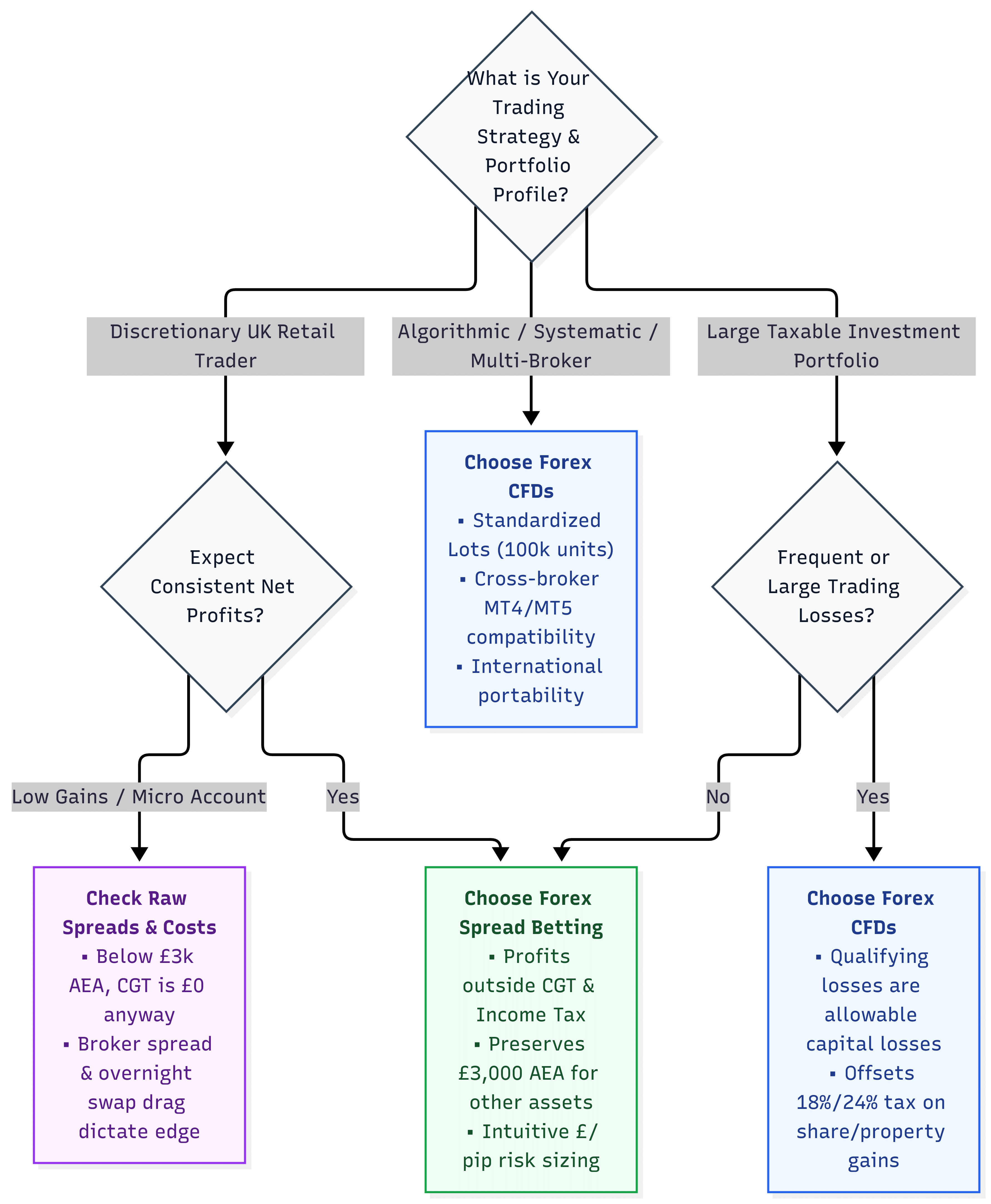
Visualizing the ultimate commercial decision for UK traders – evaluating whether tax exemptions, loss relief, platform interoperability, or execution costs should dictate product selection.
For a consistently profitable UK retail trader with no capital loss requirements, spread betting provides an undeniable tax advantage. Avoiding an 18% or 24% CGT liability on substantial annual profits directly boosts compounding returns.
However, CFDs are often superior if:
- You have substantial taxable capital gains elsewhere and value the ability to claim allowable loss deductions.
- You already carry forward large capital losses that can shelter CFD gains.
- You deploy algorithmic strategies requiring standardized lot sizing across international brokers.
- The CFD broker offers significantly tighter raw spreads and lower round-turn commission that outweigh the tax savings.
For long-term positional currency exposure, neither leveraged derivative is ideal due to ongoing overnight financing drag. In those scenarios, physical currency holdings, currency ETFs, or exchange-traded currency futures provide much cheaper carrying structures.
History and role of financial spread betting in the UK
Financial Spread Betting in the UK: From the Betting Shop to the Financial Markets
Financial spread betting is an established pillar of the UK retail trading ecosystem, with major brokers like IG, CMC Markets, and City Index offering markets across FX, indices, and shares. However, its historical origin is rooted in Britain’s unique post-war wagering culture rather than traditional City of London banking.
The story begins in 1964
While often attributed to the 1970s, the true pioneer was Coral Index, launched in 1964 by bookmaker Coral under the Betting and Gaming Act 1960. Coral Index allowed telephone clients—predominantly London Stock Exchange members—to wager on the FT-30 and Dow Jones indices on a point-stake basis, proving that financial market speculation could thrive inside a bookmaking framework.
Investors Gold and the birth of modern financial spread betting
The modern era began in 1974, when stockbroker Stuart Wheeler founded Investors Gold (later IG Index). Wheeler created a legal workaround allowing UK residents to speculate on surging gold prices at a time when exchange control regulations and Treasury rules strictly restricted private ownership of physical gold bullion. Quoting a buy and sell price with a cash stake per point established the modern financial spread betting blueprint.
Britain already had a sophisticated betting tradition
The passage of the Betting and Gaming Act 1960 legalized commercial off-course betting shops, embedding odds, stakes, and wager settlement into everyday British life. When financial spread betting expanded, retail participants already understood the fundamental mechanism: stake a cash amount on an outcome, gain if right, lose if wrong—without needing to navigate complex investment banking terminology.
The 1980s and 1990s
The 1980s financial deregulation and the launch of the FTSE 100 in 1984 transformed index speculation into mainstream news. Competitors like City Index (founded 1983) emerged, bringing retail capital into financial markets over telephone dealing desks.
The internet changed the scale of the industry
In 1998, IG launched the UK’s first online financial spread betting platform. Digital execution eliminated phone queues, enabled real-time streaming charts, and scaled retail participation dramatically. By 2012, industry research showed over 90,000 active UK spread bettors, vastly outnumbering domestic retail CFD accounts.
A British financial hybrid
Financial spread betting represents an extraordinary structural hybrid: economic exposure to global financial markets governed by the language of betting. As a result, UK individual participants enjoy the tax-free status of punters under HMRC rules, while benefiting from the strict regulatory conduct protections of the Financial Conduct Authority (FCA) rather than the Gambling Commission.