CFDs vs. Financial Spread Betting in the UK



In the United Kingdom, Contracts for Difference (CFDs) and financial spread betting can produce almost identical exposure to the same market. One trader buying £10 per point of the FTSE 100 through a spread bet and another trader opening an economically equivalent CFD position can make or lose roughly the same amount from the same movement in the index. They may even use the same broker, trade from the same platform, see near identical prices, and receive the same statutory retail leverage protections and limitations. From the trader’s point of view, the position may feel almost interchangeable while it is open. The distinction becomes more noticeable once factors such as tax, accounting, position sizing, and long term trading costs are considered.
A notable difference between the two is tax treatment. For most UK individuals using financial spread betting for ordinary speculative trading, profits do not normally create a capital gains tax liability. This also means that spread betting losses are not normally allowable capital losses and cannot simply be used to reduce taxable gains made elsewhere. CFDs take the more conventional investment route. Retail CFD gains will generally fall within the capital gains regime, unless the trader’s circumstances cause the activity to be taxed differently. When CFD gains are taxed as capital gains, qualifying CFD losses can generally become allowable capital losses. For a consistently profitable UK trader, that difference can be worth thousands or tens of thousands of pounds a year. For a trader carrying large capital losses or making losses alongside a taxable investment portfolio, the calculation can point in the opposite direction.
Tax is the reason spread betting receives so much attention in the UK, and CFDs are far more common outside the UK where tax regimes are different. With that said, tax treatment is not the only distinction between CFD and financial spread betting. Spread betting normally expresses risk in pounds per point or pounds per pip, whereas CFDs usually use units, lots, shares, or contracts. Pricing can differ between the two account types even when the underlying market is the same. Some brokers make certain instruments available through one structure but not the other.
One common misconception should also be cleared up before we proceed. The word “betting” can make financial spread betting sound like an ordinary gambling product that sits outside mainstream financial regulation. That is not how the UK regulatory framework treats it. The Financial Conduct Authority (FCA) regulates financial spread betting within its financial-services perimeter and, for its retail CFD regime, expressly groups leveraged spread bets alongside CFDs and rolling spot foreign exchange. The FCA’s CFD sector guidance and rules make this treatment clear.
Spread betting remains closely associated with the UK because its tax treatment and legal history are unusually favourable to individual speculative traders. But for a UK retail trader, the more useful question is not whether CFDs or spread betting are inherently better in all possible situations. Instead, it is whether the tax wrapper, cost structure, and trading mechanics of one product fit your specific intended activity better than the other.
CFDs vs Spread Betting in the UK at a Glance
| Feature | Spread betting | CFDs |
| Legal in the UK | Yes | Yes |
| FCA regulated | Yes | Yes |
| Investor gets ownership of underlying asset | No | No |
| Voting rights in underlying shares | No | No |
| Ordinary shareholder dividends | No | No, although cash adjustments may apply |
| Suitable substitute for long term ownership | Usually no | Usually no |
| Ability to go long and short | Yes | Yes |
| Retail leverage framework | Yes, under applicable FCA rules | Yes, under applicable FCA rules |
| Statutory negative balance protection (NBP) for retail clients | Yes, under applicable FCA rules | Yes, under applicable FCA rules |
| Typical position sizing | £ per point or pip | Units, lots, shares, or contracts |
| Capital Gains Tax for ordinary UK individual speculation | Generally no | Generally yes |
| Capital losses are tax deductible, when applicable | Generally no | Generally yes |
| Stamp Duty or SDRT on opening derivative | No | No |
| Overnight financing | Possible | Possible |
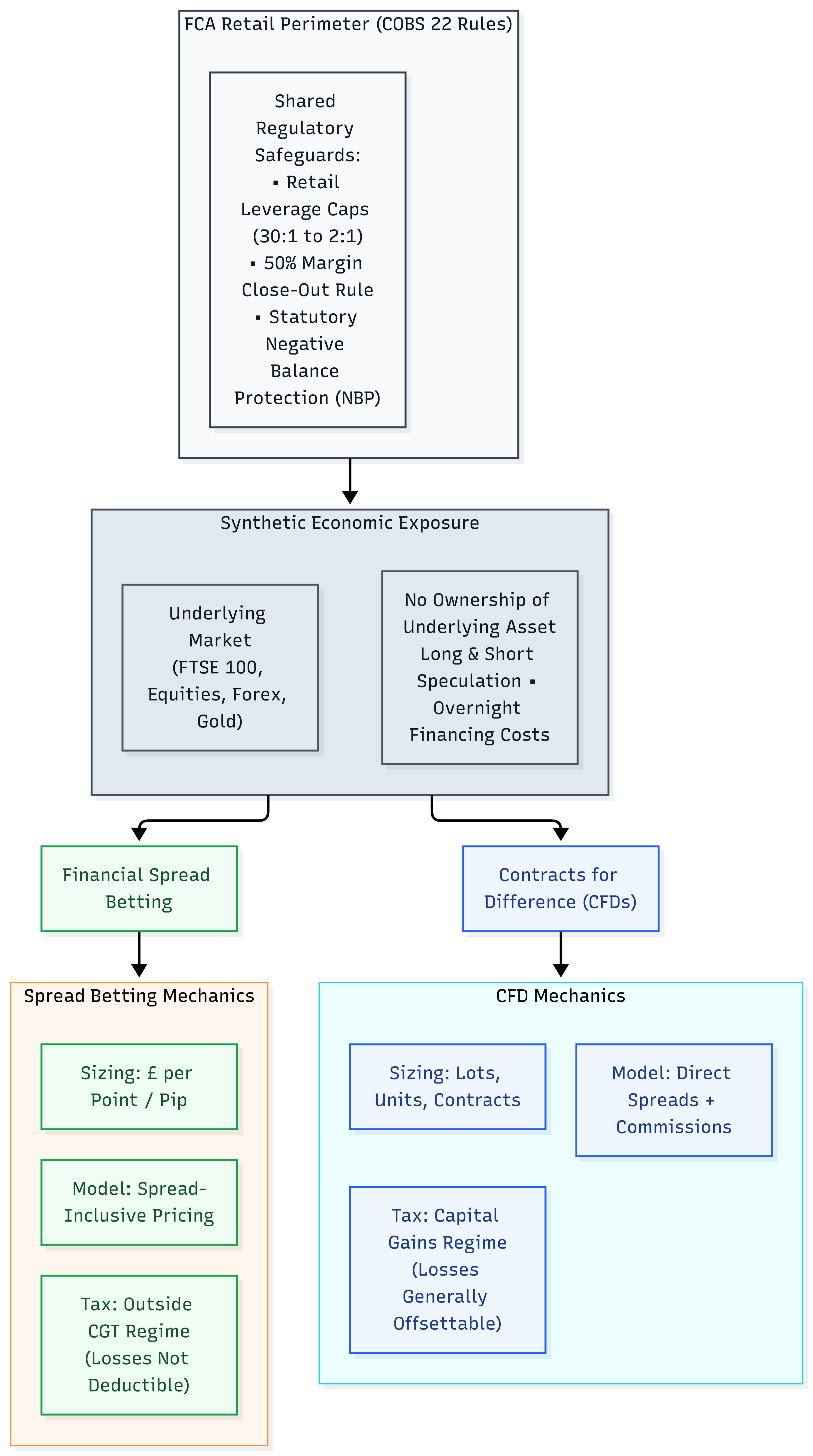
The regulatory hierarchy under the FCA (COBS 22)
The similarities are substantial. Both products are leveraged derivatives, both can create rapid gains and losses, neither makes the trader an owner of the underlying asset, and both sit inside broadly similar retail conduct rules when provided by an FCA regulated firm. The main separation appears in tax treatment, followed by the practical differences in sizing, pricing, market availability, and how easily the product fits into a trader’s broader operating setup.
What Is a CFD?
A contract for difference (CFD) is an OTC derivative that creates an agreement between a trader and a provider to exchange the economic difference in the value of a referenced asset or other underlying factor between the opening and closing of the position, subject to applicable costs and contractual adjustments. The trader does not acquire ownership of the referenced asset. If the reference price moves in the trader’s favour, the provider pays the resulting amount to the trader. If it moves against the trader, the trader owes the resulting amount to the provider. CFDs therefore allow both long and short exposure without requiring the trader to purchase or borrow the underlying asset. The underlying asset doesn’t even have to be an asset in the ordinary sense. CFDs can for instance reference stock indices, volatility indices, interest rates, weather variables, freight rates, and a wide range of other factors.
Example of CFD trading:
Suppose a trader opens a long CFD representing 1,000 shares at the share price £5. The economic exposure is £5,000, even though the trader does not spend £5,000 buying actual shares.
If the share price rises to £5.20 and the position is closed, the 20p increase across 1,000 units produces a gross gain of £200 before commissions, spreads, financing, and other applicable charges. If the share instead falls to £4.80, the same arithmetic produces a £200 loss. The trader has reproduced much of the price exposure of owning 1,000 shares without appearing on the company’s shareholder register and without receiving the legal rights that come with share ownership.
HMRC’s guidance on CFDs notes that long CFD positions can involve amounts equivalent to dividends and financing charges linked to maintaining leveraged exposure. These payments are contractual adjustments rather than ordinary dividends or interest arising from direct ownership. That distinction matters because a CFD may copy much of the economics of holding an investment while remaining a derivative for legal, tax, and accounting purposes. A trader can gain exposure to the movement of a company’s shares without acquiring the company itself in any meaningful ownership sense.
CFDs are widely used across international retail trading markets. Position size may for instance be expressed in shares, contracts, lots, or currency units depending on the product and broker. That can make CFDs easier to standardise across multiple brokers, trading systems, and countries. A strategy designed to trade 100,000 currency units or 20 index contracts has a familiar structure wherever conventional CFDs are used. UK spread betting reaches much the same economic destination, but does so through a different sizing language that is more particular to the UK market.
What Is Financial Spread Betting?
Financial spread betting allows a trader to speculate on a price movement without buying the underlying instrument.
This is how HM Revenue & Customs (HMRC), the UK´s tax, payments and customs authority, describes financial spread betting.
“Instead of buying and selling financial futures or options an individual may simply gamble on the future direction of prices or indices. There are a number of spread-betting companies in the UK with which such bets may be placed.
For example, you might choose to bet on movement in the FTSE 100. If the index stands currently at 5400, the company might offer a ‘buy’ price of 5401 and a ‘sell’ price of 5399; the difference is the company’s ‘spread’. Buying with a stake of £5 per point you win £5 for every point the then selling price exceeds 5401 when you close your bet, but lose £5 per point if the index instead has fallen. Similarly, if you bet on the market falling, you win if on closing your bet the then buying price is below 5399, but lose if the market has risen.
The spread-betting company normally requires only a small deposit. Winnings or losses may well exceed this sum.
Though the terminology used in spread betting frequently echoes that of the derivatives market, no assets are acquired or disposed of and no chargeable gains or allowable losses arise from spread betting, see CG11700.”
Source: CG56105 – Futures: financial futures: financial spread betting
One of the differences that immediately hits a trader used to CFD trading is the way the position is stated in UK spread betting. Instead of buying 1,000 units or opening a certain number of contracts, the spread betting trader usually chooses how many pounds they want to gain or lose for each point of market movement. This convention can make risk easier to judge for traders who think directly in cash terms rather than contract quantities, but it can require some adjustment for a trader who is more used to CFD trading.
Example: Suppose the FTSE 100 is quoted at 9,000 and a trader buys at £10 per point. If the relevant closing price reaches 9,050, the 50 point rise produces £500 before costs. A fall to 8,950 would produce a £500 loss.
The same logic applies to foreign exchange. A trader might risk £5 per pip on GBP/USD rather than buy or sell a fixed number of currency units. If the stop is 30 pips away, the rough market risk before slippage is £150. A CFD can reproduce the same exposure, but the trader may need to translate lot size, units, and pip value into the equivalent amount of sterling risk. Neither approach changes the underlying economics. Spread betting simply presents the calculation in a form many discretionary traders in the UK find easier to interpret.
This difference in interface can matter more than it first appears. A trader making fast discretionary decisions may prefer to see that every point is worth £2, £5, or £20 without converting contract quantities. A systematic trader may prefer CFDs because units and contract sizes fit more naturally into software, execution systems, and cross broker models. The difference is operational rather than financial. A poorly sized trade remains poorly sized whether the platform describes it as £10 per point or 100 contracts.
Are CFDs and Spread Betting Legal in the UK?
Yes. Both products are legal in the UK when supplied in accordance with the relevant regulatory framework. Financial spread betting occupies an unusual position legally, because its tax treatment looks more like wagering, while its financial regulation looks much more like the treatment applied to CFDs.
FCA Retail Protections Apply To Both
Traders sometimes erroneously assume that the word “bet” creates a separate, lightly regulated route to higher leverage or weaker customer protections, or that financial spread betting falls under gambling laws, but that is not the case. The FCA explicitly groups contracts for difference, leveraged spread betting, and rolling spot foreign exchange together for much of its supervisory work. A leveraged spread bet on the FTSE 100 is therefore far closer, from a regulatory point of view, to a CFD than it is to a bet on a football match. The permanent product intervention rules imposed on retail speculative leveraged products apply across the relevant category rather than granting financial spread betting any special exemption. The FCA has also warned consumers about firms encouraging them to reclassify as professional clients mainly to gain access to higher leverage, because professional status can mean surrendering important protections that retail clients receive automatically.
For UK retail clients, leverage is restricted according to the underlying asset, with maximum permitted levels ranging from 30:1 down to 2:1. Firms must apply a margin close out rule when account funds fall to 50% of the margin required for open positions. Qualifying retail clients have statutory negative balance protection (NBP) so they cannot lose more than the funds in the relevant account. Providers are also restricted in their use of monetary and non-monetary inducements designed to push retail clients into leveraged trading.
These protections make the risk profile of a retail spread betting account and a retail CFD account much closer than some broker marketing suggests. A spread betting account can not legally provide 1:500 retail leverage simply because the product is described as a “wager” instead of a “trade”.
Neither Product Gives the Trader Ownership
Buying a long CFD on BP shares is not the same as buying BP shares. Making a spread bet on BP shares is not the same as buying BP shares. Neither CFDs nor spread betting will give you legal ownership of the underlying asset.
In both cases, the trader holds a contract with the provider. The contract´s face value references the market price of the underlying shares. The trader is not placed on the shareholder register and does not receive normal voting rights through the derivative position.
Dividend-related adjustments can still occur, particularly on equity and equity-index positions, but these are contractual adjustments to the derivative position rather than ordinary shareholder dividends. The same basic principle applies to indices, commodities and foreign exchange. The trader takes economic exposure to movements in the reference market through a contractual relationship with the provider and does not acquire the underlying asset.
Understanding the lack of ownership is important for forex traders too. A trader who opens a long EUR/USD CFD or make a spread bet on the EUR/USD exchange rate is not buying euros and selling US dollars. Instead, the trader enters into a contract with the provider, and the value of the contract is linked to the EUR/USD exchange rate.
For example, if a CFD trader goes long in EUR/USD at 1.1000 and closes the position at 1.1100, the trader has made a gain based on the 100-pip increase in the reference exchange rate, subject to the position size, spread, financing, and other applicable charges. The trader has not, simply by opening the CFD or spread bet, acquired €100,000 and deposited it somewhere in exchange for US dollars.
The same applies to a short CFD position. A trader can speculate that EUR/USD will fall without borrowing euros, selling them for dollars and subsequently buying them back in the spot market. The provider’s contract creates the economic exposure to the movement in the exchange rate.
This is particularly relevant to retail traders because the quoted currency pair can make a CFD or spread bet look like a conventional spot FX transaction even though the legal structure is different. The trader has the provider as their counterparty instead of becoming a direct participant in the underlying foreign-exchange market.
- Buying EUR/USD in the spot FX market. The transaction involves exchanging one currency for another, creating an actual currency position.
- Going long EUR/USD through a CFD. The trader obtains derivative exposure to changes in the EUR/USD rate but does not acquire any of the underlying currencies.
- Going long EUR/USD through a financial spread bet. The trader obtains exposure to changes in the EUR/USD rate through a betting contract but does not acquire any of the underlying currencies.
Retail FX CFDs and financial spread bets can also involve overnight financing or rollover adjustments. These are contractual adjustments associated with maintaining the position and should not be confused with actually holding a conventional bank deposit in the purchased currency. The amount may reflect factors such as prevailing interest rates, the interest-rate differential between the two currencies, the provider’s funding costs, and/or the provider’s own financing methodology.
Retail Leverage Is Capped For Both Products
UK retail leverage rules remove much of the difference that once existed between leveraged products on the UK retail market. Under the current FCA framework, retail leverage caps run from 30:1 and down, depending on the underlying market. The product label does not give a provider permission to avoid those restrictions. Leveraged spread bets sit alongside CFDs and rolling spot foreign exchange for this purpose.
As always, it is important to understand exactly how leverage works before using it. If £1,000 of margin controls £20,000 of market exposure, a 2% adverse move in the underlying represents £400 before costs. That is only a modest movement in the underlying market but a 40% change relative to the trader’s £1,000 of margin. Calling the position a spread bet rather than a CFD does not make the mathematics kinder.
The relevant leverage caps are found in COBS 22.5.1106/01/2021R.
“COBS 22.5.1106/01/2021R
A firm must require a retail client to post margin to open a position of at least the following amounts:
- (1) 3.33% of the value of the exposure that the trade provides when the underlying asset is a major foreign exchange pair or relevant sovereign debt;
- (2) 5% of the value of the exposure that the trade provides when the underlying asset is a major stock market index, minor foreign exchange pair or gold;
- (3) 10% of the value of the exposure that the trade provides when the underlying asset is a minor stock market index or a commodity other than gold; or
- (4) [deleted]
- (5) 20% of the value of the exposure that the trade provides when the underlying asset is a share or an asset not otherwise listed in COBS 22.5.11R(1) to (4) above.
COBS 22.5.1201/09/2019G
For the purposes of COBS 22.5.11R, “exposure” means the total value of the exposure that the restricted speculative investment provides. Examples are set out below.
- (1) A firm offers a restricted speculative investment when the underlying asset is a 5 x leveraged index on gold. The value of the index is £800. The value of the exposure that the trade provides is therefore £800 x 5, or £4000; or
- (2) a firm offers a contract for differences where the underlying asset is a restricted option that references the FTSE 100. For this contract for differences, the value of the exposure that the trade provides is equal to the value of the underlying asset of the restricted option. For pricing the restricted option, the firm offers £1 of exposure for each point of the FTSE 100. Under these terms, if the retail client buys the contract for differences on a restricted option when the FTSE 100 is trading at 7070, the value of the exposure that the trade provides is £7070 (i.e. 7070 x £1).”
In other words, the highest retail leverage is ~30:1 and it is only permitted when the underlying is a major forex pair or relevant sovereign debt. For other categories, the cap is even lower.
| Underlying | Minimum margin | Maximum effective leverage |
| Major FX pair / relevant sovereign debt | 3.33% | ~30:1 |
| Major stock index / minor FX pair / gold | 5% | 20:1 |
| Minor stock index / commodity other than gold | 10% | 10:1 |
| Share / other qualifying underlying | 20% | 5:1 |
Retail NBP Is Present For Both Products
In the UK, both retail CFDs and retail financial spread-betting come with statutory NBP
The statutory negative balance protection (NBP) for retail accounts does not make leverage harmless, but it prevents retail clients from ending up owing the provider money when the market moves against their leveraged positions and positions can not be closed quick enough. If the account drops below zero, the provider must absorb that loss.
The rules regarding this statutory negative balance protection are found in COBS 22 – Restrictions on the distribution of certain complex investment products. More specifically, COBS 22.5.1701/08/2019R is the rule, while COBS 22.5.1801/08/2019G and COBS 22.5.1901/08/2019G provide guidance.
“Negative balance protection
COBS 22.5.1701/08/2019R
The liability of a retail client for all restricted speculative investments connected to the retail client’s account is limited to the funds in that account.
COBS 22.5.1801/08/2019G
COBS 22.5.17R means that a retail client cannot lose more than the funds specifically dedicated to trading restricted speculative investments.
COBS 22.5.1901/08/2019G
For the purposes of COBS 22.5.17R, funds in a retail client’s account are limited to the cash in the account and unrealised net profits from open positions. “Unrealised net profits from open positions” means the sum of unrealised gains and losses of all open positions recorded in the account. Any funds or other assets in the retail client’s account for purposes other than trading restricted speculative investments should be disregarded.”
Source: https://handbook.fca.org.uk/handbook/cobs22
COBS 22.5.17R–19G applies to both retail CFDs and retail financial spread bets, because both are within the FCA’s definition of “restricted speculative investments” when they meet the relevant criteria. The definition in the FCA glossary includes leveraged contracts for differences, leveraged spread bets, leveraged rolling spot forex contracts, and restricted options.
But I am using stop-loss orders, why should I care about NBP?
Stop-loss orders can be used for both CFD trading and financial spread betting. A stop-loss allows a trader to specify a level at which an open position should be closed if the market moves against them. With a standard stop-loss, once the trigger level is reached, the order becomes a market order and the position is closed at the next available price.
Under normal market conditions, this will usually result in the position being closed at or reasonably close to the specified stop-loss level. A standard stop-loss, however, does not guarantee the execution price. If the market moves rapidly, gaps through the stop level, or there is insufficient liquidity at that price, the position may be closed at a significantly worse price.
This raises an obvious question: If a trader places a stop-loss on every position, why should negative balance protection (NBP) matter? After all, the trader’s stop-loss may be positioned well before the account could theoretically lose all of its funds. In addition, the FCA’s retail margin-close-out rules require a provider to close one or more positions when the value of the funds in the client’s account falls to 50% of the total initial margin required for the client’s open positions. So, why would the account ever become negative?
The answer is that both mechanisms depend on the ability to close the position at or near an available market price. Under normal market conditions, a combination of appropriately placed stop-loss orders and the FCA’s 50% margin-close-out requirement will cause positions to be closed before losses become large enough to exhaust the client’s available funds.
But markets do not always behave normally. A market can gap sharply through a stop-loss level, particularly following significant news, an unexpected announcement, the reopening of a market after a closure, or during periods of extreme volatility. The provider may then be unable to execute the stop at the specified level because there are no executable prices there (not enough liquidity). The position will instead be closed at the next available price, potentially generating a much larger loss than the trader anticipated.
The same lack of liquidity can affect the margin-close-out mechanism. The 50% threshold is not a guaranteed maximum loss and does not mean that a position will always be closed while the account still has 50% of its margin. It is a legal requirement to order the position to be closed, but markets can move so rapidly that the available execution price changes substantially between the threshold being reached and the actual closing of the position.
This is true and relevant even for CFD trading and spread betting, despite the fact that your counterparty in the trade is your provider and not other traders on the open market.
NBP should not be viewed as a substitute for stop-losses, nor should stop-losses and the 50% margin-close-out requirement be viewed as a substitute for NBP. Stop-loss orders helps control losses under ordinary trading conditions, while the 50% margin-close-out requirement and statutory NBP provides an additional layer of protection against the possibility that exceptional market conditions prevent positions from being closed at the expected prices.
In short: Stop-loss protection is conditional on market execution. Negative balance protection is protection against the residual liability that can remain when market execution does not occur as expected.
Overnight Financing Can Make Both CFDs and Financial Spread Betting Poor Choices For Long Term Investments
Neither spread betting nor a leveraged cash CFD should be confused with owning an unleveraged investment portfolio. Long cash CFD positions normally incur financing charges when they are held overnight, and spread bets can impose comparable financing costs. The reason is simple. The trader receives market exposure that is larger than the amount of cash posted as margin, and that leveraged exposure has a funding cost. Broker formulas vary, but the economic idea is similar across the market. A position held for a short time may hardly notice the cost. A position held for 6+ months can accumulate a very different cost.
For individuals who want longer-term exposure to the stock market, it can be tempting to use CFDs or financial spread betting to avoid paying Stamp Duty. The UK stamp duty on shares is a tax charged when you buy certain UK shares and securities. The standard rate is 0.5% of the purchase price. For electronic transactions, this is usually collected as Stamp Duty Reserve Tax (SDRT) automatically through the settlement system. For example, buying £100,000 of qualifying shares would normally incur £500 of stamp duty. The tax generally applies to purchases of existing shares in UK-incorporated companies, although there are exemptions. Because CFD trading and financial spread betting does not involve actually purchasing the underlying shares, there is no Stamp Duty.
But the absence of Stamp Duty will not automatically make these derivatives cheaper than buying shares for long term ownership. Stamp Duty is a one-time transaction tax. Financing is an ongoing charge that will continue for as long as the leveraged position remains open. A trader intending to hold exposure for more than a short period of time should compare the full carrying cost with direct ownership rather than assume a derivative is cheaper because the initial cash requirement is lower.
While we are on the subject of Stamp Duty, it would be could to clear up another common misconception. In some marketing material for spread betting, you might find the claim that spread betting avoids tax while CFDs suffer both Capital Gains Tax and Stamp Duty. That is incorrect for ordinary retail CFD trading, because neither a CFD nor a financial spread bet involves buying the underlying share. HMRC specifically states that opening or closing a CFD does not create Stamp Duty or Stamp Duty Reserve Tax. Because no stock, marketable security, or other chargeable security is purchased. Its Stamp Taxes guidance for CFDs is explicit on this point.
Position Sizing And How Size Is Measured
UK Spread Betting
In the UK, spread betting normally describes a position in pounds per point or pounds per pip, which is easy to understand for discretionary traders. If a trader risks £2 per pip on GBP/USD with a 50 pip stop, the rough pre-slippage market risk is immediately visible at £100. There is no need to translate a contract quantity into sterling exposure to understand what the stop represents.
Example:
Market: GBP/US
Stake: £2 per pip
Stop-loss: 50 pips
So the potential loss (assuming the stop can be filled at the intended level) is £2 × 50 pips = £100.
Suppose GBP/USD is trading at 1.3500 and you go long at £2 per pip. You place your stop-loss 50 pips below your entry.
- Entry: 1.3500
- Stop: 1.3450
- Distance: 50 pips
- Stake: £2/pip
If GBP/USD falls from 1.3500 to 1.3450 and your stop is executed there, your approximate loss is 50 × £2 = £100.
If the trade instead moves 100 pips in your favour, your approximate profit would be
100 × £2 = £200
The £/pip stake directly tells you the monetary impact of each pip, so the 50-pip stop immediately translates into roughly £100 of market risk without requiring you to calculating the notional contract size.
CFD Trading
CFDs normally use contract quantity, lots, shares, or units. That may look less intuitive to a spread betting trader accustomed to cash risk, but it often fits better with global professional and systematic trading infrastructure. Software can size positions in 100,000 currency units, 2,500 share CFD units, or a certain number of index contracts and reproduce the same logic across several brokers or jurisdictions. The CFD format is more familiar outside the UK, which can matter to traders who, for instance, want to use foreign brokers or run automated execution systems.
This does not mean that conventional CFD measurements somehow automatically produce better (or worse) returns. The economic reality is the same regardless how it is expressed. Both conventions express the same exposure, but for a particular trader one convention might suit their workflow and preferences better. Spread betting is often easier to read manually. CFDs can be easier to standardise.
Spread Betting and CFD Tax Treatment in the UK
In the UK, tax treatment is the feature that separates spread betting most clearly from CFDs. For an ordinary UK individual making speculative financial spread bets with their own money, profits will generally fall outside the Capital Gains Tax (CGT) regime. HMRC states in its financial spread betting guidance that, in the ordinary case, no chargeable gain or allowable loss arises. That means a profitable spread bettor may receive the full economic gain without a CGT charge. That also means that the same trader cannot normally use losses from spread bets to offset taxable capital gains made elsewhere. For a trader with sizeable capital gains made elsewhere, and sizeable spread-betting losses, this can be a major drawback.
CFDs sit on the other side of that tax treatment. HMRC’s guidance on contracts for difference states that retail CFD results will ordinarily fall within the capital gains regime unless the facts are such that the activity is taxed as trading income. For a typical private investor, that means profitable CFD trading can create chargeable gains, and CFD losses can generally be used to offset taxable capital gains made elsewhere.
For the 2026/27 UK tax year used throughout the examples in this section of our guide, individuals have a Capital Gains Tax Annual Exempt Amount of £3,000. General CGT rates are 18% and 24%, with the applicable rate depending on taxable income and how much of the basic rate band remains unused. HMRC’s current figures are set out in its Capital Gains Tax rates and allowances guidance. The examples below assume a UK resident individual trading speculatively with their own funds, not through a company, and not in circumstances where the activity amounts to a taxable trade. They also assume the full £3,000 Annual Exempt Amount remains available unless stated otherwise.
CFD vs. Spread Betting Tax Examples
The short-hand phrase “spread betting is tax free” is useful for many UK individuals, but it can hide how the details actually works, and make CFDs look worse than they actually are from a retail trading tax perspective. CFD gains are not automatically taxed at 24% from the first pound. The £3,000 Annual Exempt Amount, unused basic rate band, existing losses, and other chargeable gains can all change the bill. A trader making £10,000 from CFDs may face a relatively modest tax cost. A trader making £100,000 may see a much larger difference. And that same tax structure becomes less attractive when the trader is losing money, because spread betting losses are typically not allowed to be deducted when you do your CGT calculation.
Examples: £10,000 Annual Trading Profit
Consider two traders who make exactly £10,000 from the same market movements. Trader A uses financial spread betting and Trader B uses CFDs.
Under the ordinary individual treatment, Trader A’s £10,000 spread betting profit remains outside the capital gains calculation, so the CGT bill is £0 and the entire £10,000 remains after CGT. The £3,000 Annual Exempt Amount has not been used because the spread betting profit never entered the capital gains calculation in the first place. The trader still have that allowance available against other chargeable gains made during the year.
For a higher rate taxpayer making the same £10,000 through CFDs, the starting gain is reduced by the £3,000 Annual Exempt Amount, leaving £7,000 taxable. If the entire amount falls within the 24% CGT rate, the tax bill is £1,680 and the trader retains £8,320 after CGT. The practical spread betting advantage in this simplified case is therefore £1,680, not 24% of the full £10,000.
| £10,000 annual profit | Spread betting | CFD |
| Gross profit | £10,000 | £10,000 |
| CGT exemption used | £0 | £3,000 |
| Taxable gain | £0 | £7,000 |
| CGT | £0 | £1,680 at 24% |
| Profit after CGT | £10,000 | £8,320 |
That same £10,000 CFD gain could produce a lower tax bill for somebody still within the basic rate band. Assume taxable income of £20,000 after allowances. With the 2026/27 basic rate band at £37,700 of taxable income, £17,700 remains available. After applying the £3,000 Annual Exempt Amount, the £7,000 taxable CFD gain fits entirely inside that unused band. At an 18% CGT rate, the liability becomes £1,260, leaving £8,740 after CGT. For this trader, spread betting avoids £1,260 rather than £1,680.
Examples: £50,000 Annual Trading Profit
At £50,000 of annual profit, the difference becomes much more noticeable. A £50,000 spread betting gain made by an ordinary UK individual remains outside the normal capital gains calculation under the assumptions used here, leaving £50,000 after CGT. The Annual Exempt Amount remains available for other chargeable investments because the spread betting result did not consume it.
A higher rate taxpayer producing the same £50,000 through CFDs starts with the £50,000 gain and deducts the £3,000 Annual Exempt Amount. That leaves £47,000 chargeable. If the full amount falls at 24%, the CGT bill is £11,280 and the trader retains £38,720 after CGT. At this profit level, the tax wrapper is no longer a minor line item. Two traders can generate the same trading P&L before tax and finish the year more than £11,000 apart after tax because one used spread betting and the other used CFDs.
| £50,000 annual profit | Spread betting | CFD |
| Gross profit | £50,000 | £50,000 |
| Annual Exempt Amount | Not required | £3,000 |
| Taxable gain | £0 | £47,000 |
| CGT at 24% | £0 | £11,280 |
| Profit after CGT | £50,000 | £38,720 |
The calculation changes again if the CFD trader has £20,000 of taxable income and therefore £17,700 of the basic rate band still available. After the £3,000 exemption, the £47,000 taxable gain is split between the 18% and 24% rates. The first £17,700 produces £3,186 of CGT. The remaining £29,300 produces £7,032 at 24%, taking the total tax bill to £10,218 and leaving £39,782 after CGT. Spread betting still produces £50,000 after CGT under the stated assumptions, so the tax difference is £10,218.
Examples: £100,000 Annual Trading Profit
A £100,000 spread betting profit remains £100,000 after CGT under the ordinary individual speculative treatment used here. There is no chargeable capital gain and the £3,000 Annual Exempt Amount remains untouched for use elsewhere.
For a higher rate taxpayer making £100,000 through CFDs, the £3,000 Annual Exempt Amount reduces the chargeable amount to £97,000. At 24%, the CGT liability is £23,280, leaving £76,720. The difference between the two products is therefore £23,280. If execution, spreads, commissions, and financing were equal, that would be a very substantial economic advantage to the spread betting structure.
| £100,000 annual profit | Spread betting | CFD |
| Gross profit | £100,000 | £100,000 |
| Annual Exempt Amount | Not required | £3,000 |
| Taxable gain | £0 | £97,000 |
| CGT | £0 | £23,280 |
| Profit after CGT | £100,000 | £76,720 |
The same £100,000 CFD gain produces a slightly lower bill if the trader begins with £20,000 of taxable income and has £17,700 of basic rate band remaining. After the £3,000 exemption, the taxable gain is £97,000. Taxing the first £17,700 at 18% produces £3,186. The remaining £79,300 at 24% produces £19,032, taking total CGT to £22,218. The trader retains £77,782 after CGT, compared with £100,000 under the spread betting assumptions. Again, the spread betting advantage is substantial, but it is not calculated by simply applying 24% to the original £100,000.
Comparing the Three Profit Levels
The pattern is fairly simple for a trader whose chargeable CFD gains all fall at 24%. At £10,000 of profit, the £3,000 exemption shields a material part of the gain. At £50,000, the exemption is much less important in percentage terms. At £100,000, most of the profit sits inside the taxable calculation and the difference becomes large.
| Annual trading profit | Spread betting CGT | CFD CGT | CFD profit after CGT | Spread betting tax advantage |
| £10,000 | £0 | £1,680 | £8,320 | £1,680 |
| £50,000 | £0 | £11,280 | £38,720 | £11,280 |
| £100,000 | £0 | £23,280 | £76,720 | £23,280 |
These figures assume the full £3,000 exemption is available and there are no other capital gains affecting the calculation. They also show why the phrase “spread betting saves 24% tax” can be misleading. The saving depends on the taxable portion of the CFD gain, not simply the headline profit. More importantly, the direction of the advantage changes once losses enter the picture.
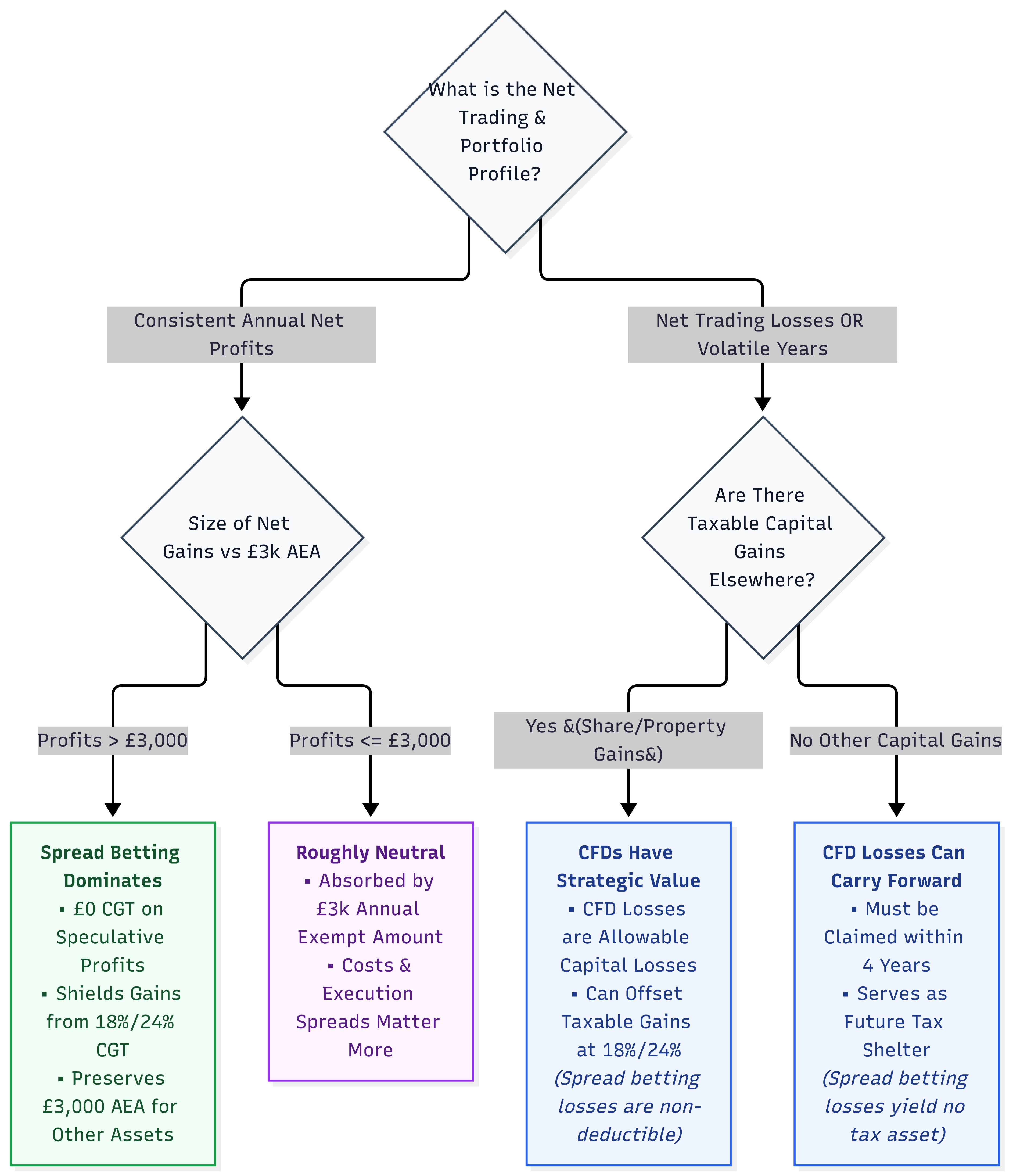
Why “tax-free” is not universally superior
The Tax Cost of Losing Through Spread Betting
The same rule that keeps ordinary spread betting profits outside CGT also keeps the losses outside. This is where the apparent tax advantage becomes less one-sided. HMRC explains that an individual will normally not be able to deduct ordinary financial spread betting losses from taxable gains made on shares, funds, property, or CFDs. A losing spread bet is economically real, but it does not produce a deductible loss.
Suppose a trader loses £10,000 through financial spread betting. There is no ordinary allowable capital loss to carry into another capital gain. If the trader also realises £20,000 of chargeable gains elsewhere, the £10,000 spread betting loss does not reduce those gains to £10,000. It remains outside the calculation. A CFD loss can receive a different treatment because a qualifying CFD result generally sits within the capital gains rules.
What Happens With a £10,000 CFD Loss?
A £10,000 CFD capital loss does not create an immediate £2,400 tax refund. Capital losses are not cash credits from HMRC. Their value comes from the ability to offset qualifying chargeable gains. Unused losses can generally be carried forward after being claimed correctly, and HMRC states that losses can normally be claimed within four years after the end of the relevant tax year.
Assume a trader incurs a £10,000 allowable CFD loss and later realises a £20,000 capital gain. Without the earlier loss, the £20,000 gain is reduced by the £3,000 Annual Exempt Amount to £17,000. At 24%, that produces £4,080 of CGT. With the £10,000 CFD loss, the £20,000 gain falls to £10,000 before the exemption. The £3,000 allowance then reduces the taxable amount to £7,000, producing £1,680 of CGT. The old CFD loss has therefore cut the eventual tax bill by £2,400. An equivalent spread betting loss would normally have produced no such benefit.
What About a £50,000 CFD Loss?
The tax value becomes more noticeable with larger losses, although it still depends on whether the trader has gains available to use them against. Suppose an individual records a £50,000 allowable CFD capital loss in a year with no other gains. There is no immediate tax reduction simply because the loss exists. If a later year produces £50,000 of chargeable gains, the brought forward loss can be used under the relevant HMRC rules.
Using the £3,000 Annual Exempt Amount assumed in this article, the trader may only need to use £47,000 of the £50,000 brought forward loss to reduce the gain to £3,000, leaving no CGT payable on that gain. Roughly £3,000 of losses can remain available for later use. If the original £50,000 loss had come from ordinary financial spread betting, none of it would normally enter the capital loss pool. The market loss is the same. The tax asset is not.
£100,000 Losses
The same principle scales upward. A £100,000 spread betting loss ordinarily creates no allowable capital loss for an individual speculative trader, whereas a qualifying £100,000 CFD loss can potentially be carried forward and used against future capital gains. At a 24% CGT rate, fully usable losses of £100,000 could shelter gains that might otherwise generate up to £24,000 of tax. At 18%, the corresponding amount would be £18,000. The actual benefit may be lower because of the Annual Exempt Amount, mixed tax rates, other losses and the timing of future gains.
| Trading result | Spread betting | CFD |
| £10,000 loss | No ordinary allowable capital loss | Potential £10,000 allowable capital loss |
| £50,000 loss | No ordinary allowable capital loss | Potential £50,000 allowable capital loss |
| £100,000 loss | No ordinary allowable capital loss | Potential £100,000 allowable capital loss |
This is why a trader with a large taxable investment portfolio may not view spread betting’s tax treatment as an automatic win. Tax free profits are attractive, but tax-invisible losses can be expensive when those losses could otherwise have been used against gains elsewhere.
Worked Example: £40,000 Share Gain and £25,000 Trading Loss
A mixed portfolio shows the distinction more clearly than looking at trading profits alone. Assume a higher rate taxpayer sells investments and realises a £40,000 chargeable gain during the year. The same individual also loses £25,000 through leveraged trading. If the £25,000 loss comes from CFDs and is allowable, it reduces the £40,000 gain to £15,000. After applying the £3,000 Annual Exempt Amount, the taxable gain is £12,000. At 24%, the CGT bill is £2,880.
If the same £25,000 trading loss comes from ordinary financial spread betting, the loss is normally ignored for CGT. The original £40,000 capital gain therefore remains intact. After deducting the £3,000 Annual Exempt Amount, £37,000 is taxable. At 24%, the resulting CGT liability is £8,880. The difference is £6,000, exactly 24% of the £25,000 loss. For a trader making profits, spread betting can dominate the tax comparison. For somebody producing trading losses alongside taxable investment gains, CFDs may create the more useful outcome.
| Same £25,000 trading loss | CFD | Spread bet |
| Separate capital gain | £40,000 | £40,000 |
| Trading loss recognised for CGT | £25,000 | £0 |
| Gain before AEA | £15,000 | £40,000 |
| Annual Exempt Amount | £3,000 | £3,000 |
| Taxable gain | £12,000 | £37,000 |
| CGT at 24% | £2,880 | £8,880 |
What if I Make £50,000 One Year and Lose £50,000 the Next?
Suppose a trader makes £50,000 in year one and loses £50,000 in year two. Economically, the two years net to zero before trading costs. Under ordinary spread betting treatment, the first year’s £50,000 profit remains outside CGT and the second year’s £50,000 loss creates no allowable capital loss. The trader ends the period with no net trading profit and no CGT liability.
The CFD result is less tidy. In year one, a higher rate taxpayer making £50,000 may have a £47,000 taxable gain after the £3,000 Annual Exempt Amount, creating £11,280 of CGT at 24%. If year two then produces a £50,000 allowable CFD loss, that loss can generally be carried forward, but it does not normally rewind the previous year’s ordinary CGT bill. The trader may therefore have paid £11,280 after the profitable year while carrying a £50,000 capital loss into future years.
That carried forward loss can have substantial future value, but the cash timing can still be unpleasant. The trader has lost the entire £50,000 profit economically across the two years and may still have paid tax in the profitable first year. Spread betting avoids this pattern because both the gains and losses normally sit outside the capital gains system for the ordinary individual speculative case. This can make spread betting attractive to active traders whose results vary sharply from one tax year to the next.
Existing Capital Losses Can Reduce the Appeal of Spread Betting
Spread betting’s tax advantage becomes less valuable when a trader already holds a large pool of allowable capital losses. Suppose an investor carries £100,000 of losses forward from previous investments and then makes £50,000 through CFDs. Depending on the rest of the individual’s capital gains position and the rules governing use of brought forward losses, much or all of the CFD gain may be sheltered. The immediate tax bill could therefore be zero.
Making the same £50,000 through spread betting does not suddenly create an additional £50,000 tax saving. The trader may preserve the historical losses for future gains, which still has value, but the short term comparison is much closer. Tax treatment is therefore personal to the trader’s wider capital position. A trader with no losses, substantial annual gains, and a high marginal CGT rate may place a large value on spread betting. Another trader with large loss carry-forwards may not.
Small CFD Gains May Produce No Tax Difference
The tax comparison matters much less at low profit levels. If an individual makes £3,000 from CFDs in 2026/27, has no other capital gains and retains the full £3,000 Annual Exempt Amount, the taxable gain can fall to zero. The same £3,000 made through spread betting also produces no CGT under the ordinary treatment. In practical terms, both structures produce the same after tax result for that year.
At £5,000 of CFD gains, only £2,000 remains above the exemption. For a higher rate taxpayer facing a 24% CGT rate, the liability would be £480 under the simplified assumptions used here. Spread betting still produces a tax advantage, but £480 may be less important than differences in spread, commission, financing or execution. Tax becomes more influential as profitable trading moves well beyond the available exemption. Below that level, product costs can easily dominate the comparison.
Does Spread Betting Use the £3,000 CGT Allowance?
Ordinarily, no. A spread betting profit that remains outside the capital gains regime does not use the Annual Exempt Amount. This can be useful for an individual who also owns chargeable investments. Suppose a trader makes £30,000 through ordinary financial spread betting and separately realises £3,000 of chargeable investment gains. The spread betting result stays outside CGT, while the £3,000 investment gain may be absorbed by the Annual Exempt Amount. Under the simplified assumptions used here, the individual has generated £33,000 of economic profit without creating a CGT liability.
If the £30,000 trading profit had instead come from CFDs, that gain would normally join the other chargeable gains inside the capital gains calculation. The practical value of spread betting is therefore not just the tax treatment of the trading profit itself. It may also preserve the annual exemption for investments elsewhere.
Why The Claim “Tax Free Spread Betting” Needs Qualification
For an ordinary UK individual making speculative financial spread bets, “tax free” is a useful shorthand. This is the standard case; a UK resident individual trading speculatively using their own funds.
But not every situation is a standard case, and the “tax free” shorthand does not automatically apply to every possible person and purpose. HMRC distinguishes between individuals and companies, and the treatment can change where financial bets are part of a commercial activity or are used for a business purpose such as hedging. A company cannot assume that opening an account labelled “spread betting” automatically removes the resulting profits from Corporation Tax. If the spread bet is used for a commercial purpose such as a hedge, HMRC guidance BIM56880 applies.
Caution also applies where spread-betting activity is connected with an existing trade or is undertaken for a commercial purpose. Although an individual placing ordinary speculative spread bets is normally not treated as carrying on a trade, HMRC says the tax treatment of a particular spread bet depends on the contract and the economic substance of what is done.
Residence also matters. A person living outside the UK cannot assume the British treatment follows them into another tax jurisdiction simply because the broker is based in the UK and offers a UK style spread betting account.
For more information, these links are a good place to start:
- HMRC BIM22015 — Betting and gambling: introduction. HMRC says the basic position is that betting and gambling do not constitute trading, but notes that there are exceptions.
- HMRC BIM22020 — Spread betting. HMRC says that whether a particular spread bet is taxable depends on the terms of the contract and the economic substance of what is done. Spread-betting wins can be taxable where they arise from the carrying on of an existing trade.
Spread Betting Used for Hedging
HMRC specifically warns that normal gambling or wagering treatment may not apply when a financial spread bet is used for a commercial purpose such as hedging. A private trader shorting GBP/USD because they expect sterling to fall is in a very different position from a company systematically using spread bets to hedge foreign currency receipts. Once a transaction becomes part of a commercial hedging programme, generic retail promises of regarding tax treatment become much less reliable.
CFDs Income Can Be Taxed as Income From a Trade – But Usually Isn´t
Capital gains or income from a trade?
HMRC states that retail CFDs are financial futures and that, unless profits are taxed as trading income, outcomes will in almost every case fall within the capital gains regime. When taxed as capital gains, all debits and credits to the CFD account, including commissions and amounts equivalent to interest and dividends, are brought into the calculation of the net chargeable gain or allowable loss when the CFD is closed. For a typical private investor, profitable CFD trading can therefore create chargeable gains, while qualifying CFD losses can become allowable capital losses. As explained above, the individual Capital Gains Tax Annual Exempt Amount is £3,000 (for the 2026/27 tax year used in this article) and the general individual CGT rates are 18% and 24%. The practical bill depends on taxable income, unused basic rate band, available capital losses, the Annual Exempt Amount and other gains made during the year.
Under certain circumstances, it is possible CFD trading to be taxed as trading income and not capital gains. The HMRC says a CFD can be taxed as trading income if the individual’s dealings in derivatives themselves amount to a trade, or if the CFD is entered into for the purposes of an existing trade. But the threshold is not simply “you trade frequently” or “you make a living from CFDs.”
There are essentially two routes. The CFD activity itself amounts to a trade, or the CFD activity is part of an existing trade.
The CFD activity itself amounts to a trade
HMRC says an individual can contend that their dealings in derivative contracts constitute a trade. HMRC does not accept that CFDs are automatically a trade merely because they are sophisticated financial instruments. Instead, it says the question must be approached in the same way as deciding whether dealing in shares constitutes a trade, looking at all the circumstances. No single factor is decisive in itself.
Examples of factors that can be considered:
- a profit-seeking motive
- the number and frequency of transactions
- whether transactions are systematic and repeated
- the nature of the asset
- whether there are similar transactions forming part of an existing trade
So, for example, someone who runs a genuinely organised financial-dealing operation, with repeated transactions and circumstances indicating that they are dealing in financial instruments as a business, could potentially be treated as trading.
For more information, visit BIM56880 – Financial traders – instruments and shares: derivative contracts and non-corporate entities
The CFD activity is part of an existing trade
This is typically a clearer situation. HMRC gives the example of an individual or other non-corporate entity entering into a derivative for the purposes of an existing trade, such as using a derivative to hedge exchange-rate exposure. Where the derivative is held for trade purposes, its profits and losses are taken into account in calculating the profits of that trade.
Example: A UK business expects to receive €1 million from a customer and is exposed to EUR/GBP movements. It enters into a CFD contract to hedge that currency exposure.
The CFD isn’t simply a personal speculative investment. It is connected to the business’s existing commercial activity, so its result can be part of the trading-profit calculation.
For more information, visit:
https://www.gov.uk/hmrc-internal-manuals/business-income-manual/bim56880
https://www.gov.uk/hmrc-internal-manuals/business-income-manual/bim56900
https://www.gov.uk/hmrc-internal-manuals/corporate-finance-manual/cfm50070
General Betting Duty Does Not Mean the Financial Spread Trader Pays 3%
Financial spread betting falls within the UK betting duty framework, but this does not mean that a retail spread betting trader pays a direct 3% tax on their winnings.
For 2026/27, HMRC lists General Betting Duty on financial spread bets at 3% of the provider’s relevant net stake receipts. But the liability for this duty falls on the betting provider and does not create a separate 3% CGT-style charge on each trader’s profitable trade.
With that calculated, the duty can still matter to customers, despite being imposed at provider level. Providers have operating, regulatory and tax costs, and these costs may be reflected in the prices they offer through wider spreads, financing charges, or other fees. The extent to which this happens will depend on the provider and its pricing structure. The 3% duty should not be assumed to translate mechanically into a 3% cost for the customer.
The important distinction is therefore between the legal taxpayer and the retail spread-betting customer. The provider is responsible for General Betting Duty, while the customer does not simply have 3% deducted from every profitable position. Traders should therefore compare the actual spreads, financing rates, commissions, and other charges offered by providers rather than thinking that the 3% betting-duty rate is a direct tax on their trading profits.
Tax Should Be Compared With Trading Costs
Spread betting has a genuine and potentially large UK tax advantage for many profitable individuals. That advantage can become so prominent that it distracts from the more basic question of whether the trading strategy makes money after costs. A £23,280 tax saving on a hypothetical £100,000 gain is valuable. But it is also irrelevant to a strategy that loses money consistently. Execution quality, spread, commissions, overnight financing, available markets, and similar factors still matter. A trader should not accept materially worse pricing simply because one account has better tax treatment.
A tax advantage only matters after trading friction has been deducted. Suppose a spread betting version of a strategy generates £50,000 before tax but costs £4,000 more a year than the equivalent CFD strategy because of wider spreads, poorer execution, or higher financing. The correct comparison starts with net economic profit, not the headline market P&L. Spread betting’s favourable tax treatment may still leave it ahead, but the advantage can be smaller than the tax calculation alone suggests.
The issue becomes more intense as trading frequency rises. A difference of a fraction of a point may seem insignificant on one trade but can become material across hundreds or thousands of transactions. Larger position sizes magnify the same effect. Traders should therefore compare gross return minus transaction costs, financing and tax rather than treating “tax free” as the final answer before the trade has even been priced.
The decision therefore comes down to several factors, including tax position, trading costs, and operating preference. A consistently profitable UK individual with no pressing need for allowable losses may find spread betting highly attractive. An investor who values loss offsets, trades internationally or already carries capital losses may have stronger reasons to use CFDs. The market exposure can be almost identical. The tax ledger, accounting treatment and trading workflow are not.
Costs: Is Spread Betting Cheaper Than CFDs in the UK?
There is no universal winner on cost, since the final calculation depends on several factors. Both CFDs and spread-betting products can charge through bid and offer spreads, commissions, overnight financing, currency conversion, and other market or account related fees. The exact structure depends on the broker, account type, and the asset being traded.
In the UK, spread betting has traditionally been presented using a spread inclusive model, where much of the direct transaction charge appears inside the difference between the provider’s buy and sell prices. CFDs may use the same model on some instruments, but share CFDs and certain account types can also combine tighter market spreads with an explicit commission.
Comparing displayed spreads alone can therefore produce a misleading result. A spread bet quoted one point wider may still be cheaper than a CFD carrying commission in both directions, or the CFD may be much cheaper once the full round trip is calculated.
For a day trader opening and closing positions frequently, spread and commission costs can dominate. For someone holding leveraged positions for weeks or months, financing can become the larger expense. The correct comparison is the total economic cost of reproducing the same exposure through each account.
The FCA’s 2025 multi-firm review of CFD providers’ pricing illustrates why traders should look beyond the headline spread when comparing accounts. The review considered a range of costs, including bid/offer spreads, commissions and overnight funding charges. For the purposes of the review, the FCA’s CFD portfolio included firms offering CFDs, spread bets, and rolling-spot foreign exchange to retail clients. The FCA found that many firms’ fair-value assessments placed too much emphasis on quoted spreads while giving less consideration to other costs. It also found significant differences between firms in overnight funding charges, with some firms charging substantially more than others and, in some cases, not adequately explaining those differences. This provides a useful framework for comparing trading accounts. A product with a narrower headline spread is not necessarily cheaper overall if it has higher commissions, financing costs or other charges. The relevant comparison is the total cost of trading for the way the account will actually be used, including the cost of opening and closing positions and, where applicable, holding them overnight.
Financial Spread Betting – Why Did It Become So Popular in the UK?
Origins
Financial spread betting is strongly associated with the United Kingdom, where it has been a feature since the mid-1970s.
The concept is generally credited to stockbroker Stuart Wheeler, who devised a way for people to speculate on gold prices without actually having to buy and store gold. He established a buy price and sell price and allowed people to bet on whether the price would move up or down.
Financial spread betting eventually evolved from just commodity prices to underlyings such as currency, shares, bonds, interest rates, and futures-related markets.
The first major wave of commercial growth came during the 1980s. City Index, for example, entered the market in 1983. Then a second wave of strong growth started in the late 1990s as online retail trading and betting arrived on a large scale in the UK.
To say that financial spread betting only exists in the UK would be wrong. But if we look at it globally, CFDs and other similar derivatives vastly dominate. The UK is by far the largest market for financial spread betting, followed by Ireland. The UK is the origin of financial spread betting and is where the product became culturally established. The combination of a strong betting culture, favourable tax treatment, and London’s financial-services ecosystem helped make it unusually successful here. Ireland also have financial spread betting providers and the Irish Central Bank treats financial spread betting firms as investment firms subject to MiFID-derived regulation. But the Irish financial spread betting market is very small compared to the one in the UK.
It was originally considered gambling
In the UK, financial spread betting was originally treated as gambling by the law. The activity was considered betting/wagering and not investing/trading.
But as it evolved, financial spread betting was increasingly treated by regulators as a financial-services product rather than bookmaker gambling. And today, it is not the Gambling Commission but the Financial Conduct Authority (FCA) that regulates and supervises financial spread betting firms.
Interestingly, advertising for financial spread betting must comply with both financial-product advertising rules and certain gambling advertising rules. The Advertising Standards Authority explains that since 2007, spread-betting advertising has to comply with financial-product rules as well as the betting/gaming provisions of the CAP Code.
How financial spread betting is taxed in the UK is also a heritage from the time when it was considered gambling and taxed as gambling.
In other words, financial spread betting has been brought into the financial services category, but still retains legal and tax characteristics from its history of being a gambling activity. This hybrid character is fundamental to understanding financial spread betting and why the UK situation looks the way it does.
Financial spread betting characteristics
Examples of factors that have contributed to the popularity of financial spread betting in the UK:
- No Stamp Duty Reserve Tax (SDRT) on the underlying share transaction, because you aren’t actually buying shares. (This is also true for CFD trading.)
- The UK already had a large and culturally established betting industry when financial spread betting emerged in the 1970s. This attracted individuals who did not see themselves as traders or investors, but still wanted to speculate on the financial markets.
- A familiar format. For many punters, the format “”£5 per FTSE100 point” was easier to immediately understand than the mechanics of futures contracts.
- Normally no Capital Gains Tax on winnings, because from a tax perspective, a financial spread bet is still treated as gambling rather than an investment for an individual.
- No dealing commission in the traditional sense. The provider makes money through the spread and financing. Some individuals prefer this design.
- Easy leverage. You can take a £10-per-point position on an index without purchasing the underlying shares. (This is also true for CFD trading.)
- You can go short easily. Betting on an index falling is as straightforward as betting on it rising. (This is also true for CFD trading.)
- You don’t need to own the underlying asset. (This is also true for CFD trading.)
The History of Spread Betting in the United Kingdom
Intro
The history of UK financial spread betting is best understood as a gradual transformation. It began as a fairly improvised way of speculating on gold, then expanded into financial indices and shares, became an established City business, and developed into a sophisticated retail derivatives industry.
The important thing is that financial spread betting did not begin as a conventional investment product. Its early identity was betting, even though the things being bet on were found on the financial markets.
1960s: Coral Index
Although IG is often described as the company that invented financial spread betting, the historical record is more complicated. The first significant UK financial spread-betting company was Coral Index, which began operating in 1964. Research by the London School of Economics describes Coral Index as the first spread-betting company registered under the 1960 Betting and Gaming Act. Its origins were closely connected with the bookmaker Coral, and its early business involved betting on financial markets such as the FT-30 share index.
Coral Index therefore represents the first stage of British financial spread betting. It was an adaptation of the bookmaker’s betting model to financial markets. Rather than buying shares or entering conventional futures contracts, customers could bet on where an index or other financial price would move. This was a novel way of obtaining financial-market exposure, but the business remained closely connected to the traditional betting industry.
Thus, Coral Index was the pioneer of the original financial spread-betting concept, while IG was the company that helped develop and commercialise the modern form of the industry. This distinction explains why both dates (1964 and 1974) appear in articles about how the UK spread betting industry got its start.
1970s: IG Index
The generally accepted starting point for modern financial spread betting in Britain is 1974, when stockbroker Stuart Wheeler created what became IG Index. IG itself describes Stuart Wheeler as the founder of the world’s first financial spread-betting company and says the business was originally called Investors Gold, reflecting its initial purpose. That name eventually developed into IG Index.
The timing was right. In the early 1970s, gold was becoming an increasingly interesting speculative asset. The international monetary system was changing rapidly, and the Bretton Woods system was effectively ended in August 1971 when U.S. President Richard Nixon announced that the United States would suspend the U.S. dollar’s convertibility into gold. Gold prices were rising dramatically, but people living in the United Kingdom were facing restrictions when it came to dealing in physical gold. In December 1972, the government confirmed that residents other than authorised dealers could not hold or transact in gold bullion without Treasury consent, although gold coins could be traded freely.
Stuart Wheeler’s idea was to separate exposure to the price of gold from ownership of gold itself. Instead of buying bullion, a customer could speculate on movements in the gold price. Wheeler would quote a buying price and a selling price, and the customer would bet on whether the price would rise or fall. This was a significant conceptual step. The customer did not need to purchase an asset, take delivery of it or store it. The customer’s financial result simply depended on the movement between the opening and closing prices. This distinction between the underlying market and the bet was fundamental. A customer might be interested in the gold price, but the customer was not buying gold. The customer was entering into a wager whose payoff depended on gold’s price. That distinction would eventually become extremely important to the tax and regulatory treatment of spread betting.
In 1974, Wheeler established the company IG Index. It focused on commodities, particularly gold, and served as a workaround that allowed people to obtain speculative exposure to an underlying commodity without owning the underlying asset. Wheeler´s structure also introduced an important feature that would remain central to spread betting in the UK. The size of the customer’s exposure was expressed as an amount of money per unit of price movement.
At this point in time, the gold price has been rising sharply for well over two years. The IMF record shows that gold rose from approximately 45 USD an ounce at the end of 1971 to almost 200 USD by the end of 1974, with inflation, uncertainty over currencies, speculative demand and the energy crisis among the factors contributing to the rise. Naturally, this attracted mainstream attention.
1980s: Competition and growth
In the 1980s, additional spread betting providers emerged, including the famous City Index which was formed in 1983 and began operations in 1984. The arrival of additional providers mattered because it changed spread betting from essentially one company’s novel product into a new financial-services market.
The general economic climate of the 1980s helped boost interest in financial spread betting, as this was a period when the UK saw a major expansion in financial markets and increasing public interest in investment and market speculation. The deregulation and financial-market changes associated with the decade helped create an environment in which products giving individuals direct exposure to market movements could grow rapidly. Spread betting was particularly suited to this environment because it allowed relatively small amounts of retail capital to produce a large exposure.
Still, financial spread-betting remained fairly niche and could not be considered a mass-market product at this stage. Customers had to seek out providers by telephone, since online betting platforms did not exist.
1984: The start of the FTSE era
The FTSE 100 (Financial Times Stock Exchange 100 Index) was launched in 1984. It became important for spread-betting, since it made it possible to express a view on the UK economy without buying a portfolio of shares. More specifically, the FTSE 100 tracks the performance of the 100 largest companies listed on the London Stock Exchange by market capitalisation, subject to the index’s eligibility rules.
The FTSE 100 quickly became an important reference point for the UK stock market and subsequently became one of the major underlying markets offered by financial spread-betting providers. The FTSE 100 was particularly well suited to spread betting because it allowed a trader to speculate on the direction of the UK large-cap market without coming up with enough money to buy and own a basket of shares.
The 1990s: Individual financial securities and increased competition
During the 1990s, spread betting moved increasingly toward individual financial securities, and from 1995, IG was offering spread bets on individual shares.
The late 1990s brought another wave of competition, as Spreadex and Finspreads entered the market, adding further specialist providers to the growing UK financial spread-betting industry. At the same time, the internet was beginning to change the entire structure of retail financial markets and betting.
2000: IG becomes a public company
A particularly symbolic moment came in July 2000, when IG Group floated on the London Stock Exchange. The flotation demonstrated that spread betting had evolved considerably from Wheeler’s original gold-betting operation. What began in 1974 as a small specialist business had become a substantial financial-services company.
2000s: Spread betting expands and moves online
During the early 2000s, financial spread-betting providers continued to expand the range of markets available to retail customers, while investing increasingly in online trading technology. The product had developed well beyond its original focus on commodities and equity, giving traders access to a broader range of financial markets, including currencies, interest rates, and bonds. Online account management went mainstream and the customer experience began to resemble online securities trading, even though the legal structure of the transaction remained different. This was also the period when contracts for difference (CFDs) became increasingly important among retail traders in the UK.
2010s: The digital transformation is complete
By the beginning of the 2010s, the transformation of spread betting into an online activity was essentially complete, and an industry that had started with gold quotes over the phone now offered its customers online access to a wide range of markets.
IG, which had begun in 1974 with gold quotes over the phone, had by 2010 become a substantial international financial-services company, with more than 100,000 active financial clients and operations spanning 14 countries. IG was no longer purely a spread-betting company by this point, as CFDs and other products had become major parts of the business. Still, its UK spread-betting business alone generated more than £100 million in net trading revenue during the 2010 financial year.
At this point, Coral Index no longer existed as an independent spread-betting business. It had been acquired by Ladbrokes in 1981. Interestingly, former Coral Index personnel had played an important role in the creation of IG competitor City Index. Jonathan Sparke, who had joined Coral Index in 1979, subsequently left with Christopher Hales and helped establish City Index in 1983.
Verdict – Spread Betting or CFDs Trading?
When Spread Betting May Make More Sense
Spread betting tends to be most attractive to a UK resident individual trading speculatively with personal funds and expecting profits large enough to create meaningful CGT liabilities through CFDs. The tax difference becomes more valuable as gains move beyond the Annual Exempt Amount, particularly for a trader whose chargeable gains would otherwise fall mainly at the 24% rate. The pounds per point convention can also make risk easier to visualise for many.
The same structure is less compelling when annual gains are small enough to remain inside the available CGT exemption, when the trader already has large capital losses to use against CFD gains, or when the trader expects substantial losing periods and would value the ability to recognise those losses for tax purposes. Spread betting can also become less convenient for people running international systems because it is more UK centred than the CFD format. Tax therefore points strongly toward spread betting in some cases without settling the decision for everybody. A profitable UK individual with no capital losses and a low cost spread betting account may find the case straightforward. A trader with substantial taxable gains elsewhere, large potential trading losses or a need for international portability has more to compare.
When CFDs May Make More Sense
CFDs can be more suitable when loss recognition has real value, particularly for investors who already realise taxable capital gains elsewhere. A losing CFD strategy may create allowable capital losses that can reduce those gains or remain available for future years. The same economic loss through ordinary financial spread betting normally gives the investor no capital loss asset at all.
Existing capital losses can make the immediate tax disadvantage of CFDs much smaller. If a trader already has enough allowable losses to shelter future gains, moving the same profitable strategy into spread betting may produce little current tax saving. The trader preserves the historic losses for later use, but the decision becomes an accounting and cost comparison rather than a simple “tax free versus taxable” choice.
CFDs also fit international trading infrastructure more naturally. Contract quantities, lots and units are common across brokers and jurisdictions, making it easier to reproduce a strategy without translating every position into a UK style pounds per point stake. A trader expecting to relocate, use several international brokers or automate a strategy may find that consistency useful.