FSCS Double Banking



Even though we don´t like to think about it, bankruptcy is possible for both brokers and banks. In the United Kingdom, money and asset segregation rules are in place to safeguard the money and assets you keep in UK-licensed broker accounts and banks, but sometimes that is not enough, and there simply is not enough money left in the insolvency estate to ensure that each client gets back all that belongs to them. Segregation rules can have been broken, fraud and accounting errors are a possibility, and British law allows certain administrative costs associated with the insolvency process to be taken out of client claims. In the case of a complex multinational corporate group, the insolvency process can become even more complicated. When different companies within a group are be incorporated in different countries, they are subject to different legal systems. If records are incomplete or funds have moved between group entities, disputes may arise over which assets belong to which insolvency estate. Resolving these issues can take considerable time, particularly when courts, insolvency practitioners, and regulators in multiple jurisdictions are involved, and this process can further diminish how much that is ultimate left to distribute to claimants.
The Financial Services Compensation Scheme (FSCS) was established to help safeguard traders, investors, and bank clients in the UK, and boost our collective faith in the financial system. It will step in and compensate eligible claims, up to a cap. In the case of eligible claims due to broker failure, the cap is now £85,000, per client, per firm. For eligible bank failures, it is now £120,000 per client, per firm. (There are also special rules in place for an account that held a temporary high balance due to an eligible life event.)
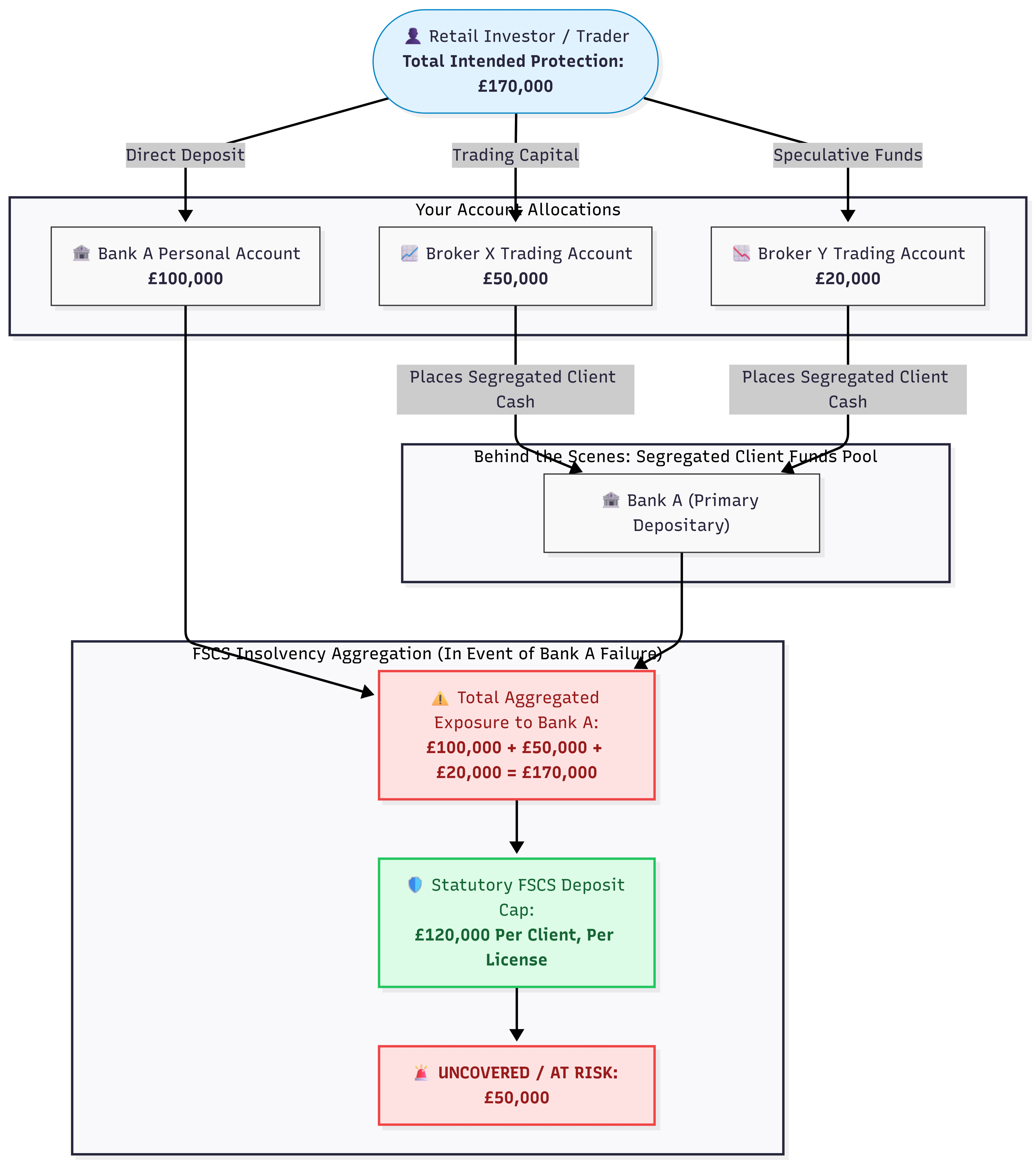
The Illusion of Safety: An investor places £100,000 in a high-street savings account with Bank A and splits £70,000 across two regulated brokerages: £50,000 with Broker X and £20,000 with Broker Y. Because each allocation is below the individual firm limit, the investor assumes 100% of their capital is protected.
The Hidden Concentration: Unknown to the investor, both Broker X and Broker Y place their omnibus client cash pools with Bank A.
The Legal Reality: Under UK insolvency rules, the beneficial ownership of those segregated funds remains with the investor. If Bank A fails, the FSCS aggregates all direct and indirect holdings tied to that banking licence:
Total Aggregated Exposure = £100,000 + £50,000 + £20,000 = £170,000
The Shortfall: Because the statutory FSCS limit applies per client, per banking licence, coverage stops at £120,000, leaving £50,000 exposed to the bank’s insolvency estate.
What is important to know is that FSCS compensation is capped per client, per firm. This is why we need to talk about the FSCS double banking trap. If you have £100,000 in an account in Bank A, and £50,000 in your trading account with Broker X, you probably feel safe, right? You have diversified your money and kept it below each applicable cap with each firm. The problem arises when Broker X puts your £50,000 in a segregated client money account pool in Bank A. Suddenly, your total exposure to Bank A is £150,000. If Bank A fails, only £120,000 of your money is protected, since the cap applies per client, per firm. You are still considered the client, even though you did not put the £50,000 into a Bank A account yourself. It is your money, hence, you are the client.
Another situation where the double banking trap can harm you is when you have money and assets sitting with several different brokers, but they all put that money into the same bank. You might for instance have £100,000 sitting in your account with Broker X because you are planning to make a large equity investment, and Broker X is your choice of broker for long-term investments. At the same time, you are keeping £50,000 in your trading account with Broker Y, the broker you use for short-term speculative trading. Both Broker X and Broker Y put your money into accounts at Bank A, which means £30,000 of your money becomes uncovered by the FSCS.
On their official site, the FSCS clearly explains how they treat situations where an individual´s own bank account is with Bank A, and the person´s broker also puts the individual´s trading account money into a client/pooled account with Bank A.
“If any of the beneficiaries have their own account within the same bank/banking group, that may affect the amount they are eligible for, as they are only protected up to £120,000 in total.” Source: https://www.fscs.org.uk/industry-resources/e-learning-portal
“I have an account in my own name and I’m also a beneficiary of a group account listed in the above table where the account is held with the same bank/building society. Am I protected?
Yes. FSCS protects you up to £120,000 in total. This is because, although the trust/pension/client account may not be in your name, the part of the account that you are entitled to belongs to you as an individual. Our rules state that we can only pay an individual £120,000 in total across all accounts held in their name within the bank/banking group. FSCS would also protect other beneficiaries of the trust/pension/client account up to £120,000 in total.” Source: https://www.fscs.org.uk/industry-resources/e-learning-portal
Because of the FSCS double banking trap, it is important for an eligible client to know where your broker or brokers actually put your money. Knowing that the money is being “kept segregated in a UK bank” is simply not enough. Exactly where your money is being kept will become relevant if the bank fails. Bank failure is not common in the UK, but it does happen.
It is also important to understand that the FSCS protection applies at the banking license level, meaning exposure across personal accounts and pooled broker accounts can be aggregated even though you see different bank brands. To find out more, you can use the FSCS bank and savings protection checker at the FSCS web site. The checker uses data from the Financial Conduct Authority (FCA) Financial Services Register and displays all firms linked to the same Firm Reference Number (FRN), including trading names and subsidiaries, to help you identify the firm more easily. Note: The FSCS urges the checker users to also confirm details with the individual bank, building society or credit union, and check the FCA Register for authoritative information.
What is the FSCS?
In the UK, the Financial Services Compensation Scheme (FSCS) protects eligible customer claims when authorized financial firms fail. This is the UK´s statutory compensation scheme for customers of certain UK authorized financial services firms, and it provides protection when a regulated firm is unable, or likely to be unable, to meet customer claims against it.
The Financial Services Compensation Scheme (FSCS) was established in 2001 under the Financial Services and Markets Act 2000 (FSMA 2000). It became operational when the Financial Services Authority (FSA) assumed its powers on 30 November 2001. Before the FSCS, the UK had several separate compensation schemes for different parts of the financial services industry, including the Deposit Protection Scheme (for banks), the Building Societies Investor Protection Scheme, the Investors Compensation Scheme, and the Policyholders Protection Board. The FSCS replaced these with a single statutory compensation scheme covering eligible deposits, investments, insurance, mortgages, and certain other regulated financial services.
Examples of accounts that can be covered under the FSCS (assuming eligibility) are bank and building society deposits, investment and trading accounts, pensions, insurance products, mortgage advice and arranging, debt management services, and funeral plans. Coverage depends on factors such as the type of service involved, and whether the firm is authorized by the Financial Conduct Authority (FCA) or the Prudential Regulation Authority (PRA).
Traders often think about the FSCS in the context of a broker failing, and the cap is £85,000 per client, per firm (license). But the FSCS also covers bank failures, and for such situations the cap is higher: £120,000 per client, per firm (license). In this article, that is the scenario we will focus on.
When a bank fails, the FSCS investigates who is the underlying beneficial owner of client-money. When your broker puts your money into a segregated client-money account with a bank, you remain the legal owner of that money, and is thus the beneficial owner even though you might not even know your money is kept with this bank. This means you risk hitting the £120,000 cap even if you don´t know where your broker or brokers have put your money.
Which Bank Or Banks Are Actually Keeping the Money I Have In My Trading Account?
To understand your potential exposure under the Financial Services Compensation Scheme (FSCS), you need to know where your money is held. This includes money that belongs to you but has been deposited in bank accounts by your broker as segregated client funds.
The first step is to determine which bank or banks your broker uses to hold segregated client money and whether your beneficial interest in those client-money accounts would be identifiable for the purposes of FSCS deposit protection.
Some FCA-authorised brokers disclose this information only upon request. Others include it in their client agreement or other key customer documents. In some cases, general information about the banks a broker uses can also be found in its CASS disclosures or annual reports.
A challenge arises when a prospective client wants to obtain this information before opening an account or accepting the client agreement. At Investing.co.uk, we have contacted a large number of FCA-authorised brokers to ask which banks they use to hold segregated client money. While some brokers have been willing to provide this information, others have declined to do so.
A refusal to disclose this information places prospective clients in a difficult position. Prudent traders may wish to assess their potential FSCS exposure before choosing a broker, but without knowing which banks the broker uses to hold segregated client funds, they cannot determine whether their deposits may create additional FSCS risk.
Several Banking Brands Can Operate Under The Same Banking License
As mentioned above, the FSCS looks at the banking license when they decide which firm that is holing your money, for the purpose of establishing if you have reached the per client, per firm cap of £120,000. More than one brand can operate under the same banking license, and “diversifying” by keeping your money with different brands, but under the same banking license, does not reduce FSCS risk.
Real-world examples of this are found at the FSCS site. They do for instance mention that the building society Nationwide also uses the brand names Derbyshire Building Society, Cheshire Building Society, The Derbyshire, Derbyshire Direct, Dunfermline Direct, and Dunfermline Building Society. All these brands, including Nationwide, operate under the same banking licence.
Many banks and building societies are also very open with this information on their own sites. Example: At their FSCS information page, First Direct states that eligible deposits with HSBC UK Bank plc are protected up to £120,000 in total and that this limit applies across HSBC UK, HSBC Private Bank, First Direct, M&S Bank, and M&S Savings and Investments. (This means that deposits held across these brands are aggregated by the FSCS.)
To make the situation more clear in the event of firm insolvency, the Prudential Regulation Authority (PRA) requires banks and other deposit-takers to maintain a Single Customer View (SCV). If the firm fails, the SCV makes it easier to quickly identify FSCS eligible clients and their deposits.
How To Check If More Than One Bank Operates Under The Same Banking License
On the FSCS site, you can use the Banking License Checker to display which brands that share the same banking license for FSCS purposes.
If you want to obtain additional information, you can also pay a visit to the FCA Financial Services Register. This register will for instance show you a firm’s legal name, Firm Reference Number (FRN), trading names, and regulatory permissions.
What Is The FSCS Temporary High Balance Protection?
Many of us never have enough money sitting in our bank account, or even in all our aggregated accounts combined, to hit the £120,000 FSCS cap. There are, however, situations in our lives where we might temporarily hold much more money in one or more accounts than normally, and there fore hit the cap, e.g. because we just sold our house or received an inheritance.
Because of this, the FSCS can protect temporarily high balances up to £1.4 million for six months, provided that specific “Temporary High Balance” requirements are met, and this includes that the money must come from a qualifying event.
The qualifying events:
- Sale of your main home
- Property purchase or equity release
- Inheritance
- Insurance payouts
- Retirement benefits
- Redundancy
- Divorce or civil partnership dissolution
- Compensation claims (including unfair dismissal or wrongful conviction)
- Personal injury compensation
- Disability or incapacity benefits
Note: If the temporary high balance is because of a personal injury, disability, or incapacity award, it may qualify for unlimited protection, i.e. the £1.4 million cap might not apply.
What happens if I move the money?
According to FSCS guidance, the temporary high balance protection can remain even after a move, provided that the qualifying conditions are still met.
However, the FSCS has not published any information specifically explaining what happens if you move your money to your trading account, and the money is then put back into a bank account by the broker, and that bank fails. It would of course be tempting to reach out to the FSCS to get a written explanation pertaining to your specific situation before you make a move, but the FSCS has specifically stated that it can not confirm protection until a firm fails and evidence is reviewed.
Within this context, it is also important to remember that if you move money to your broker, and the broker (not the bank) fails, the FSCS coverage is capped at £85,000 per client, per firm.
The Client Asset Sourcebook (CASS) and Bank Aggregation Risk Management
FAC-authorised brokers cannot deposit segregated client money with just any bank. They must comply with strict rules governing where client money may be held. However, these requirements also mean that brokers have a relatively limited number of eligible banks and credit institutions to choose from.
The FCA recognises that this can inadvertently create concentration risk, with many brokers placing client money with the same institutions. To help mitigate this risk, the FCA has included specific requirements in its Client Assets Sourcebook (CASS) governing how firms should select, monitor, and diversify the banks that hold client money.
Under CASS, brokerage firms must uphold their governance and due diligence obligations as they select and maintain institutions for the client money. They are obliged to exercise due skill, care and diligence in the selection, appointment, and ongoing review of these institutions as part of their client money protection arrangements. The brokerage firms must also have suitable systems and controls in place to manage the risk of holding client money with credit institutions. This includes consideration of concentration risk.
Diversification consideration is mandatory
“CASS 7.13.8 03/01/2018R. (1) A firm that does not deposit client money with a central bank must exercise all due skill, care and diligence in the selection, appointment and periodic review of the CRD credit institution, bank or qualifying money market fund where the money is deposited and the arrangements for the holding of this money. (2) The firm must consider the need for diversification as part of its due diligence under (1).” Source: CASS 7.13.803/01/2018R
Complying with this aspect of CASS is not a one-and-done thing. CASS 7.13.22 R makes it obligatory for the firm to periodically review its arrangements for holding client money, and this includes reviewing if it is appropriate to diversify (or further diversify) placements across credit institutions.
Periodical diversification review is mandatory
“CASS 7.13.22 03/01/2018R. Subject to the requirement at CASS 7.13.20 R, and in accordance with Principle 10 and CASS 7.12.1 R, a firm must: (1) periodically review whether it is appropriate to diversify (or further diversify) the third parties with which it deposits some or all of the client money that the firm holds; and (2) whenever it concludes that it is appropriate to do so, it must make adjustments accordingly to the third parties it uses and to the amounts of client money deposited with them.” Source: CASS 7.13.22 03/01/2018R
For guidance on how a firm is expected to fulfil its CASS 7.13.22 R obligations, see CASS 7.13.23G. This provision provides guidance how to make the assessment and points out the need to consider exposure to entities within the same group when assessing concentration risk.
“CASS 7.13.23 03/01/2018G. In complying with the requirement in CASS 7.13.22 R to periodically review whether diversification (or further diversification) is appropriate, a firm should have regard to: (1) whether it would be appropriate to deposit client money in client bank accounts opened at a number of different third parties; (2) whether it would be appropriate to limit the amount of client money the firm holds with third parties that are in the same group as each other; (3) whether risks arising from the firm’s business models create any need for diversification (or further diversification); (4) the market conditions at the time of the assessment; and (5) the outcome of any due diligence carried out in accordance with CASS 7.13.8 R and CASS 7.13.10 R.” Source: CASS 7.13.23 03/01/2018G”
Placing client money with banks or money market funds within the broker’s own corporate group
Placing client money with banks or money market funds within the broker’s own corporate group is allowed, but only in accordance with CASS rules, including CASS 7.13.20R.
While most of the CASS client money rules are principles-based and rely on firms exercising due skill, care, and diligence, CASS 7.13.20R actually imposes a specific numerical concentration limit. It requires a firm to ensure that the amount of client money deposited or held with a relevant group entity, or a combination of relevant group entities, does not exceed 20% of the firm’s total client money holdings. This hard limit is unusual within CASS, which generally relies on principles-based governance, due diligence, and ongoing risk management rather than prescribing fixed numerical thresholds. The rule reflects the FCA’s concern that placing excessive amounts of client money with banks or money market funds within the broker’s own corporate group creates a heightened concentration risk if the group experiences financial distress.
“CASS 7.13.2003/01/2018R. Notwithstanding the requirement at CASS 7.13.22 R a firm must limit the funds that it deposits or holds with a relevant group entity or combination of such entities so that the value of those funds do not at any point in time exceed 20 per cent of the total of all the client money held by the firm under CASS 7.13.3R.” Source: CASS 7.13.20 03/01/2018R
It should be noted, however, that CASS 7.13.21AR provides a limited exemption from CASS 7.13.2003/01/2018R. A firm may depart from the 20% limit if it can demonstrate that applying the limit would not be proportionate in light of the amount of client money it holds, the nature, scale, and complexity of its business, and the safety offered by the relevant group entities.
To find out what is considered “a relevant group entity” under CASS, we need to look at CASS 7.13.21 03/01/2018R.
“CASS 7.13.2103/01/2018R“
For the purpose of CASS 7.13.20 R an entity is a relevant group entity if it is:
- (a) CRD credit institution; or
- (b) a bank authorised in a third country; or
- (c) a qualifying money market fund; or
- (d) the entity operating or managing the qualifying money market fund; and
Group entities vs. third-party entities
The 20% limit for members of the same group is found in CASS 7.13.20R and reflects the FCA’s view that deposits within a firm’s own corporate group present a heightened concentration risk because financial distress affecting one group entity may quickly spread to others.
For all other third-party banks and credit institutions, CASS does not prescribe fixed concentration limits. Instead, firms are required to exercise due skill, care, and diligence when selecting depositaries, periodically assess whether further diversification is appropriate, and continually monitor the suitability of the institutions holding client money. This principles-based framework recognises that concentration risk cannot always be addressed through rigid numerical thresholds and instead requires firms to make informed, risk-based judgments.
Accordingly, CASS 7.13.20R and the related provisions are not general banking diversification rules. Rather, they are targeted measures designed to limit the additional systemic risk that arises when client money is concentrated within the same corporate group as the broker itself, where a single adverse event could threaten both the broker and the institutions safeguarding client funds.
Rules vs. guides: Understanding the structure of CASS
In the FCA Handbook, including CASS, the letter after a provision tells you its legal status. The letter R signifies a Rule, while the letter G signifies Guidance. An R is a binding rule made by the FCA under its statutory powers. Example: CASS 7.13.22R. A G is guidance, which explains how the FCA interprets its rules and how the FCA expects firms to meet those obligations. Example: CASS 7.13.23G. A firm does not have to follow the guidance exactly, but if it takes a different approach, it should be able to demonstrate that it is still complying with the applicable rule. As we discussed above, CASS 7.13.22R creates the legal obligation for firms to review whether they should diversify client money deposits, while CASS 7.13.23G provides guidance on the considerations that should inform that review.