Best Credit Card Brokers 2026



Using a credit card to fund your trading account can feel convenient. It’s quick, most people already have one, and you don’t need to set up anything extra. But in the UK, there are specific rules, limits, and costs that make it less straightforward than it looks.
Find the best brokers that accept credit card deposits in the UK, along with the key considerations.
Top Credit Card Brokers
-


Established in 1974, IG is a unit of IG Group Holdings Plc, listed on the LSE as IGG. It provides access to over 17,000 markets through intuitive platforms and apps. For half a century, IG has remained an industry leader, excelling in all vital aspects for traders.
Instruments Regulator Platforms CFDs (not in US), Forex, Stocks, Indices, Commodities, ETFs, Futures, Options, Crypto, Spread Betting (UK only) CFTC, NFA, FCA, BaFin, ASIC, FINMA, MAS, JFSA, FMA, DFSA, BMA, CONSOB Web, L2 Dealer, MT4, TradingView, AutoChartist, TradingCentral, ProRealTime Min. Deposit Min. Trade Leverage $0 0.01 Lots 1:30 (Retail), 1:222 (Pro) -
Established in Poland in 2002, XTB caters to over a million clients worldwide. This forex and CFD broker offers a robust regulatory framework, a diverse range of assets, and prioritises trader satisfaction. It provides an intuitive proprietary platform equipped with excellent tools to support aspiring traders.
Instruments Regulator Platforms CFDs on shares, Indices, ETFs, Raw Materials, Forex currencies, cryptocurrencies, Real shares, Real ETFs FCA, CySEC, KNF, DFSA, FSC, SCA, CMF, Bappebti xStation Min. Deposit Min. Trade Leverage $0 0.01 Lots 1:30 -
Spreadex, regulated by the FCA, provides spread betting across 10,000+ CFD instruments, including 60 forex pairs. Traders have the option to engage in short-term positions on sporting events as well. With a history exceeding 20 years, the company has earned numerous accolades.
Instruments Regulator Platforms Forex, CFDs, Indices, Commodities, Stocks, Crypto, Bonds, Interest Rates, ETFs, Options, Spread Betting FCA Spreadex Platform, TradingView, AutoChartist Min. Deposit Min. Trade Leverage £0 (but £5 minimum for standard payment methods) £0.01 1:30 -
Trade Nation is a leading FX and CFD broker regulated in the UK and Australia, among other places. The company provides competitively priced fixed and variable spreads on over 1,000 assets. Traders benefit from advanced platforms and comprehensive training materials. Additionally, the Signal Centre offers valuable trade ideas.
Instruments Regulator Platforms CFDs, Forex, Indices, Shares, Commodities, Futures, Bonds, Spread Betting (UK and Ireland only), Cryptos (Bahamas entity only) FCA, ASIC, CMVM , FSCA, SCB, FSA TN Trader, MT4, TradingView Min. Deposit Min. Trade Leverage $0 0.1 Lots 1:30 -
Established in Australia in 2010, Pepperstone is a top-rated forex and CFD broker with over 830,000 clients worldwide. It offers access to 1,400+ instruments on leading platforms MT4, MT5, cTrader and TradingView, maintaining low, transparent fees. Pepperstone is also regulated by trusted authorities like the FCA, ASIC, and CySEC, helping to ensure a secure environment for traders at all levels.
Instruments Regulator Platforms CFDs, Forex, Currency Indices, Stocks, Indices, Commodities, ETFs, Crypto CFDs (only Pro clients), Spread Betting FCA, ASIC, CySEC, BaFin, DFSA, SCA, SCB, CMA-Kenya Pepperstone Trading Platform, MT4, MT5, cTrader, TradingView Min. Deposit Min. Trade Leverage $0 0.01 Lots 1:30 (Retail - UK, EU, Australia), 1:500 (Pro), 1:200 (Offshore), 1:400 (Kenya) -
Eightcap, an acclaimed broker regulated by the FCA, offers exceptionally low trading costs. Recognised as the top-rated brand by TradingView's vast user base of 100 million, traders can directly access the platform. UK traders can open a live account with a minimum deposit of just £100.
Instruments Regulator Platforms CFDs in Forex, Stocks, Indices, Commodities FCA, ASIC, CySEC, FSC, SCB, FSA MT4, MT5, TradingView, TradeLocker Min. Deposit Min. Trade Leverage £100 0.01 Lots 1:30 -
Founded in 2009, Vantage provides access to over 1,000 short-term CFD products for millions of clients. Trade Forex CFDs from 0.0 pips via RAW accounts on TradingView, MT4 or MT5. ASIC-regulated, Vantage segregates client funds and offers social trading tools for copy traders.
Instruments Regulator Platforms CFDs, Forex, Stocks, Indices, Commodities, ETFs, Bonds, Spread betting FCA, ASIC, FSCA, VFSC, CIMA ProTrader, MT4, MT5, TradingView, TradingCentral, DupliTrade Min. Deposit Min. Trade Leverage $50 0.01 Lots 1:30
 IG
IG XTB
XTB Spreadex
 Trade Nation
 Pepperstone
 Eightcap
 Vantage FX
Safety Comparison
Compare how safe the Best Credit Card Brokers 2026 are and what features they offer to protect traders.
| Broker | Trust Rating | FCA Regulated | Negative Balance Protection | Guaranteed Stop Loss | Segregated Accounts |
|---|---|---|---|---|---|
| IG | ✔ | ✔ | ✔ | ✔ | |
| XTB | ✔ | ✔ | ✘ | ✔ | |
| Spreadex | ✔ | ✔ | ✔ | ✔ | |
| Trade Nation | ✔ | ✔ | ✘ | ✔ | |
| Pepperstone | ✔ | ✔ | ✘ | ✔ | |
| Eightcap | ✔ | ✔ | ✘ | ✔ | |
| Vantage FX | ✔ | ✔ | ✘ | ✔ |
Payments Comparison
Compare which popular payment methods the Best Credit Card Brokers 2026 support and whether they have trading accounts denominated in British Pounds (GBP).
| Broker | GBP Account | Debit Card | Credit Card | Neteller | Skrill | Apple Pay |
|---|---|---|---|---|---|---|
| IG | ✔ | ✔ | ✔ | ✘ | ✘ | ✘ |
| XTB | ✔ | ✔ | ✔ | ✔ | ✔ | ✘ |
| Spreadex | ✔ | ✔ | ✔ | ✘ | ✘ | ✘ |
| Trade Nation | ✔ | ✔ | ✔ | ✘ | ✔ | ✘ |
| Pepperstone | ✔ | ✔ | ✔ | ✔ | ✔ | ✔ |
| Eightcap | ✔ | ✔ | ✔ | ✔ | ✔ | ✘ |
| Vantage FX | ✔ | ✔ | ✔ | ✔ | ✔ | ✘ |
Mobile Trading Comparison
How good are the Best Credit Card Brokers 2026 at mobile trading using apps or other mobile interfaces.
| Broker | Mobile Apps | iOS Rating | Android Rating | Smart Watch App |
|---|---|---|---|---|
| IG | iOS & Android | ✔ | ||
| XTB | iOS & Android | ✔ | ||
| Spreadex | iOS & Android | ✘ | ||
| Trade Nation | iOS & Android | ✘ | ||
| Pepperstone | iOS & Android | ✘ | ||
| Eightcap | iOS & Android | ✘ | ||
| Vantage FX | iOS & Android | ✘ |
Beginners Comparison
Are the Best Credit Card Brokers 2026 good for beginner traders, that might want an affordable setup to get started, along with good support and educational resources?
| Broker | Demo Account | Minimum Deposit | Minimum Trade | Support Rating | Education Rating |
|---|---|---|---|---|---|
| IG | ✔ | $0 | 0.01 Lots | ||
| XTB | ✔ | $0 | 0.01 Lots | ||
| Spreadex | ✘ | £0 (but £5 minimum for standard payment methods) | £0.01 | ||
| Trade Nation | ✔ | $0 | 0.1 Lots | ||
| Pepperstone | ✔ | $0 | 0.01 Lots | ||
| Eightcap | ✔ | £100 | 0.01 Lots | ||
| Vantage FX | ✔ | $50 | 0.01 Lots |
Advanced Trading Comparison
Do the Best Credit Card Brokers 2026 offer features that allow for more advanced trading strategies?
| Broker | Automated Trading | Pro Account | Leverage | VPS | AI | Low Latency | Extended Hours |
|---|---|---|---|---|---|---|---|
| IG | Expert Advisors (EAs) on MetaTrader, build your own on ProRealTime | ✔ | 1:30 (Retail), 1:222 (Pro) | ✔ | ✔ | ✔ | ✔ |
| XTB | - | ✔ | 1:30 | ✘ | ✘ | ✔ | ✘ |
| Spreadex | ✘ | ✔ | 1:30 | ✘ | ✘ | ✔ | ✔ |
| Trade Nation | Expert Advisors (EAs) on MetaTrader | ✘ | 1:30 | ✘ | ✘ | ✘ | ✘ |
| Pepperstone | Expert Advisors (EAs) on MetaTrader, cBots on cTrader | ✔ | 1:30 (Retail - UK, EU, Australia), 1:500 (Pro), 1:200 (Offshore), 1:400 (Kenya) | ✘ | ✘ | ✔ | ✘ |
| Eightcap | TradingView Bots | ✘ | 1:30 | ✔ | ✘ | ✔ | ✘ |
| Vantage FX | Myfxbook AutoTrade, Expert Advisors (EAs) on MetaTrader | ✘ | 1:30 | ✔ | ✘ | ✘ | ✘ |
Detailed Rating Comparison
Use this heatmap to compare our detailed ratings for all of the Best Credit Card Brokers 2026.
| Broker | Trust | Platforms | Mobile | Assets | Fees | Accounts | Support | Research | Education |
|---|---|---|---|---|---|---|---|---|---|
| IG | |||||||||
| XTB | |||||||||
| Spreadex | |||||||||
| Trade Nation | |||||||||
| Pepperstone | |||||||||
| Eightcap | |||||||||
| Vantage FX |
Our Take On IG
"IG offers a complete package: an easy-to-use web platform, top-tier beginner education, enhanced charting via TradingView, up-to-date data, and strong trade execution for seasoned traders."Tobias Robinson
Reviewer
Pros
- The web-based platform supports traders at every level, offering advanced charting tools and real-time market data vital for trading. Additionally, IG now includes TradingView integration.
- IG provides a wide range of professional and engaging educational materials, such as webinars, articles, and analyses, tailored for traders.
- IG excels with its diverse instruments, offering stocks, forex, indices, commodities, and cryptocurrencies. Additionally, it provides US-listed futures, options, and an AI Index, ensuring varied diversification opportunities.
Cons
- Beginners may find IG's fees complicated, as they vary depending on the trades or services. This could cause confusion and unexpected costs.
- IG has ended its swap-free account, diminishing its attractiveness to Islamic traders.
- IG imposes a monthly inactivity fee of $12 to $18 after two years, discouraging occasional investors.
Our Take On XTB
"XTB excels for novice traders with its superb xStation platform, minimal trading costs, no required deposit, and outstanding educational resources, many of which are fully integrated into the platform." William Berg
Reviewer
Pros
- Top-notch customer support, available 24/5, includes a welcoming live chat with response times under two minutes during tests.
- XTB has raised interest rates on uninvested funds and introduced zero-fee ISAs (for ETFs and real shares, or 0.2% on trades over €100k) for UK clients, offering access to a wide array of markets.
- XTB processes withdrawals swiftly, paying within 3 business days, subject to the method and amount.
Cons
- XTB lacks a raw spread account, a feature increasingly offered by competitors such as Pepperstone. This omission might not satisfy traders seeking the most competitive spreads.
- It is frustrating that XTB products do not allow traders to modify the default leverage level. Manually adjusting leverage can greatly reduce risk in forex and CFD trading.
- Trading fees are competitive, with average EUR/USD spreads of about 1 pip. However, they are not as low as the most affordable brokers, such as IC Markets. Additionally, an inactivity fee applies after a year.
Our Take On Spreadex
"Spreadex attracts UK traders keen on spread betting in financial markets and traditional sports wagers. It offers low fees for short trades, and spread bet profits are tax-free. With a robust charting platform and no minimum deposit, it's easy to begin."Tobias Robinson
Reviewer
Pros
- Our fee analysis shows the EUR/USD at 0.6 pips during off-peak hours. FTSE and S&P 500 spreads remain competitively priced for spread-betting brokers. Trading costs are reasonable.
- Over 10,000 instruments and superior access to AIM small-caps are available, including exclusive offerings not found with larger brokers. This provides UK-centric traders with enhanced opportunities in niche small-cap configurations.
- From testing, the platform facilitates seamless active trading. Features like one-click trading, watchlists, and saved layouts functioned effectively, including Force Open. Constructing a tidy workspace and handling short-term trades proved straightforward.
Cons
- Spreadex requires real funds initially, offering no demo accounts. Few spread betting brokers neglect to accommodate new traders in this manner.
- Execution is satisfactory, though not top-tier. Tests showed 0.2–0.4 pip slippage in stable liquid markets, but news-induced volatility increased some fills to around 1 pip. Thinner AIM stocks often experienced 2–4 point slippage.
- Spreadex lacks MT4, MT5, cTrader, API, VPS, and algorithmic trading support, making it ideal for active traders rather than those using automated or bespoke trading systems.
Our Take On Trade Nation
"Trade Nation caters to discretionary traders aiming to speculate on major indices like the US 500 or liquid FX pairs, with the certainty of fixed spreads. Our tests revealed the TN Trader's fixed spreads to be advantageous, especially during economic announcements, thanks to its dependable charting and capped spreads."Tobias Robinson
Reviewer
Pros
- The demo includes a £5,000 practice account, and you can request a personalised platform walkthrough via callback. This level of individual assistance is uncommon.
- Trade Nation's 2026 alliance with Volt has streamlined payments for Australian traders, enabling instant deposits and withdrawals via PayID. Faster payout features are also anticipated for UK and EU clients.
- The broker expanded into Europe by launching regulated online trading services, after securing authorization from Portugal's CVMV, enhancing safety measures for European residents.
Cons
- The FCA, CMVM, and ASIC clients are ineligible for the 2–20% rebate scheme. Consequently, active traders in these areas cannot receive transaction rebates.
- Withdrawals may take up to five business days, aligning with industry norms. However, this is slower compared to the 1-3 days many brokers now offer to minimise complaints from retail investors.
- Offshore SCB and FSA firms offer retail investors leverage up to 1:200 and 1:500. In contrast, regions like the UK, Europe, and Australia cap leverage at 1:30. Thus, an FSA client can access 16 times more exposure than a UK retail client on identical trades. However, this comes with reduced oversight and no compensation schemes.
Our Take On Pepperstone
"Pepperstone excels in trading with tight spreads, swift execution, and advanced charting for seasoned traders. Beginners enjoy zero minimum deposit, comprehensive educational materials, and outstanding 24/5 support, including 18-hour weekend assistance."Tobias Robinson
Reviewer
Pros
- Support for top-tier charting platforms such as MT4, MT5, TradingView, and cTrader. These tools accommodate different short-term trading methods, including algorithmic trading.
- Pepperstone presents itself as an economical choice for traders, offering spreads as low as 0.0 in its Razor account. The Active Trader programme provides rebates up to 30% on indices and commodities, plus $3 per lot on forex.
- Provides a specialised CopyTrading app for traders preferring a more passive strategy, available in select countries.
Cons
- Pepperstone has withdrawn support for key tools enhancing the trading experience for active retail traders, including Autochartist, Capitalise.ai, and a free VPS, now limited to pro traders in certain countries.
- Overnight holding fees exceed those of some Market Maker brokers (typically Benchmark + 2.5%). Pepperstone suits traders and forex scalpers well but is less ideal for swing traders who keep positions open overnight.
- Execution might not appear as dependable in rapid markets as headline speeds imply. Our tests showed swift execution at targeted prices. However, community feedback highlights concerns over slippage, stop-loss fills, and order triggers sensitive to spreads amid volatility.
Our Take On Eightcap
"Eightcap excels for traders, offering diverse charting platforms, educational Labs, and AI tools. With over 120 crypto CFDs, it stands out in crypto trading and has won our 'Best Crypto Broker' award twice consecutively."William Berg
Reviewer
Pros
- In 2026, Eightcap integrated TradeLocker in select areas, establishing itself as the premier regulated broker for this platform. It continues to offer ultra-fast execution and competitive fees for active traders using the charting software.
- In 2021, Eightcap enhanced its lineup, now providing an extensive range of cryptocurrency CFDs. It offers crypto/fiat and crypto/crypto pairs, along with crypto indices for comprehensive market exposure.
- Eightcap excels with a suite of advanced trading tools, such as MT4 and MT5, and has recently joined the 100-million-user social trading network, TradingView.
Cons
- The demo account is available for 30 days, after which it requires a request for extension. This is less convenient than XM's offering, which provides an unlimited demo mode.
- Eightcap must enhance its range of over 800 instruments to rival top competitors like Blackbull Markets, which offers 26,000+ assets, especially improving its limited commodities selection.
- Despite the growing range of tools available, Eightcap lacks popular industry resources such as Autochartist and Trading Central. These provide advanced charting analytics, live news, and essential market insights for traders focused on short-term strategies.
Our Take On Vantage FX
"Vantage is an ideal choice for CFD traders looking for a well-regulated broker with access to the dependable MetaTrader platforms. With a swift sign-up process and a minimum deposit of $50, starting trading is simple and fast."Tobias Robinson
Reviewer
Pros
- The trading software suite is outstanding, featuring the acclaimed MT4 and MT5 platforms.
- Vantage has enhanced its trading tools for experienced traders, introducing AutoFibo EA to pinpoint potential market reversals.
- Opening a live account is both straightforward and swift, requiring under 5 minutes to complete.
Cons
- It's unfortunate that some clients must register with the offshore firm, which provides reduced regulatory safeguards.
- Based on tests, average execution speeds of 100ms to 250ms are slower compared to other options.
- To access optimal trading conditions, a substantial deposit of $10,000 is required. This includes a commission of $1.50 per transaction per side.
How Investing.co.uk Chose the Best Brokers That Allow Credit Cards
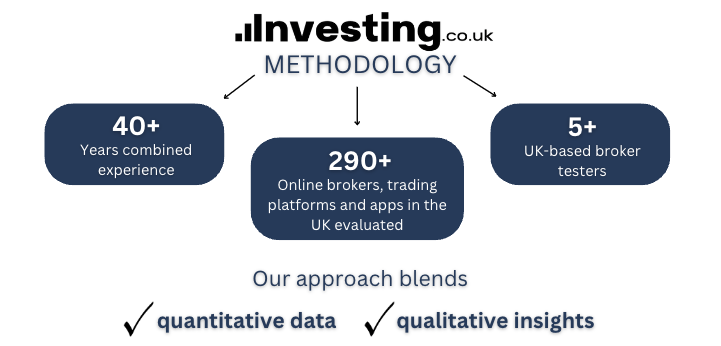
We verified that each shortlisted platform accepts credit card deposits by checking cashier portals and, where needed, confirming with customer support.
Brokers were then ranked by our overall ratings system, which covers more than 200 factors — including accepted payment methods, deposit and withdrawal speed, trading costs, platform reliability, and FCA regulatory strength.
Trading Rules With Credit Cards
The first thing to understand is regulation. In 2020, the Gambling Commission banned the use of credit cards for gambling in the UK.
The ban included spread betting and many CFD accounts, since these products are high-risk and often treated like gambling.
What this means in practice:
- If you want to trade CFDs in the UK, you usually cannot fund your account with a credit card.
- If you’re trading regular stocks, ETFs, or certain forex products, some brokers still allow credit card deposits.
So, whether you can use your card depends on the type of account you’re opening. Don’t assume all brokers will treat deposits the same way.
[tCheck their funding page or ask for support directly. If they avoid giving a straight answer, that’s a warning sign.
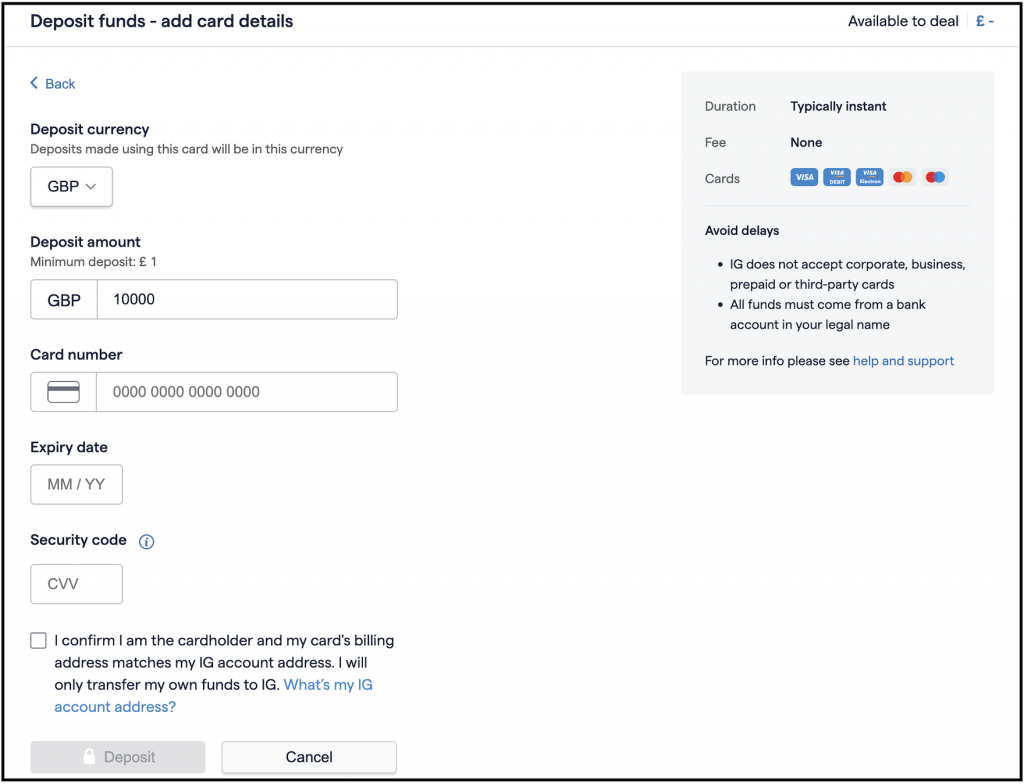
IG lets you fund your account with a credit card in just a few clicks
Deposit Fees From Brokers
Most brokers charge a fee for card deposits. The cost can be a flat charge, but it’s more often a percentage of the deposit. A rate of 1%–3% is standard. That doesn’t sound like much until you’re putting in larger sums.
If you deposit £2,000 and the broker charges 2%, that’s £40 gone straight away. Over multiple deposits, this adds up.
Some brokers advertise ‘no deposit fees,’ but always read the fine print. Sometimes they absorb the fee for debit cards but still pass it on for credit cards. Others waive the fee only for deposits above a specific size. Don’t rely on assumptions—confirm the exact cost.
Cash Advance Fees From Your Bank
Even if the broker doesn’t charge you, your card provider might. We’ve seen that many UK banks treat deposits to brokers as ‘cash advances.’ That comes with:
- A fee, usually around 3% of the deposit.
- A higher interest rate than for regular purchases.
- No grace period, meaning interest begins to accrue immediately.
This can make credit card funding far more expensive than it looks. Imagine you deposit £1,000, and your card charges a 3% cash advance fee. That’s £30 before you’ve even placed a trade. If you don’t clear the balance promptly, interest will also begin to accumulate.
The only way to know for sure is to check your card’s terms or call the provider. Ask them specifically how they treat payments to trading brokers.
Withdrawal Rules & Limits
Depositing with a card is one thing. Getting your money back is another. Many brokers only let you withdraw to the card up to the amount you originally deposited.
For example, say you deposit £500 with a credit card, make £200 profit, and then request a £700 withdrawal. Often, only £500 will go back to the card. The remaining £200 has to be withdrawn by bank transfer. That can slow things down, since bank transfers usually take longer to process.
Other brokers don’t allow card withdrawals at all. They may accept your card for deposits, but insist all withdrawals go through your bank account. This isn’t always a deal-breaker, but it’s worth knowing upfront so you don’t get caught off guard.
Funding Speed
The main reason traders use cards is speed. UK bank transfers with Faster Payments are usually quick, but not always instant. Sometimes they take a few hours, or even until the next working day.
Credit card payments usually appear in your account within minutes. That can make a significant difference if you need to move quickly and open a trade immediately.
But not every broker processes card payments around the clock. Some only credit your account during working hours. If you plan to fund your account late at night or over the weekend, test it with a small deposit first.
Currency Conversion Costs
If your broker’s account is in USD, and your credit card is in GBP, you’ll pay conversion costs. There are usually two parts to this:
- The broker’s exchange rate when converting your deposit.
- Your bank’s foreign transaction fee is often 2%–3%.
It doesn’t take long for these fees to eat into your balance, especially if you deposit and withdraw often.
If possible, choose a broker that offers GBP-denominated accounts. That way, you avoid double conversion and keep costs down.
Deposit Limits
Both your credit card and the broker may limit the amount you can deposit. Some brokers only allow a few thousand pounds per day to be charged to a card. Others set monthly limits.
If you plan to trade with larger sums, these limits may be too restrictive. In that case, bank transfers are usually a better option. They’re built for higher amounts and rarely come with extra costs.
Security & Regulation
Card payments are generally safe, but it’s still advisable to closely examine the broker’s safeguards. Always check that the broker is FCA authorised. This means they adhere to UK financial regulations, and your funds are protected under client money rules.
Additionally, ensure the broker utilises secure, encrypted payment systems. A trustworthy broker will never ask you to email card details or send payments to an individual’s account. If anything feels off, don’t proceed.
The Risk Of Using Credit
The biggest issue with using credit cards for trading isn’t the broker—it’s the debt that accumulates. When you deposit with a card, you’re trading with borrowed money. Losses don’t cancel out what you owe the bank.
Even if you plan to pay it off immediately, things can still go wrong. A slow withdrawal, a bigger loss than expected, or a delay in settlement can leave you stuck paying interest.
If you wouldn’t borrow money to make the same trade another way, think twice about using a credit card. The risk isn’t just market losses—it’s debt that follows you even after you stop trading.
Alternatives To Credit Cards
In the UK, two main alternatives are safer and cheaper:
- Debit cards: Just as fast as credit cards, but without the ‘cash advance’ treatment from banks. Most brokers accept them with little or no fee.
- Bank transfers: Slower in some cases, but usually free. Faster Payments often clear in hours, sometimes minutes.
Some UK brokers also support PayPal, Skrill, or Neteller. These are convenient but often more expensive. E-wallets can be helpful if you want to keep trading funds separate from your main bank account. However, be sure to check the fees carefully.
Practical Steps Before You Start
Here’s a simple checklist to follow before using a credit card with a broker:
- Confirm FCA regulation.
- Ask directly if your account type supports card funding.
- Read the broker’s deposit and withdrawal fee schedule.
- Contact your card provider to inquire about their treatment of broker deposits.
- Test the system with a small deposit before committing a larger amount.
Doing this may feel tedious, but it can save you a lot of money and frustration.
Bottom Line
Credit cards can be a quick way to get funds into your trading account. But they’re rarely the cheapest or safest method. Between broker fees, bank cash advance charges, and withdrawal restrictions, costs add up.
For many traders, debit cards or bank transfers are simpler and better value. If you decide to use a credit card for trading deposits, start small, understand the risks, and closely monitor the fees.
A reliable trading broker that accepts credit card deposits will be upfront about their terms, and it’s worth taking the time to read them closely before you deposit.